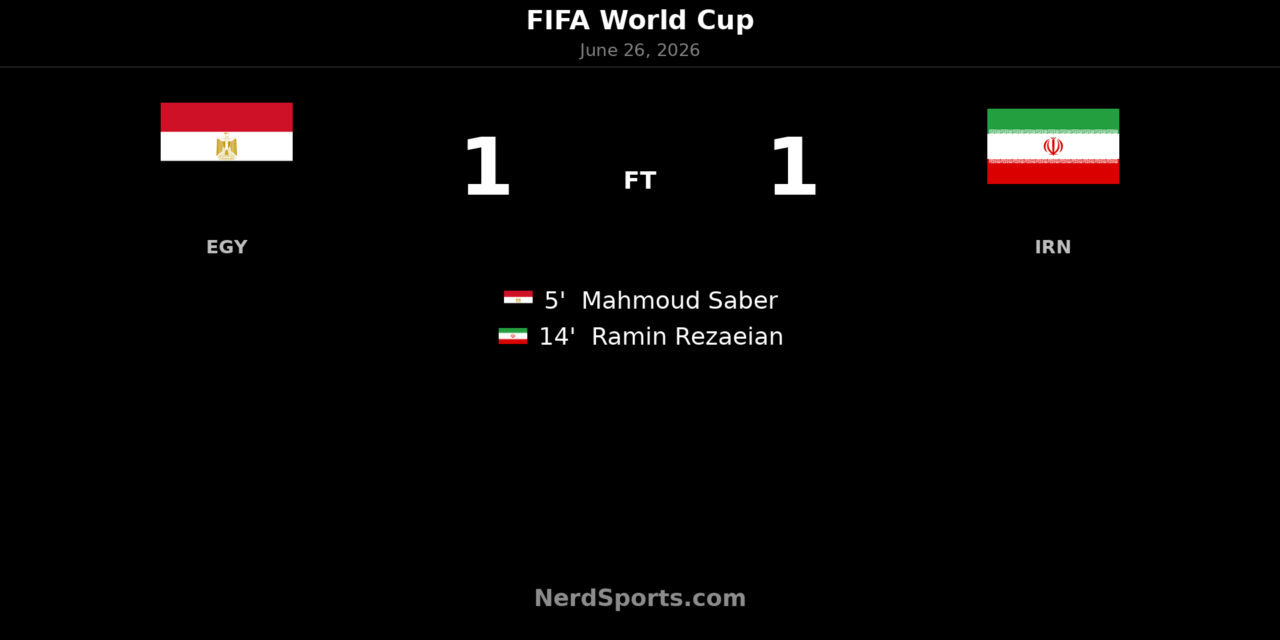
Egypt and Iran played out a 1-1 draw in the FIFA World Cup 2026 on Friday night, with Mahmoud Saber putting Egypt ahead in the 5th minute before Ramin Rezaeian replied for Iran in the 14th. An open first half ultimately defined a fixture that settled into a tense, hard-fought stalemate.
Egypt started sharply at Lumen Field in Seattle and were rewarded almost immediately. Saber found the breakthrough in the 5th minute, capping a bright opening spell in which Egypt pressed higher up the pitch and moved the ball with purpose through wide areas. That early goal seemed to give Egypt control, and for a stretch they looked the more likely side to dictate the rhythm.
Iran, though, responded well. Rezaeian brought them level in the 14th minute, finishing off a quick attacking move to restore parity before the match had reached its quarter-hour mark. It was an important response from a side that had spent much of the opening exchanges without the ball but remained capable of creating direct danger when spaces opened up.
That first period contained all the scoring and much of the intensity. Egypt finished the night with 61.3 percent possession, 15 total shots, and eight corners, underlining how much of the territorial advantage they enjoyed. Iran, however, were efficient in key moments, putting four shots on target from 12 attempts and showing why they remained a threat even while seeing less of the ball.
The second half became more tactical and more fragmented. Egypt continued to probe, using sustained possession to pin Iran back for stretches, but the final pass and finishing touch were just not there often enough. Iran defended with discipline, protected central spaces, and looked increasingly comfortable managing the draw as the half wore on.
There was also a feisty edge to the fixture, reflected in a steady stream of cautions. Hossein Kanani was booked for Iran in the 19th minute, while Saber went into the book for Egypt a minute later. Yasser Ibrahim saw yellow in the 42nd minute, Ali Nemati followed for Iran in the 43rd, Saeid Ezatolahi was cautioned in the 79th, and late bookings for Mohanad Lashin in the 90’+2 and Shoja Khalilzadeh in the 90’+4 summed up a closing spell full of tension but short on clear openings.
Key performers
Saber was Egypt’s standout attacking threat, not only for his 5th-minute goal but for the energy he brought down the left side before and after the interval. For Iran, Rezaeian’s 14th-minute equaliser was the pivotal contribution, arriving at a moment when Egypt threatened to seize full control. At team level, Egypt’s midfield structure helped them dominate possession, while Iran’s back line and compact shape were central to preserving a valuable point.
NerdSports Stat: Egypt had 61.3 percent possession and won the corner count 8-2, yet Iran finished with more shots on target, 4-3 — a strong sign of how clinical Iran were with their limited spells in attack.
A point apiece leaves both teams with work still to do in Group G, but neither side leaves Seattle empty-handed. Egypt may feel they did enough to take all three points after controlling long stretches, while Iran can be satisfied with a disciplined response after conceding early. Both managers will now turn quickly to the next fixture, knowing the margins in a World Cup group can shift fast.
Frequently Asked Questions
Mahmoud Saber (5′) for Egypt and Ramin Rezaeian (14′) for Iran.
Egypt 1 – 1 Iran.
The draw gives Egypt and Iran a point each in Group G, keeping both teams in the mix with the group stage still finely balanced.
Mahmoud Saber was the standout performer with Egypt’s early 5th-minute goal and an energetic display on the left.