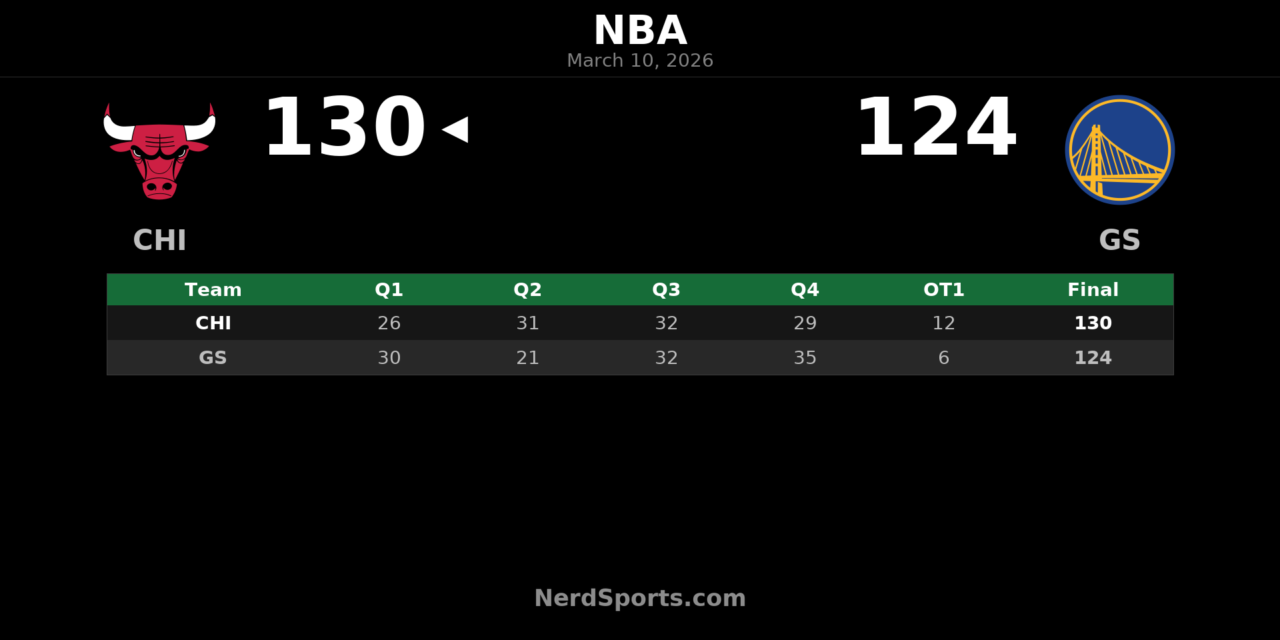
The Chicago Bulls came into Chase Center on Tuesday night and came away with a hard-fought 130-124 overtime victory over the Golden State Warriors, improving to 27-38 on the season while dropping Golden State to 32-33. It took five periods to settle matters, but a dominant overtime stretch — outscoring the Warriors 12-6 in the extra session — allowed Chicago to secure a road win in San Francisco before an attendance of 18,064. Matas Buzelis was the story of the night, and Josh Giddey was his relentless co-author.
Quarter-by-Quarter Breakdown
First Quarter: Warriors Take an Early Lead, 30-26
Golden State opened with purpose, outpacing Chicago 30-26 in the first quarter and establishing early rhythm at home. The Warriors’ ball movement was sharp, and their perimeter shooting gave them a four-point cushion heading into the second period. Chicago, however, showed no signs of being rattled, keeping things competitive and staying within striking distance.
Second Quarter: Bulls Take Control, 57-51 (CHI) at the Half
The second quarter was where Chicago shifted momentum significantly. The Bulls outscored the Warriors 31-21 in the period, taking a 57-51 lead into halftime. Golden State’s offense stalled — managing just 21 points in the frame — while Chicago’s Buzelis began asserting himself as the most impactful player on the floor. The Bulls’ ball movement through Giddey opened up driving lanes and created quality looks throughout the quarter.
Third Quarter: Even Exchange, 89-83 (CHI)
Golden State responded in the third, matching Chicago’s 32 points in an evenly contested period. The Warriors’ defense tightened, and their offense found its footing again, but they were unable to fully erase the halftime deficit. Chicago held a 89-83 advantage heading into the fourth, with Buzelis continuing to find ways to score and Giddey facilitating at a remarkable rate.
Fourth Quarter: Warriors Draw Level, 118-118 at Regulation’s End
Golden State delivered its best quarter of the night in regulation, outscoring Chicago 35-29 in the fourth to force overtime. The Warriors rallied with urgency, closing the gap steadily and eventually pulling even at 118. The Chase Center crowd came alive as the home team appeared poised to complete a significant comeback. It was a reminder of just how competitive this Warriors group can be when playing with focus and energy.
Overtime: Bulls Pull Away, 130-124 Final
The extra session told a different story. Chicago outscored Golden State 12-6 in overtime, taking control and not looking back. Buzelis and Giddey kept Chicago’s offense functional when it mattered most, while the Warriors’ offense, which had just 6 points in the period, could not sustain the late-game momentum it had built in the fourth quarter. The Bulls walked out of Chase Center with the road victory.
Key Performers
Matas Buzelis — Chicago Bulls: 41 PTS, 6 REB
Buzelis was the engine of Chicago’s offense from start to finish. He led all scorers on the night with 41 points, showcasing his ability to create off the dribble, get to the free-throw line, and knock down shots in high-pressure moments. His performance in overtime was particularly composed, as he maintained his efficiency when the margin for error was narrowest. At just 21 years old, Buzelis is demonstrating the kind of two-way impact that suggests he could anchor Chicago’s rebuild for years to come.
Josh Giddey — Chicago Bulls: 13 REB, 17 AST
Giddey produced one of the more remarkable stat lines of the NBA season so far, recording 17 assists alongside 13 rebounds. He did not lead the Bulls in scoring, but his facilitation was the connective tissue of Chicago’s offense all night. Seventeen assists in a single game is an elite-level output, and Giddey’s vision and pace of play kept Golden State’s defense constantly adjusting. It was the kind of complete performance that does not always show up in a box score headline but shaped the outcome of the game entirely.
Gui Santos — Golden State Warriors: 17 PTS
Santos led Golden State in scoring with 17 points, providing a reliable offensive option for the Warriors throughout the contest. His production was a positive note in an otherwise difficult night for the home team.
Gary Payton II — Golden State Warriors: 12 PTS, 11 REB, 3 STL
Payton II delivered a well-rounded performance, recording a double-double with 12 points and 11 rebounds while adding 3 steals. He was among the more impactful Warriors on the floor and earned the team’s top efficiency rating for the game. His defensive activity gave Golden State bright spots even as Chicago controlled much of the game’s flow.
Brandin Podziemski — Golden State Warriors: 7 AST
Podziemski led the Warriors in assists with 7, keeping Golden State’s offense connected and showing continued growth as a playmaker at the NBA level.
Game Analysis
This game came down to two contrasting narratives. Chicago’s Buzelis-Giddey combination gave the Bulls a dynamic offensive identity that Golden State could not consistently solve. Giddey’s 17 assists reflect an offense that moved the ball with intention and efficiency — Chicago finished with 34 team assists on 50 made field goals, a ratio that reflects genuine offensive cohesion. The Bulls shot 44.6 percent from the field overall and also outrebounded the Warriors decisively, 64 to 49. That rebounding gap, particularly on the offensive glass, likely contributed to additional possessions that proved decisive in a close game.
Golden State’s performance was defined by inconsistency. The Warriors outscored Chicago 30-26 in the first quarter and 35-29 in the fourth, but the 21-point second quarter derailed what could have been a more comfortable home result. Attempting 54 three-pointers while converting at 37.0 percent reflects a strategy that had moments of success but could not sustain the needed volume. In overtime, the Warriors managed only 6 points — a significant drop-off after a strong fourth quarter — and Chicago capitalized fully. Golden State’s 49 rebounds compared to Chicago’s 64 is a gap that rarely leads to winning outcomes at any level of basketball.
For the Bulls, this is the kind of result that can build confidence for a young roster. Winning on the road in overtime, with a player dropping 41 points and a facilitator posting 17 assists, reflects genuine competitive capability even in a difficult season.
Standings and Series Context
With the victory, the Chicago Bulls move to 27-38 on the season (11-20 on the road), remaining in the lower tier of the Eastern Conference standings but picking up a quality road win. For the Golden State Warriors, the loss drops them to 32-33 overall (19-14 at home), keeping them in a precarious position in the Western Conference playoff picture as the March stretch run intensifies. Every game in this final portion of the regular season carries added weight for both franchises, and Tuesday’s overtime result is a meaningful data point in how each team’s playoff aspirations develop over the coming weeks.