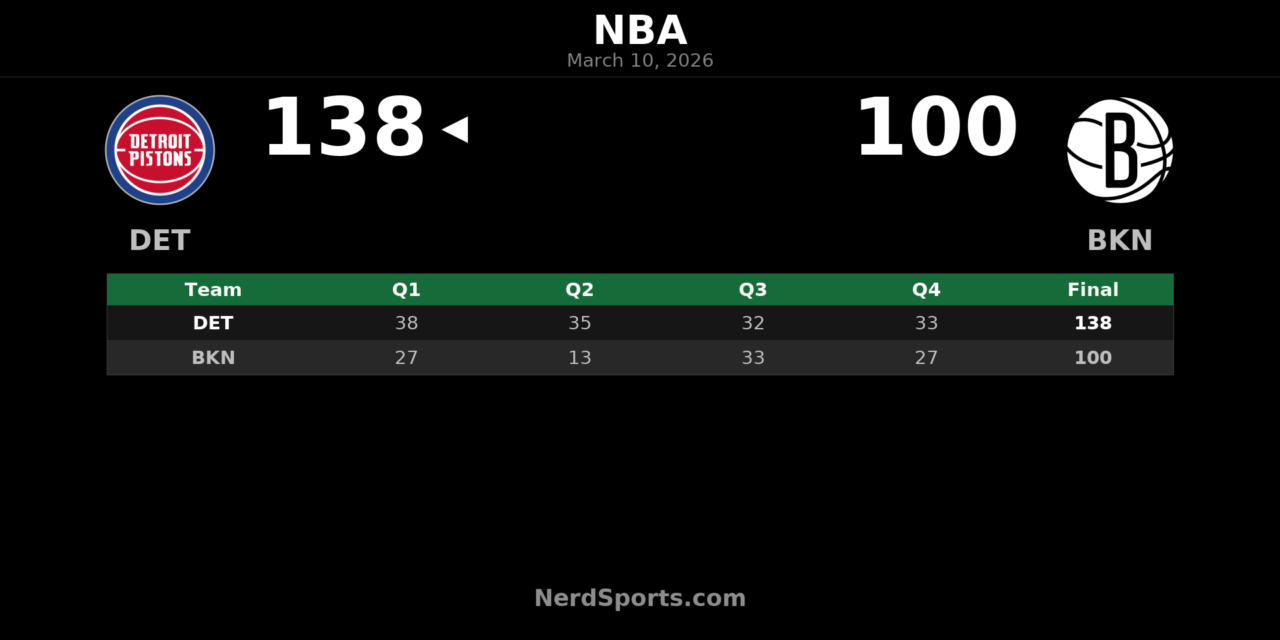
Detroit Pistons 138, Brooklyn Nets 100 — Final
The Detroit Pistons came into Barclays Center on Tuesday night and put together one of their most complete performances of the season, outpacing the Brooklyn Nets 138-100 to secure a convincing road win. Led by a dominant Cade Cunningham and a big night from Jalen Duren, Detroit took control early, built a massive first-half lead, and never looked back. For the Nets, a difficult evening was compounded by a second quarter in which they managed just 13 points — an effort that all but decided the outcome before halftime.
Quarter-by-Quarter Breakdown
First Quarter: Detroit Sets the Tone Early
The Pistons wasted no time asserting themselves, outscoring Brooklyn 38-27 in the opening frame. Detroit’s offense moved with efficiency and purpose, spreading the ball effectively and converting at a high rate from the field. The Nets kept it within a workable margin through the first 12 minutes, but the warning signs were already present as Detroit’s pace and ball movement proved difficult to contain.
Second Quarter: Pistons Extend to a Decisive Lead
The second quarter told the story of the game. Detroit outscored Brooklyn 35-13 in a dominant stretch that pushed the halftime margin to a staggering 33 points (73-40). The Nets’ offense stalled almost completely, and the Pistons capitalized with relentless ball movement and efficient shooting. By the time both teams headed to the locker room, the outcome was effectively decided.
Third Quarter: Brooklyn Shows Some Pride
To their credit, the Nets responded with a competitive third quarter, outscoring Detroit 33-32 in the period. Michael Porter Jr. and Ben Saraf helped Brooklyn find some rhythm, and the home crowd briefly had reason to engage. But with a 30-plus point deficit to overcome, the rally never carried any real threat of changing the result.
Fourth Quarter: Detroit Closes It Out
The Pistons closed out the game professionally in the fourth, outscoring Brooklyn 33-27 to wrap up a 38-point road victory. With reserves seeing extended run, Detroit maintained composure and kept the Nets from making the final score more respectable. The 138 points represented a season-level statement performance for a team clearly operating with championship-level ambitions.
Key Performers
Cade Cunningham — Detroit Pistons
Cunningham was the engine behind Detroit’s win, finishing with 21 points and a game-high 15 assists. His ability to find open teammates and dictate the tempo of the offense was on full display. A 15-assist performance reflects just how well he commanded Detroit’s attack from start to finish, earning him the game’s top efficiency rating.
Jalen Duren — Detroit Pistons
Duren led all scorers with 26 points and added significant interior presence throughout the evening. The young center capitalized on every opportunity near the rim, taking advantage of favorable matchups and converting at a high rate. His performance was a key driver of Detroit’s 56.5% field goal percentage as a team.
Isaiah Stewart — Detroit Pistons
Stewart pulled down a team-high 8 rebounds, providing Detroit with the interior presence to complement Duren’s scoring output. His effort on the glass helped the Pistons finish the game with 40 total rebounds to Brooklyn’s 31.
Michael Porter Jr. — Brooklyn Nets
Porter Jr. led Brooklyn’s scoring with 19 points in a difficult night for the home team. He provided some offensive spark in the second half, but the deficit was simply too large to overcome. He was one of the few Nets who remained consistent throughout.
Danny Wolf — Brooklyn Nets
Wolf put together Brooklyn’s best all-around stat line of the night, finishing with 13 points, 8 rebounds, and 3 blocks. The forward was one of the few bright spots for the Nets, earning the team’s top efficiency rating with his versatile two-way contribution.
Ben Saraf — Brooklyn Nets
The young guard led Brooklyn in assists with 6, showing some playmaking ability despite the lopsided score. Saraf’s performance offered a glimpse of the development Brooklyn is building toward in what has been a challenging season.
Game Analysis
The statistical gap between these two teams told the full story on Tuesday. Detroit shot 56.5% from the field compared to Brooklyn’s 42.0%, and the Pistons were particularly effective from three-point range, connecting on 16 of 32 attempts for an impressive 50.0% clip. Brooklyn, by comparison, hit just 13 of 38 attempts from distance (34.2%). The assist totals were equally telling — Detroit recorded 36 assists on 48 made baskets, reflecting the kind of team-oriented offense that has carried them to one of the league’s better records this season.
The 22-point second quarter from Detroit — which included a 35-13 scoring edge — was ultimately the defining stretch. Brooklyn was never able to recover from that run, and while the third quarter showed the Nets still competing hard, the foundation for a comeback was simply not there. Detroit’s depth and ball movement remain among their most formidable attributes, and on this evening, both were on full display.
For Brooklyn, the loss continues a pattern that has defined their season. At 17-48, the Nets are among the league’s least productive teams and will look to the draft lottery as their primary source of optimism. Still, individual performances from players like Wolf, Saraf, and Porter Jr. offer some indication of what the organization is working to build for the future.
Standings and Series Context
With the win, the Detroit Pistons improve to 46-18 on the season — one of the strongest records in the NBA — and further cement their position as a legitimate Eastern Conference contender. Their road record of 22-10 is a testament to how consistently this team performs away from home. As the regular season winds toward its conclusion, Detroit will be focused on seeding and positioning heading into the postseason. Tuesday’s performance in Brooklyn was a reminder that the Pistons have the offensive firepower and team cohesion to compete with anyone in the league. For the Nets at 17-48, the remainder of the season is about player development, evaluation, and positioning for the 2026 NBA Draft.