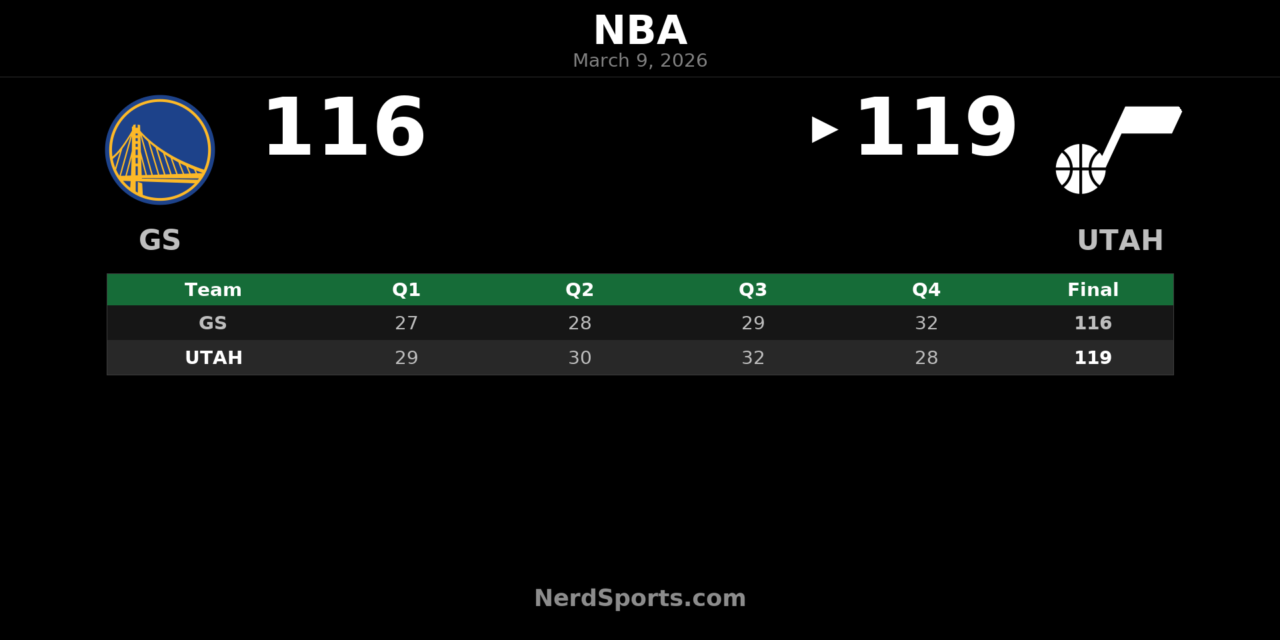
The Utah Jazz came away with a hard-earned 119-116 victory over the Golden State Warriors on Monday night at the Delta Center in Salt Lake City, holding off a late Warriors charge in front of 18,186 fans. Utah led wire to wire in the first three quarters but had to withstand a 32-point Golden State fourth quarter to seal the win. Kyle Filipowski and Brice Sensabaugh led the way for Utah, while De’Anthony Melton and Draymond Green kept the Warriors competitive until the final buzzer.
Quarter-by-Quarter Breakdown
First Quarter: Jazz Set the Tone Early
Utah took control from the opening tip, outscoring Golden State 29-27 in the first quarter. The Jazz moved the ball efficiently and established a rhythm on offense, while Golden State relied heavily on perimeter attempts to stay within reach. A two-point edge at the end of the period was modest, but Utah’s ball movement and interior presence signaled a purposeful game plan.
Second Quarter: Jazz Maintain Their Edge
The second quarter followed a similar pattern. Utah outscored the Warriors 30-28, extending their halftime lead to four points at 59-55. Golden State continued to push the pace and generate opportunities from three-point range, but Utah’s free throw efficiency — the Jazz would finish 27-of-29 from the line for the game — kept the margin stable heading into the break.
Third Quarter: Utah Extends the Lead
The Jazz had their best quarter of the evening in the third, outscoring Golden State 32-29 to push their advantage to seven points entering the final frame. Filipowski was a consistent presence in the frontcourt, and Utah’s team-wide assist total of 29 reflected a collective offensive effort that created quality looks throughout the half.
Fourth Quarter: Warriors Rally, but Fall Short
Golden State mounted a genuine challenge in the fourth quarter, outscoring Utah 32-28 to close the deficit to three. The Warriors launched 52 three-pointers on the night and connected on 16 of them (30.8%), with the fourth quarter representing their most efficient stretch. Utah’s lead, which had been as comfortable as seven, was suddenly fragile. But the Jazz made enough plays down the stretch — aided by their composure at the free throw line — to hold the lead and come away with the 119-116 final.
Key Performers
Kyle Filipowski — Utah Jazz
Filipowski was Utah’s most impactful player on Monday, finishing with 19 points and a game-high 15 rebounds. His presence on the glass gave Utah critical second-chance opportunities and limited Golden State’s ability to extend possessions. He earned the game’s top performance rating and was a steady anchor in the frontcourt throughout all four quarters.
Brice Sensabaugh — Utah Jazz
Sensabaugh led all Utah scorers with 21 points, providing an offensive punch that the Jazz needed to sustain their lead. His scoring efficiency helped offset Golden State’s volume three-point attack and gave Utah a reliable option when the offense needed a bucket.
Cody Williams — Utah Jazz
Williams orchestrated Utah’s offense effectively, distributing 7 assists to lead the Jazz. His ability to find open teammates contributed to Utah’s 29 total assists on 40 made field goals — a strong assist-to-made-basket ratio that reflects a well-structured offensive system.
De’Anthony Melton — Golden State Warriors
Melton was the Warriors’ standout performer, leading all scorers in the game with 22 points to go along with 7 rebounds. He earned Golden State’s top performance rating and was the most consistent offensive contributor on the visiting side throughout the evening.
Draymond Green — Golden State Warriors
Green finished with 10 assists, directing Golden State’s offense and keeping the Warriors’ ball movement sharp. His playmaking helped generate the Warriors’ 32 total assists, and his floor vision was central to the fourth-quarter rally that nearly pulled Golden State even.
Game Analysis
This game came down to two contrasting offensive approaches. Utah (48.2% FG, 93.1% FT) prioritized shot quality and free throw generation, taking 83 field goal attempts and getting to the line 29 times. Golden State, by contrast, attempted 99 field goals — 52 of them from three-point range — reflecting a volume-based, perimeter-oriented attack. The Warriors’ 30.8% three-point percentage on that volume was not sufficient to overcome Utah’s interior efficiency and free throw accuracy.
Utah’s rebounding advantage (50 to 46) also proved meaningful. Filipowski’s 15-rebound performance gave the Jazz extra possessions and helped neutralize Golden State’s ability to generate second-chance opportunities. The Warriors’ 66.7% free throw shooting (14-of-21) was another area where Golden State left points on the board, a contrast that became significant in a three-point game.
For Utah, this was a well-rounded team effort. The Jazz posted 29 assists as a team and shot nearly 50% from the field, demonstrating a level of offensive cohesion that has been a point of emphasis during their rebuild. Golden State’s fourth-quarter surge showed their competitive resilience, but the Jazz were steady enough in the closing minutes to preserve the result.
Standings and Series Implications
With the win, the Utah Jazz improve to 20-45 on the season (12-21 at home), continuing to develop their young roster as the 2025-26 campaign winds toward its conclusion. For the Golden State Warriors, the loss drops them to an even 32-32 overall, a record that carries real playoff implications. At the .500 mark with the postseason picture in the Western Conference tightening, every road result matters for Golden State. Monday’s loss at Salt Lake City is the kind of game the Warriors will need to learn from as they push to secure their playoff positioning in the weeks ahead.