Cavaliers Take Care of Business at Home, Outpace 76ers 115-101
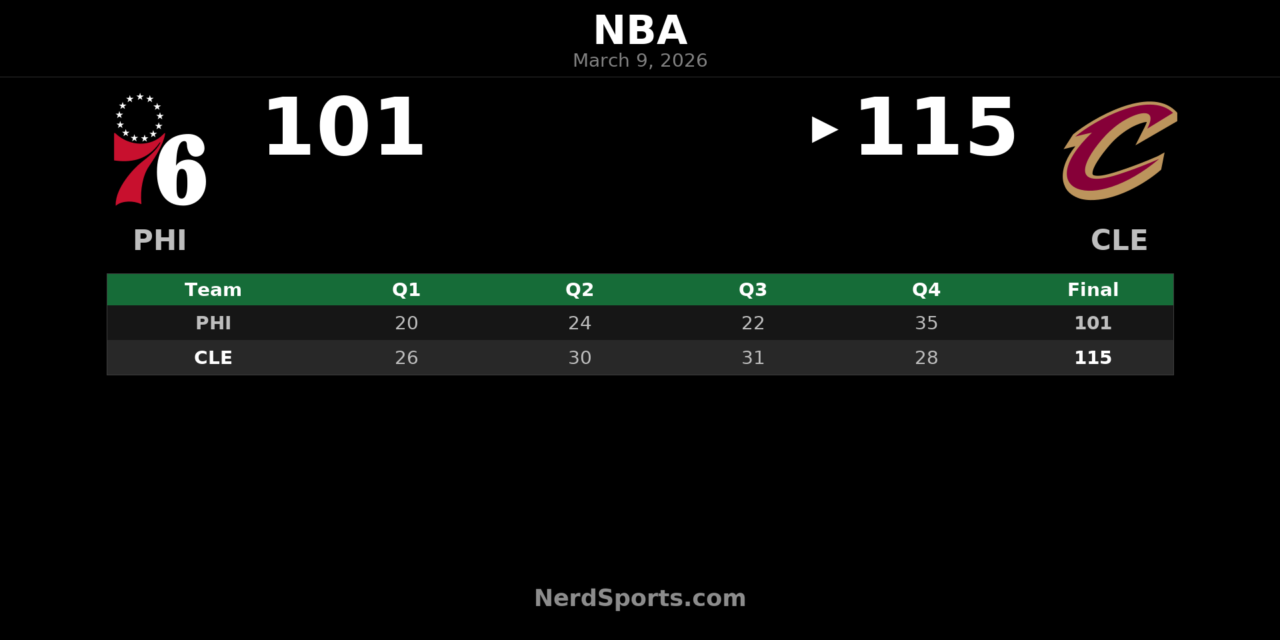
The Cleveland Cavaliers came away with a convincing 115-101 victory over the Philadelphia 76ers on Monday night at Rocket Arena, led by a balanced offensive effort and a strong three-quarter performance that gave the home side enough cushion to withstand a late Philadelphia push. Before a crowd of 19,432, Cleveland outscored Philadelphia in the first three frames by a combined 30 points before the 76ers rallied in the fourth, making the final score more competitive than the game’s overall tone suggested.
Quarter-by-Quarter Breakdown
First Quarter: Cleveland Establishes Early Rhythm
Cleveland wasted little time setting the tone, outscoring Philadelphia 26-20 in the opening quarter. The Cavaliers moved the ball efficiently and got into an early offensive rhythm, while the 76ers struggled to generate consistent looks in the half-court. The six-point deficit at the end of the first was a sign of things to come for Philadelphia.
Second Quarter: Cavaliers Extend the Lead
The second quarter was more of the same for Cleveland, as the Cavaliers posted another 30 points to Philadelphia’s 24. The hosts went into halftime with a commanding 56-44 advantage, having outscored the 76ers by 12 across the first two periods. Cleveland’s ball movement — the team finished the game with 28 assists — was a clear separator in the first half.
Third Quarter: Cleveland Pulls Away
The third quarter was Cleveland’s best of the night. The Cavaliers poured in 31 points against just 22 for Philadelphia, pushing their advantage to a game-high 21 points at various stages and firmly taking control of the contest. Philadelphia’s inability to defend Cleveland’s perimeter attack — the Cavaliers connected on 16-of-44 three-point attempts — was a notable theme throughout.
Fourth Quarter: 76ers Finish Strong, But Too Late
With the outcome largely decided, Philadelphia’s reserves and role players found their footing in the final period, posting a game-high 35 points to Cleveland’s 28. Quentin Grimes and others contributed to the late push, but the deficit proved too significant to overcome. The Cavaliers held on for the 115-101 final.
Key Performers
James Harden — Cleveland Cavaliers
Veteran guard James Harden led all Cleveland scorers with 21 points and earned the game’s top individual rating. Playing with composure and precision throughout, Harden controlled the pace on offense and was a key driver of Cleveland’s ball-movement-oriented attack. The Cavaliers’ 28 assists as a team reflected the kind of connected offensive play Harden often enables.
Donovan Mitchell — Cleveland Cavaliers
Donovan Mitchell led the team in assists with 6, adding to his scoring contributions and serving as a secondary playmaker alongside Harden. His ability to pressure the defense and create for teammates helped Cleveland maintain its advantage through the middle quarters.
Dean Wade — Cleveland Cavaliers
Forward Dean Wade led all Cleveland players in rebounding with 10 boards, providing a reliable presence on the glass. Wade’s effort on the defensive end helped limit Philadelphia’s second-chance opportunities, a meaningful contribution given the 76ers’ 42 total rebounds on the night.
Quentin Grimes — Philadelphia 76ers
Grimes was Philadelphia’s top scorer with 17 points and earned the highest individual rating on the visiting side. He was particularly active in the fourth quarter as the 76ers mounted their late push, but his contributions came too late to alter the outcome.
Adem Bona — Philadelphia 76ers
Center Adem Bona led Philadelphia in rebounds with 7, offering some interior presence for a 76ers squad that struggled to match Cleveland’s efficiency at both ends of the floor.
Cameron Payne — Philadelphia 76ers
Point guard Cameron Payne led Philadelphia in assists with 4, though the 76ers’ overall assist total of 20 trailed Cleveland’s 28 — a reflection of the organizational difference in how the two teams shared the ball on the night.
Game Analysis
This was a game defined more by Cleveland’s sustained excellence over three quarters than any individual hero performance. The Cavaliers built their advantage methodically, using a pass-first offensive approach — evidenced by their 28 team assists on 38 field goals — to consistently find open looks. Their 45.2% field goal percentage was respectable, and while their 36.4% three-point shooting was not exceptional, the volume (44 attempts) created consistent pressure that Philadelphia could not consistently absorb.
Philadelphia, by contrast, shot 45.9% from the field but connected on just 28.9% of their 38 three-point attempts. The free throw line also proved problematic for the visitors, who converted just 12 of 18 attempts (66.7%), compared to Cleveland’s efficient 23-of-25 (92.0%) — a margin of nearly a full possession worth of points in a game decided by 14.
The 76ers’ fourth-quarter effort — 35 points — should not be overlooked as a sign of resilience, but the game had already shifted well out of their reach by that point. Philadelphia’s inability to win any of the first three quarters ultimately determined the result.
Standings and Series Implications
With the win, the Cleveland Cavaliers improve to 40-25 on the season, maintaining their strong positioning in the Eastern Conference standings as the playoff push intensifies. Their 22-12 home record underscores how reliable Rocket Arena has been as a competitive advantage this year. Philadelphia, meanwhile, drops to 34-30 overall — still above the .500 mark but now needing to regroup as the postseason picture continues to sharpen in the East. The 76ers remain in a competitive fight for seeding, and performances like Monday’s will need to be corrected if they intend to secure a favorable playoff position.