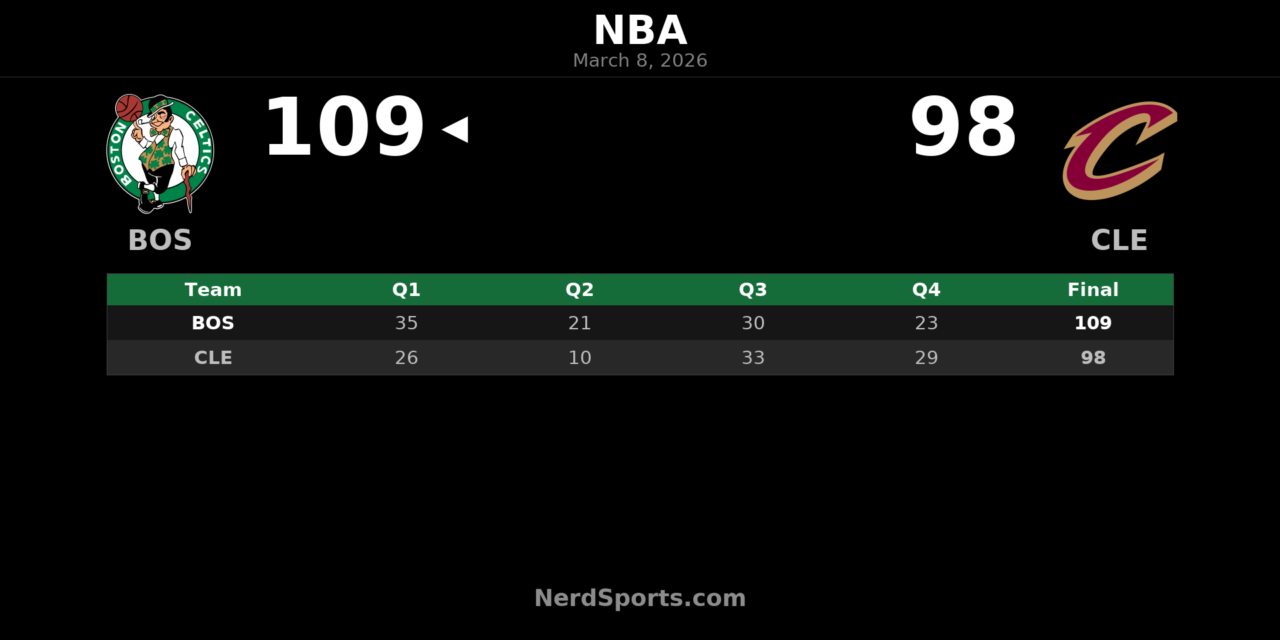
Celtics Take Control Early, Hold Off Cavaliers for 109-98 Road Win
The Boston Celtics came away with a convincing 109-98 victory over the Cleveland Cavaliers on Sunday afternoon at Rocket Arena, improving to 43-21 on the season in the process. Broadcast nationally on ABC, the game drew an attendance of 19,432 and featured a dominant first-half performance from Boston that Cleveland was ultimately unable to overcome. Despite a spirited second-half push from Donovan Mitchell and the Cavaliers, the Celtics held their advantage throughout and closed the game with purpose.
Quarter-by-Quarter Breakdown
First Quarter: Boston Takes Command Early
The Celtics wasted no time establishing control, outscoring Cleveland 35-26 in the opening quarter. Boston moved the ball efficiently and converted at a solid clip, setting a pace that the Cavaliers struggled to match. Cleveland showed flashes of competitiveness, but the Celtics’ movement and ball distribution gave them a clear edge heading into the second period.
Second Quarter: Boston Extends Its Lead Significantly
The second quarter was where the game’s outcome took clearest shape. Boston outscored Cleveland by a staggering 21-10 margin, turning what had been a nine-point deficit into a 56-36 halftime advantage for the visitors. The Cavaliers went cold offensively during this stretch, managing just 10 points over 12 minutes — a stretch that made their second-half path considerably more difficult. Boston’s defense held firm while its offense continued to flow freely.
Third Quarter: Cleveland Responds
Cleveland came out of halftime with renewed energy, outscoring Boston 33-30 in the third quarter. Donovan Mitchell helped lead the charge as the Cavaliers trimmed the deficit, pulling the crowd back into the game at Rocket Arena. The quarter showed Cleveland’s character, but the 20-point halftime hole proved too deep to fully escape. Boston led 86-69 heading into the fourth.
Fourth Quarter: Celtics Close It Out
Cleveland continued to compete in the fourth, outscoring Boston 29-23 in the final frame. The Cavaliers cut into the lead, but the Celtics managed the game with composure and controlled the clock effectively. Boston’s final margin of 109-98 was a fair reflection of their overall performance on the afternoon.
Key Performers
Jaylen Brown — Boston Celtics
Jaylen Brown delivered the game’s top all-around performance, finishing with 23 points, 9 rebounds, and 8 assists to earn the top rating among all players on the floor. Brown’s ability to contribute across multiple statistical categories gave the Celtics a versatile offensive and playmaking weapon that Cleveland had no consistent answer for. His 8 assists reflected Boston’s commitment to ball movement and shared offensive responsibility.
Neemias Queta — Boston Celtics
Center Neemias Queta led all players on the boards, pulling down 11 rebounds to anchor Boston’s frontcourt presence. Queta contributed to Boston’s overall rebounding advantage — the Celtics held a 49-42 edge on the glass — which proved meaningful in controlling second-chance opportunities throughout the game.
Donovan Mitchell — Cleveland Cavaliers
Despite the loss, Donovan Mitchell delivered a standout individual effort, leading all scorers with 30 points and adding 7 rebounds. Mitchell was Cleveland’s primary offensive engine and kept the Cavaliers in reach during the second half. His performance was one of the few consistent bright spots for a Cleveland squad that struggled in the first half when the game effectively slipped away.
James Harden — Cleveland Cavaliers
James Harden contributed meaningfully to Cleveland’s offense in a playmaking capacity, finishing with 10 assists to lead all players in that category. Harden’s passing and court vision helped Cleveland generate looks, but the Cavaliers’ 40.7% field goal percentage — compared to Boston’s 44.0% — limited how much his distribution could impact the final score.
Game Analysis
The numbers tell a straightforward story. Boston outperformed Cleveland in virtually every key efficiency metric. The Celtics shot 44.0% from the field compared to Cleveland’s 40.7%, and connected on 15-of-38 three-point attempts (39.5%) versus the Cavaliers’ 13-of-45 (28.9%). Boston also went 20-of-22 from the free-throw line at a 90.9% clip, while Cleveland managed only 15-of-21 (71.4%). The rebounding edge of 49-42 in Boston’s favor further underscored the Celtics’ collective dominance.
The second quarter remains the critical inflection point. Cleveland’s 10-point output in that period effectively sealed the Cavaliers’ fate. While Mitchell and the Cavaliers responded admirably after halftime, digging out of a 20-point hole against a Boston team of this caliber proved too tall an ask. The Celtics, with 25 assists on 37 field goals made, demonstrated the kind of team-oriented offense that has defined their season.
For Cleveland, the concerns are primarily about consistency. Mitchell’s scoring remained elite, Harden’s distribution was useful, and Evan Mobley contributed 8 rebounds on the interior. But the team’s inability to generate offense in the second quarter — and its 45 three-point attempts at under 29% — points to an offense that can be disrupted when Boston’s defense locks in.
Standings and Series Context
With the win, the Boston Celtics move to 43-21 on the season and hold a strong position in the Eastern Conference standings as the regular season approaches its final stretch. Their 22-11 road record is among the best in the league and speaks to the team’s ability to perform consistently away from TD Garden. The Cleveland Cavaliers fall to 39-25 overall and 21-12 at home. Cleveland remains in a solid playoff position in the East, but this loss is a reminder of the gap that still exists between the Cavaliers and the conference’s top contenders. With the postseason nearing, both teams will look to sharpen their performances in the weeks ahead.