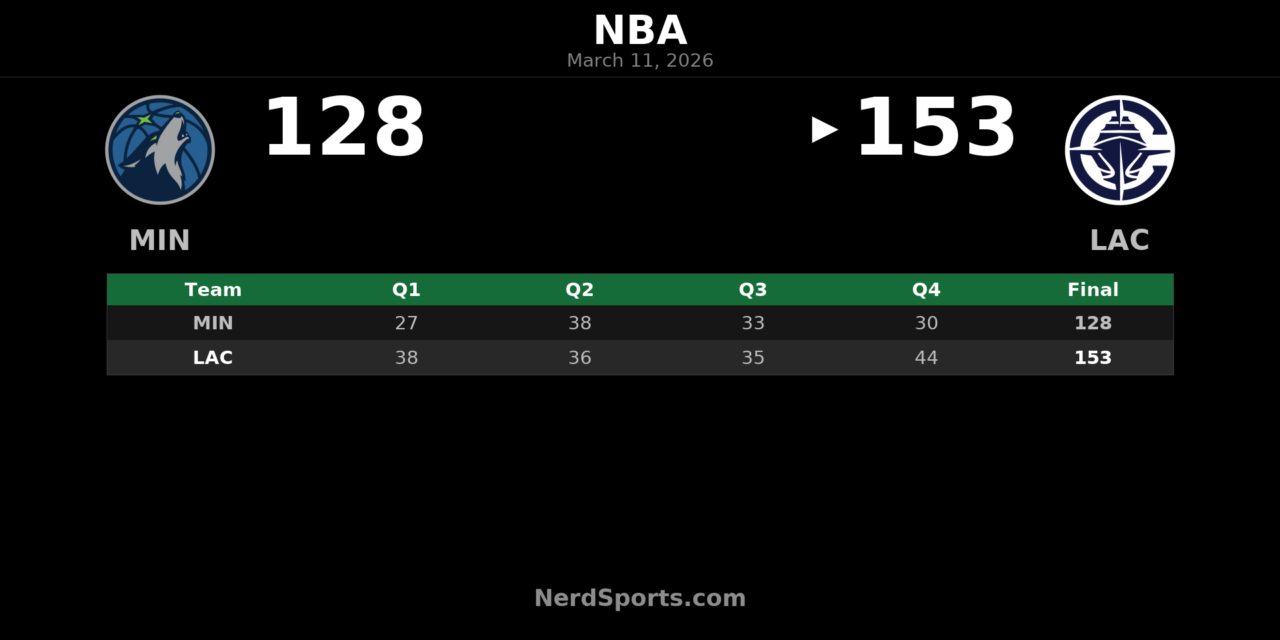
The LA Clippers came away with a convincing 153-128 victory over the Minnesota Timberwolves on Wednesday night at Intuit Dome in Inglewood, California. Kawhi Leonard was the central figure in a high-scoring performance, posting 45 points to lead all scorers on the evening. The Clippers shot 63.4% from the field and connected on 19 three-pointers, outpacing a Timberwolves squad that put up a strong second quarter but could not keep up with LA’s offensive efficiency across the full 48 minutes.
Quarter-by-Quarter Breakdown
First Quarter: Clippers Take Early Control
LA wasted no time taking command of this contest. The Clippers outscored Minnesota 38-27 in the opening period, building an 11-point cushion before the first horn sounded. The offense moved efficiently from the opening tip, finding open looks and converting at a high rate, while the Timberwolves struggled to establish any consistent offensive rhythm.
Second Quarter: Minnesota Responds
The Timberwolves came out of the locker room with renewed energy in the second quarter, outscoring the Clippers 38-36 in the period. Anthony Edwards was particularly active, helping Minnesota claw back into the game and trimming the deficit to single digits at the half. The Clippers led 74-65 heading into the break, keeping a comfortable but no longer commanding lead.
Third Quarter: Clippers Hold Steady
Minnesota made another push in the third quarter, outscoring LA 33-35 in what became a relatively competitive period. The Clippers held off each Timberwolves run, maintaining a lead that hovered in the low double digits throughout. Leonard continued to deliver on the offensive end, keeping LA’s margin intact as the teams headed to the final period with the Clippers ahead 109-98.
Fourth Quarter: LA Takes Full Control
The fourth quarter belonged entirely to the Clippers. LA put up a remarkable 44 points in the final period — their highest-scoring quarter of the night — while holding Minnesota to just 30. The Clippers outpaced the Timberwolves by 14 points in the fourth quarter alone, stretching a manageable lead into a commanding 25-point final margin. The 16,871 fans at Intuit Dome saw their team close out a dominant performance in emphatic fashion.
Key Performers
Kawhi Leonard — LA Clippers
There is no other place to start. Kawhi Leonard led all scorers with 45 points, delivering one of the most efficient and composed offensive performances of the NBA season. His game rating was the highest on the floor, and he was the central reason the Clippers’ offense operated so effectively. Leonard’s ability to get to his spots, convert in the mid-range, and draw fouls gave LA a consistent source of points throughout all four quarters.
Jordan Miller — LA Clippers
Guard Jordan Miller was the engine of LA’s ball movement, distributing a game-high 7 assists. His ability to read the defense and find the open man contributed directly to the Clippers’ exceptional 63.4% field goal percentage. Miller’s playmaking kept the offense fluid and gave Leonard and his teammates open opportunities all night.
Isaiah Jackson — LA Clippers
Forward Isaiah Jackson led the Clippers on the glass with 6 rebounds, contributing to a team total of 29 boards. His presence in the paint provided interior stability on both ends of the floor.
Anthony Edwards — Minnesota Timberwolves
Despite the final score, Anthony Edwards had a strong individual outing for the Timberwolves, finishing with 36 points and 5 assists to lead Minnesota in both categories. He was the primary driver of the Timberwolves’ second-quarter comeback effort and remained competitive even as LA began to extend its advantage in the fourth. Edwards’ performance, while impressive, was not enough to offset the Clippers’ collective output.
Julius Randle — Minnesota Timberwolves
Julius Randle led the Timberwolves on the boards with 6 rebounds and contributed on the offensive end, though Minnesota’s overall efficiency (59.7% field goal percentage) was ultimately overshadowed by an even more productive Clippers squad.
Game Analysis
This was a matchup of two teams headed in different directions on the night, even if both put up impressive shooting numbers. The Clippers shot 63.4% from the field compared to Minnesota’s 59.7%, and that differential — coupled with 19 made three-pointers on 37 attempts (51.4%) versus the Timberwolves’ 11-of-25 from deep — tells the story of how LA was able to build such a wide margin.
The Clippers’ 36 team assists on 52 made field goals is a notable indicator of just how well the offense functioned as a unit. LA was not relying solely on individual creation; the ball moved, and the team consistently found the best shot. Kawhi Leonard was at the center of it, but the collective efficiency was the defining factor. Minnesota kept pace through the second and third quarters but simply could not sustain that level, particularly as the fourth quarter unfolded.
For the Timberwolves, Anthony Edwards’ 36 points offer a positive takeaway, but Minnesota’s inability to stop LA’s pace and ball movement in the first and fourth quarters proved decisive. The Wolves finished with 32 assists of their own, which is a strong number, but their three-point volume (only 25 attempts compared to LA’s 37) meant they were operating with fewer high-value opportunities throughout the game.
Standings and Series Context
With the win, the LA Clippers improve to 33-32 on the season, moving back to the .500 mark — a meaningful threshold for a team that has been navigating roster challenges throughout the 2025-26 campaign. Their home record now stands at 18-13. For the Timberwolves, the loss drops them to 40-26, but Minnesota remains well-positioned in the Western Conference standings. The Wolves came into Inglewood as one of the West’s better road teams (18-14 away from home) and will look to bounce back quickly as the playoff push intensifies. Both teams remain in contention for strong postseason positioning, with fewer than 20 games remaining in the regular season.