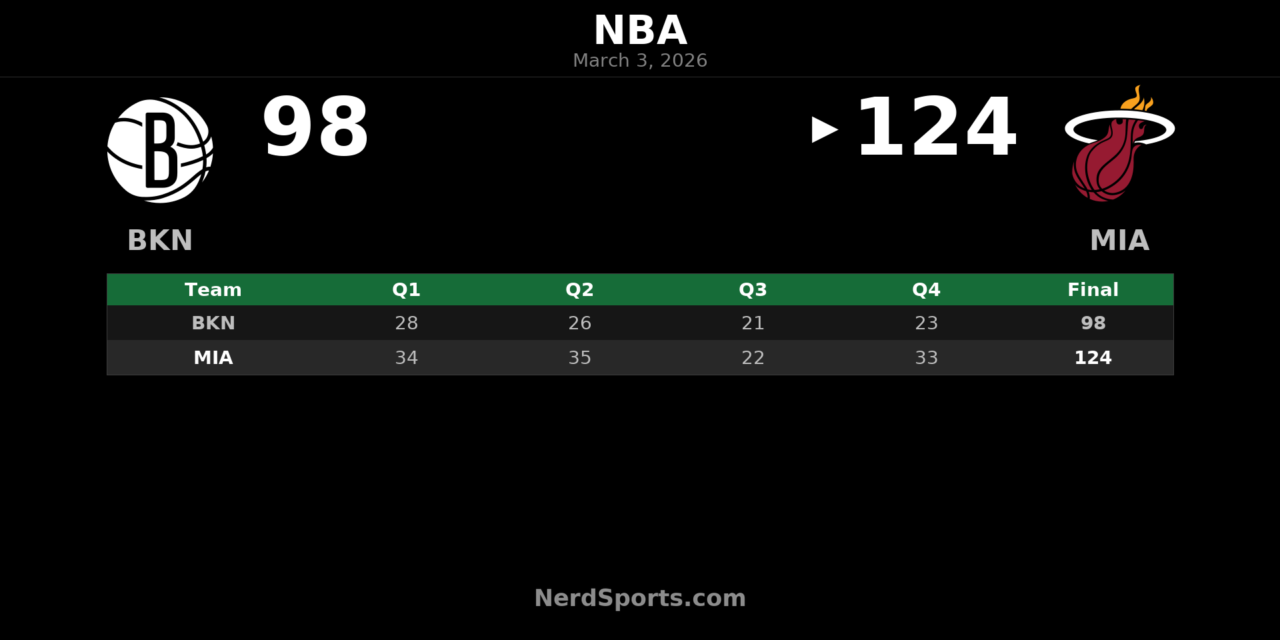
The Miami Heat delivered a complete team performance on Tuesday night at Kaseya Center, outscoring the Brooklyn Nets 124–98 in front of an announced crowd of 19,700. Miami held the advantage in three of four quarters and never allowed Brooklyn to string together a meaningful run, steadily extending their lead on the way to a 26-point final margin. With the win, the Heat improve to 33–29 on the season and remain in the thick of the Eastern Conference playoff race.
Quarter-by-Quarter Breakdown
First Quarter: Miami Sets the Tone Early
Miami came out purposeful and efficient, outscoring Brooklyn 34–28 in the opening period. The Heat moved the ball with intention, connecting on enough early looks to build a six-point cushion before the first whistle. The Nets struggled to find rhythm offensively, and their 28 points — while not terrible — weren’t enough to match Miami’s pace out of the gate.
Second Quarter: Heat Extend the Advantage
The second quarter proved to be the most decisive stretch of the game. Miami outscored Brooklyn 35–26, pushing the halftime lead to 69–54. The Heat’s ball movement was sharp — they finished the half with a significant assist advantage — and their interior presence limited Brooklyn’s second-chance opportunities. Going into the break up 15, Miami had established full control of the contest.
Third Quarter: Nets Keep It Respectable
Brooklyn showed a bit more defensive resolve in the third quarter, holding Miami to just 22 points while posting 21 of their own. The margin didn’t change significantly — Miami led 91–75 heading into the final frame — but the Nets at least managed to keep the score from getting completely out of reach at that stage.
Fourth Quarter: Miami Closes Strong
Any hope Brooklyn had of mounting a comeback was quickly put to rest in the fourth. Miami outscored the Nets 33–23 in the final period, putting together their second-best quarter of the night to seal the outcome. The Heat’s bench contributions kept the pressure on, and Brooklyn had no answer for Miami’s sustained offensive production through 48 minutes.
Key Performers
Bam Adebayo – Miami Heat
Adebayo was Miami’s standout performer and earned the game’s top efficiency rating. The veteran center led all scorers with 23 points and added 9 rebounds along with a remarkable 6 steals — a stat line that reflected his impact on both ends of the floor. Adebayo’s ability to disrupt Brooklyn’s offense while remaining productive on the offensive end was central to the Heat’s success on the night.
Kel’el Ware – Miami Heat
The young center made his presence felt on the glass, pulling down a game-high 13 rebounds. Ware’s work in the paint gave Miami a consistent edge on the boards, contributing to a 46–38 overall rebounding advantage for the Heat.
Kasparas Jakucionis – Miami Heat
Jakucionis paced Miami’s backcourt with a team-high 5 assists, helping facilitate the Heat’s 28-assist night. Miami’s ability to generate 28 assists on 45 made field goals underscored the ball-sharing approach that made their offense so effective throughout the game.
Noah Clowney – Brooklyn Nets
Clowney led Brooklyn with 17 points, providing the Nets’ most consistent offensive output of the evening. While his effort was notable, the lack of scoring depth around him was a recurring issue for a Brooklyn team that shot just 38.4% from the field overall.
Day’Ron Sharpe – Brooklyn Nets
Sharpe earned Brooklyn’s top efficiency rating with 10 points and 8 rebounds, making him the Nets’ most productive player by combined impact metrics. Danny Wolf contributed 5 assists to lead Brooklyn’s playmaking, though the team’s poor three-point shooting — 6-of-32 (18.8%) — made sustained offense impossible.
Game Analysis
This outcome came down to shooting efficiency and defensive activity. Miami connected on 49.5% of their field goal attempts compared to Brooklyn’s 38.4%, a gap that proved impossible to overcome over 48 minutes. The Heat also held a significant advantage from three-point range, converting 13-of-36 (36.1%) compared to Brooklyn’s 6-of-32 (18.8%). When a team shoots under 19% from beyond the arc, sustaining a competitive score against a healthy Miami roster at home is an uphill climb throughout.
Adebayo’s six steals were a particularly noteworthy element of the game. Miami’s ability to generate live-ball turnovers led to easy transition opportunities, adding to their offensive total without requiring half-court execution every time down the floor. The Heat’s 28 assists also speak to a cohesive offensive system that distributed the ball effectively and kept Brooklyn’s defense rotating all night.
For Brooklyn, the challenge remains consistent across much of this season: they simply don’t have enough reliable offensive contributors to compete with playoff-caliber opponents, particularly on the road. Their 30 free throw attempts suggest they got to the line at a reasonable rate, converting 26 of those (86.7%), but the field goal shooting numbers were too far below acceptable to put them in position to win.
Standings and Series Context
With the victory, the Miami Heat improve to 33–29 on the season and hold a 19–11 home record at Kaseya Center. As the regular season heads toward its final stretch, every win carries additional weight for Miami, who remain in contention for a top-six seed in the Eastern Conference. The Brooklyn Nets, now 15–46, continue to navigate a difficult season with limited expectations for the standings. This matchup had no playoff series history attached to it, but for Miami, staying in the win column at home is a priority as the postseason picture takes shape in March.