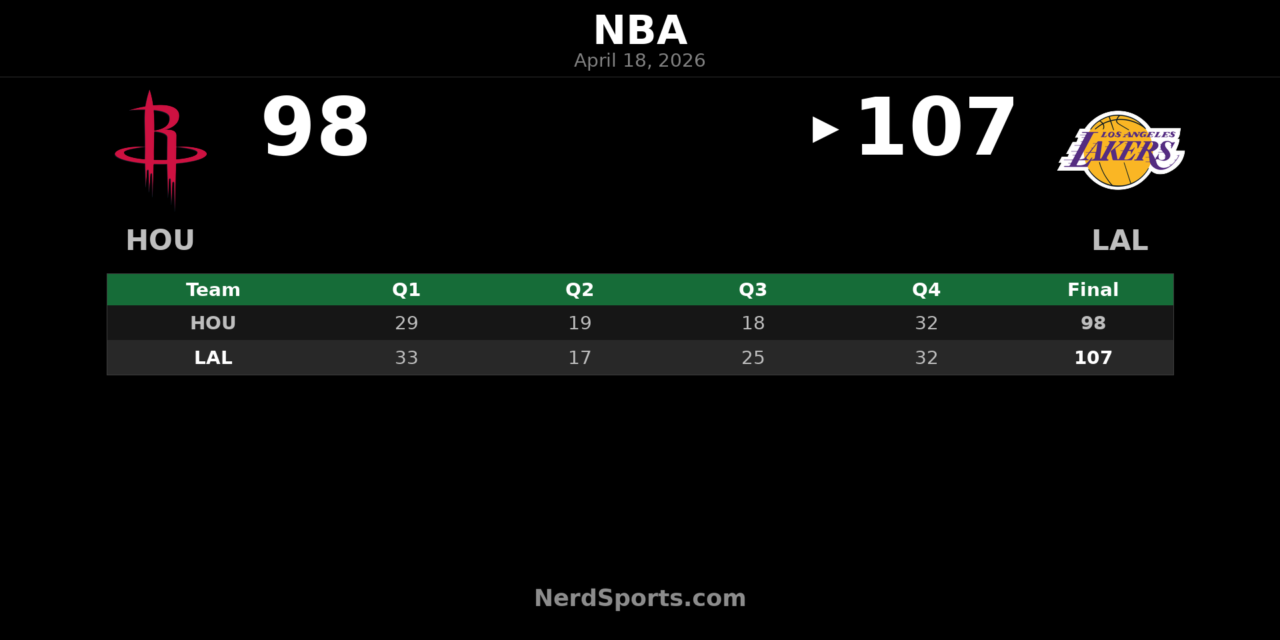
The Los Angeles Lakers opened their first-round series with a 107-98 win over the Houston Rockets on Saturday, and Luke Kennard led the way with a game-high 27 points. Los Angeles used a strong third quarter, efficient shooting, and LeBron James’ playmaking to take a 1-0 series lead at crypto.com Arena.
Quarter-by-Quarter Breakdown
First Quarter
The Lakers set the early tone by taking a 33-29 lead after one quarter. Houston kept pace with 29 points of its own, but Los Angeles was sharper offensively, moving the ball well and finding quality looks. Kennard helped space the floor early, while the Lakers did enough in transition and in the half court to stay in front.
Second Quarter
The Rockets narrowed the margin in a lower-scoring second period, outscoring the Lakers 19-17. Houston’s defense improved, and the visitors leaned on their activity on the glass to stay close. By halftime, the Lakers’ lead was down to 50-48, with the game still very much in reach for either side.
Third Quarter
This was the decisive stretch. Los Angeles outscored Houston 25-18 in the third and created needed separation. The Lakers’ offensive efficiency stood out as they converted at a high rate from the field, and James orchestrated the action with patience and control. While Houston continued to generate shots, the Lakers’ execution was cleaner, and the home team carried a 75-66 advantage into the fourth.
Fourth Quarter
Houston scored 32 points in the final quarter and kept pushing, but the Lakers matched them with 32 of their own to maintain control. Every time the Rockets threatened to trim the deficit further, Los Angeles answered with timely shot-making or a composed possession. That steady closing stretch allowed the Lakers to hold off the late pressure and finish off a nine-point win.
Key Performers
Luke Kennard, Lakers: Kennard led all scorers with 27 points and gave Los Angeles a major lift as a perimeter scorer. His efficiency helped the Lakers make the most of a relatively modest shot total.
LeBron James, Lakers: James delivered 19 points, eight rebounds, and 13 assists, controlling the tempo and repeatedly setting up teammates. His all-around impact was central to the Lakers posting 29 assists as a team.
Deandre Ayton, Lakers: Ayton led Los Angeles with 11 rebounds, helping the Lakers stabilize key possessions even though Houston finished with the overall edge on the glass.
Alperen Sengun, Rockets: Sengun paced Houston with 19 points and remained a reliable interior scoring option throughout the night.
Jabari Smith Jr., Rockets: Smith grabbed 12 rebounds and helped Houston create extra chances, part of a 44-35 rebounding advantage for the Rockets.
Tari Eason, Rockets: Eason posted 16 points, 10 rebounds, and three steals, giving Houston productive two-way minutes in a game where the visitors needed consistent secondary scoring.
NerdSports Stat: The Rockets attempted 27 more field goals than the Lakers, 93 to 66, but still lost by nine because Los Angeles shot 60.6% from the field and assisted on 29 of its 40 made baskets.
Game Analysis
The clearest difference in Game 1 was efficiency. Houston won the rebounding battle and generated far more shot attempts, but the Rockets shot just 37.6% from the field. The Lakers, by contrast, were highly effective on fewer possessions, finishing at 60.6% overall and 52.6% from three-point range.
That combination let Los Angeles overcome a few statistical disadvantages. The Lakers were outrebounded by nine and did not create the same volume of attempts, yet their half-court execution was consistently better. James’ 13 assists reflected how well the offense functioned, and Kennard’s scoring provided the type of perimeter support that can shift a playoff opener.
For Houston, the path forward is fairly clear. The Rockets created enough opportunities to make this a different game, especially through offensive activity and overall shot volume. But to even the series, they will need better conversion from the field after making only 35 of 93 attempts. More efficient support around Sengun and stronger shot selection in key stretches would go a long way in Game 2.
There was also added attention on the playoff picture entering this matchup because Kevin Durant was unavailable for Game 1 with a knee contusion. That placed even more emphasis on the Lakers’ supporting cast, and Los Angeles responded with a composed, balanced performance rather than relying on one player to carry the offense.
The Lakers also benefited from playing with control in the game’s biggest swing period. Their third-quarter edge gave them enough cushion that Houston’s 32-point fourth quarter never fully turned into a breakthrough. In a playoff setting, that kind of poise matters, especially in a series opener.
Closing Context
With the result, Los Angeles takes a 1-0 lead in this best-of-seven Western Conference first-round series. The Lakers improved to 53-29 and protected home court in Game 1, while the Rockets, who finished the regular season 52-30, now head into Game 2 looking to split the opening two games in Los Angeles before the series shifts.
Frequently Asked Questions
The Los Angeles Lakers defeated the Houston Rockets 107-98 on Saturday, April 18, 2026.
Luke Kennard scored 27 points on efficient shooting for the Lakers.
After the win, Los Angeles sits 53-29 in the Western Conference.
LeBron James was the standout performer with 19 points, eight rebounds, and 13 assists, while Luke Kennard led all scorers with 27 points.