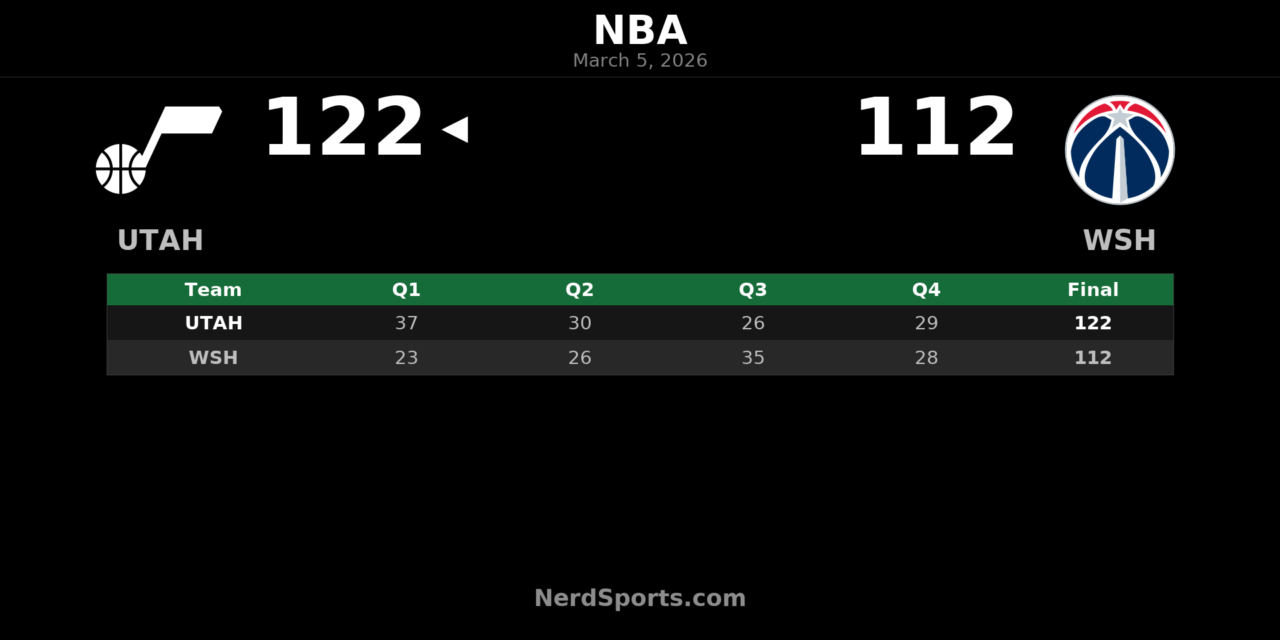
The Utah Jazz came away with a convincing 122-112 road victory over the Washington Wizards on Thursday night at Capital One Arena, improving to 19-44 on the season. Utah’s offense was efficient and well-distributed throughout the contest, and a commanding first-half lead proved to be the difference even after Washington mounted a strong third-quarter push. For the Wizards, now 16-46, the loss extended a difficult stretch heading into the final weeks of the regular season.
Quarter-by-Quarter Breakdown
First Quarter: Utah Jumps Out Early
The Jazz set the tone immediately, outscoring Washington 37-23 in the opening period. Utah’s ball movement was sharp and their transition opportunities plentiful, while the Wizards struggled to find consistent offense against a Jazz defense that rotated well. The 14-point deficit Washington faced at the end of the first quarter put them in early catch-up mode.
Second Quarter: Jazz Maintain Control
Utah kept Washington at arm’s length in the second quarter, outpacing the Wizards 30-26 to take a 67-49 lead into halftime. Washington showed some improved rhythm offensively but could not generate enough stops defensively to close the gap in any meaningful way. An 18-point halftime deficit was a steep hill to climb.
Third Quarter: Wizards Make Their Move
Washington’s best basketball came in the third quarter, where they outscored Utah 35-26 — their most productive period of the game. The Wizards tightened up defensively and found better spacing on offense, trimming the deficit to single digits at various points and giving the home crowd at Capital One Arena reason to stay engaged. Utah’s lead was 93-84 heading into the final frame.
Fourth Quarter: Jazz Hold Off the Rally
Despite Washington’s third-quarter surge, Utah steadied itself in the fourth and outscored the Wizards 29-28 to close things out. The Jazz made the right plays down the stretch, keeping Washington from completing the comeback and securing the 122-112 final.
Key Performers
Ace Bailey — Utah Jazz
The Jazz’s leading scorer on the night, Ace Bailey delivered 32 points to pace Utah’s offense. The second-year guard was assertive and efficient, providing the kind of individual scoring punch that kept Washington’s defense from committing extra attention to Utah’s playmakers.
Isaiah Collier — Utah Jazz
Collier earned game-high honors in the efficiency rating category, posting 27 points and 11 assists. His ability to both score and facilitate gave Utah a dual threat at the point guard position. Eleven assists against minimal turnovers reflected strong decision-making throughout the contest.
Kyle Filipowski — Utah Jazz
Filipowski provided a strong interior presence, leading all players with 14 rebounds. His activity on the glass gave Utah extra possessions and helped limit second-chance opportunities for Washington.
Julian Reese — Washington Wizards
In a tough loss, Julian Reese stood out with an impressive double-double, recording 18 points and a remarkable 20 rebounds. The performance was one of the more complete individual efforts on the night and gave Washington a consistent frontcourt presence despite the outcome.
Trae Young — Washington Wizards
Young led Washington’s backcourt with 6 assists, doing his best to keep the Wizards’ offense organized. His playmaking was a bright spot in a night where Washington’s supporting cast was unable to sustain the momentum built in the third quarter.
Game Analysis
The story of this game is largely about Utah’s first half versus Washington’s third quarter. The Jazz outpaced the Wizards by 18 points in the opening two periods, building a cushion that Washington could threaten but not eliminate. Utah finished the game shooting 51.1% from the field compared to Washington’s 46.8%, and the Jazz’s 31 team assists on 47 made field goals underscored how well the ball moved all night. Washington actually attempted more three-pointers (42 to Utah’s 35) and matched Utah’s 42.9% accuracy from beyond the arc, connecting on 18 threes — a respectable effort that kept the scoreboard ticking but not enough to overcome the first-half deficit. Washington’s 32 free throw attempts (making 22) compared to Utah’s 18 attempts (making 13) suggest the Wizards were active in attacking the paint, though the Jazz’s superior shooting efficiency from the floor more than compensated for the disparity at the line. Julian Reese’s 20-rebound outing was extraordinary, yet Utah still out-rebounded Washington overall 45-43, a testament to how balanced the Jazz effort was across the roster.
Standings and Context
With the victory, the Utah Jazz move to 19-44 on the season, improving their road record to 8-23. While Utah is well outside playoff contention, performances like this — particularly from young contributors like Bailey and Collier — offer encouraging glimpses into what the franchise is building. Washington falls to 16-46 overall, with an 11-22 home record making Capital One Arena a difficult place for the team to build momentum late in the season. Both franchises have their sights set on the offseason rather than the postseason, with draft positioning and player development front of mind as March progresses.