Timberwolves Pull Away From Warriors in Second Quarter, Hold On for 127-117 Victory
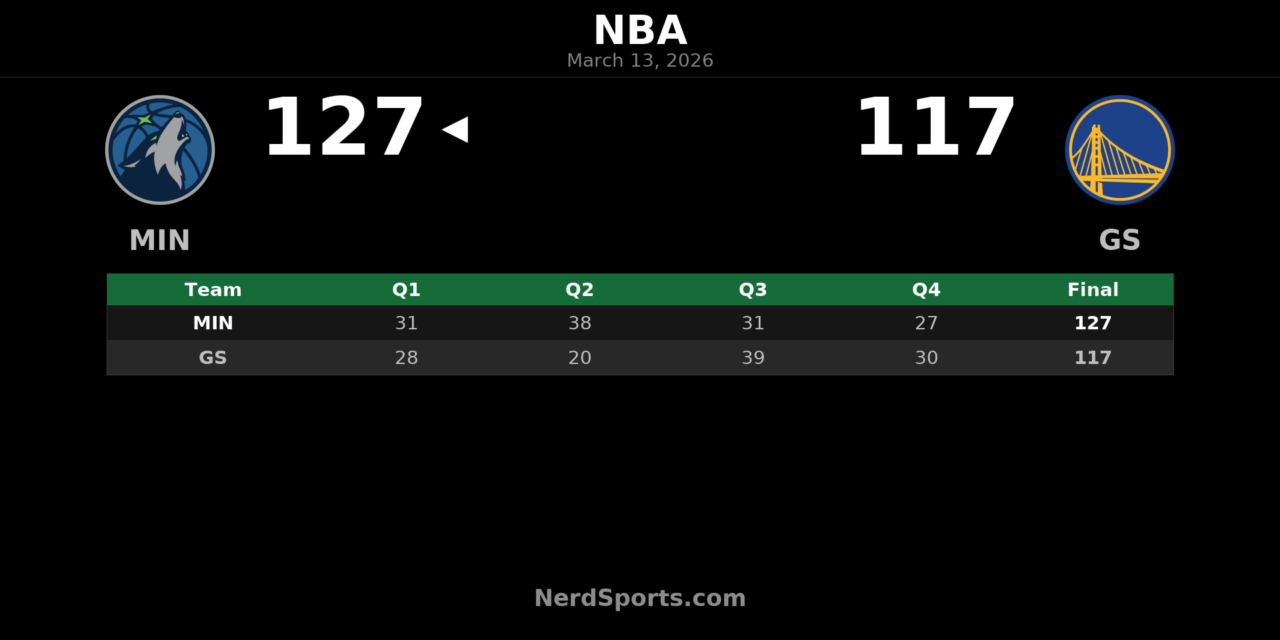
The Minnesota Timberwolves came away with a convincing 127-117 win over the Golden State Warriors at Chase Center in San Francisco on Friday night, March 13, 2026, improving to 41-26 on the season. Anthony Edwards was the driving force, delivering a standout 42-point performance that gave Golden State no answers for long stretches of the night. The Warriors, despite a spirited third-quarter rally, could not overcome a commanding second-quarter run that gave Minnesota a lead it would not relinquish.
Quarter-by-Quarter Breakdown
First Quarter: Timberwolves Draw First Blood — MIN 31, GS 28
Minnesota came out with purpose, outscoring Golden State 31-28 in the opening frame. The Timberwolves established an efficient offensive rhythm early, while the Warriors kept pace thanks to their own perimeter activity. It was a competitive start, but Minnesota’s edge hinted at what was to come.
Second Quarter: Minnesota Takes Control — MIN 38, GS 20
The second quarter was where the game shifted decisively. Minnesota outscored Golden State 38-20, building what became a substantial halftime cushion. The Warriors managed just 20 points in the period — their lowest output of the night by a significant margin — as the Timberwolves’ offense operated with remarkable efficiency. Minnesota entered the locker room up 69-48, a 21-point advantage that put the burden squarely on Golden State’s shoulders.
Third Quarter: Warriors Rally But Fall Short — MIN 31, GS 39
Golden State responded with its best quarter of the game, outscoring Minnesota 39-31 in the third period. The Warriors trimmed the deficit and gave the Chase Center crowd a reason to stay engaged. The rally showed Golden State’s resolve, but the margin remained too large to fully close in a single frame.
Fourth Quarter: Minnesota Holds Off the Warriors — MIN 27, GS 30
Golden State continued to push in the final quarter, outscoring Minnesota 30-27, but the Timberwolves were disciplined enough to protect the lead. Minnesota did not panic, worked the clock effectively, and held off the Warriors to secure the 127-117 final.
Key Performers
Anthony Edwards — Minnesota Timberwolves
Edwards was the undisputed centerpiece of Friday’s win. The Timberwolves guard led all scorers with 42 points and added 8 rebounds, finishing with a game-high rating of 68.8. His scoring came against a variety of defensive looks and set the tone for Minnesota’s overall offensive efficiency. On a night when Golden State needed stops, Edwards consistently delivered baskets in key moments.
Ayo Dosunmu — Minnesota Timberwolves
Dosunmu played an important complementary role, leading the Timberwolves with 7 assists. His ability to facilitate and keep the offense organized allowed Edwards to operate freely and helped Minnesota generate quality looks throughout the contest.
Rudy Gobert — Minnesota Timberwolves
Gobert contributed his usual steady presence, pacing Minnesota with 9 rebounds. His interior work helped the Timberwolves finish with a 45-38 rebounding advantage over Golden State, a statistic that spoke to Minnesota’s overall dominance in the paint.
Brandin Podziemski — Golden State Warriors
Podziemski was the clear standout for Golden State, recording 25 points and 10 rebounds for a double-double. He also distributed at a high level, and his 8 assists led the Warriors. For a team that struggled from the field — shooting just 39.8% overall on 98 attempts — Podziemski’s production was a genuine bright spot.
Gui Santos — Golden State Warriors
Santos contributed as a playmaker off the bench, recording 8 assists to tie Podziemski for the team lead in that category. His involvement kept Golden State’s ball movement functioning through difficult stretches.
Game Analysis
The box score tells a clear story: Minnesota was the superior team by nearly every meaningful measure on Friday night. The Timberwolves shot 56.1% from the field compared to Golden State’s 39.8%, a gap that proved insurmountable despite the Warriors’ three-point volume (48 attempts). Minnesota was more selective from deep, attempting just 30 threes while converting at a 40.0% clip — a stark contrast to Golden State’s 31.3% on 48 attempts.
The second quarter was the decisive stretch. Golden State’s offense went quiet at the wrong time, managing just 20 points while Minnesota applied consistent pressure on both ends. That 18-point halftime deficit forced the Warriors into a catch-up mode that their efficiency numbers could never fully support.
Golden State’s free-throw shooting was strong — 96.0% on 25 attempts — but it was not enough to compensate for the field-goal percentage gap. Minnesota also held the rebounding edge 45-38, which limited Golden State’s opportunities for second-chance points and helped the Timberwolves manage possessions in the second half when the Warriors were pushing hardest to close the gap.
For Minnesota, Friday’s performance reinforced why Anthony Edwards has developed into one of the most reliable offensive players in the league. His 42-point output was not the product of a high-volume, low-efficiency night — it was the result of a balanced attack that kept Golden State’s defense off balance throughout.
Standings and Implications
With the victory, the Minnesota Timberwolves improve to 41-26 on the season, strengthening their position in the Western Conference playoff picture. The Timberwolves also carry a 19-14 road record, making Friday’s result further evidence of their ability to perform away from Target Center.
For the Golden State Warriors, the loss drops them to 32-34 — a record that keeps them on the outer edge of playoff contention in the West. With a 19-15 home record, Chase Center has been a relative strength, but Friday’s result underscores the gap between Golden State and the conference’s upper tier. The Warriors will need to string together wins in the final weeks of the regular season to secure postseason positioning. Minnesota, meanwhile, continues to build momentum as one of the West’s most formidable teams.