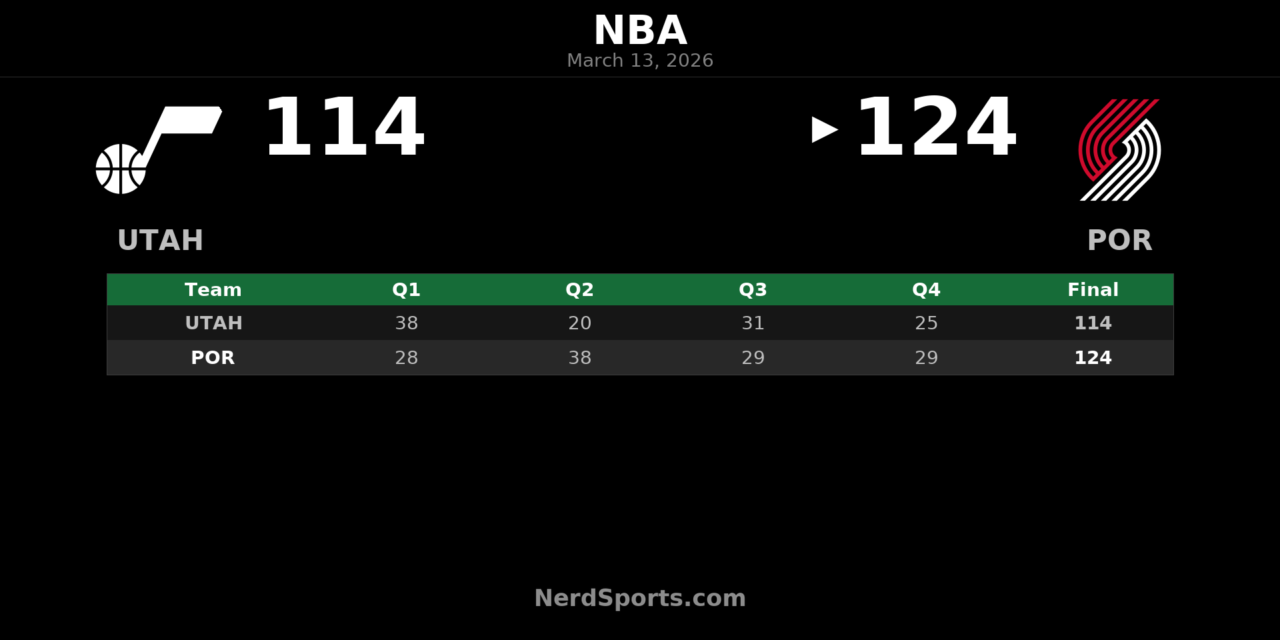
PORTLAND, Ore. — The Portland Trail Blazers came away with a 124-114 victory over the Utah Jazz on Friday night at Moda Center, rallying from a double-digit first-quarter deficit to secure their win before a crowd of 17,352. A dominant second quarter swung the game’s momentum firmly in Portland’s favor, and the Blazers held on through a competitive second half to improve to 32-35 on the season. Center Donovan Clingan was the engine of it all, delivering one of the more complete individual performances of his young career.
Quarter-by-Quarter Breakdown
First Quarter: Utah Takes Control Early
The Jazz came out with purpose in the opening period, outscoring Portland 38-28 and establishing a 10-point lead heading into the second quarter. Utah’s offense moved with efficiency and confidence, while the Blazers struggled to find consistent answers defensively. At the end of one, the Jazz looked fully in charge of the night’s proceedings.
Second Quarter: Portland’s Defining Stretch
The second quarter told an entirely different story. Portland responded with a 38-20 run over those twelve minutes, not only erasing the deficit but taking a lead into halftime. The Blazers tightened defensively, pushed the pace in transition, and connected from the perimeter to shift the scoreboard to 66-58 in their favor at the break. It was a decisive stretch that set the tone for the remainder of the game.
Third Quarter: Utah Pushes Back
The Jazz refused to fold in the third, outscoring Portland 31-29 and trimming the deficit to single digits. Utah’s offense regained some of its first-quarter rhythm, and the game appeared to be trending toward a tighter finish. Brice Sensabaugh remained a consistent offensive presence throughout, keeping the Jazz within striking distance.
Fourth Quarter: Portland Holds Firm
In the final twelve minutes, Portland outscored Utah 29-25 to close out the game and secure the 10-point win. The Blazers managed their possessions effectively, got to the free throw line when needed, and received timely contributions down the stretch. The Jazz had opportunities to make it a one-possession game but could not find the consistent stops necessary to complete the comeback.
Key Performers
Donovan Clingan, C — Portland Trail Blazers
Clingan was the clear standout of the evening, recording 21 points, 15 rebounds, and 7 blocks. His presence in the paint altered Utah’s interior offense throughout the night, and his rebounding gave Portland consistent second-chance opportunities. The 7-block performance was a statement on both ends of the floor from the young center, who earned the game’s top efficiency rating.
Jrue Holiday, G — Portland Trail Blazers
Holiday led all Portland scorers with 25 points, providing veteran steadiness at guard. His ability to find openings offensively and create opportunities for teammates was central to the Blazers’ second-quarter surge. Holiday’s experience and composure were evident in the fourth quarter as Portland worked to close out the win.
Deni Avdija, F — Portland Trail Blazers
Avdija led the game in assists with 8, serving as the connective tissue for Portland’s offense. His playmaking from the forward position added a dimension that kept the Jazz defense constantly shifting. Avdija’s eight dimes helped generate clean looks for teammates throughout the night.
Brice Sensabaugh, F — Utah Jazz
Sensabaugh was Utah’s brightest offensive performer, leading all scorers with 31 points. He was the Jazz’s primary source of offense and did much of the heavy lifting in keeping Utah competitive during the second half. Despite his individual output, Utah’s supporting cast could not provide enough consistent contributions to overcome Portland’s balanced attack.
Isaiah Collier, G — Utah Jazz
Collier distributed the ball effectively for Utah, finishing with a game-high 9 assists. He kept the Jazz offense organized and showed continued development as a playmaker, but Portland’s defense made it difficult for him to consistently create high-percentage opportunities for his teammates.
Game Analysis
This game was decided by team balance versus individual output. Portland’s 51.7% field goal percentage — compared to Utah’s 45.2% — reflected a more efficient offensive night overall, and the Blazers’ dominance on the glass (49 rebounds to Utah’s 36) gave them a significant edge in second-chance points. The 33 assists Portland recorded on 46 field goals made underscored how well the ball moved for the home team, particularly in that crucial second quarter.
Utah made things interesting in the second half, aided in part by strong three-point shooting (43.3% on 30 attempts), but Portland’s interior presence — specifically Clingan — consistently made the Jazz pay for drives to the rim. Clingan’s 7 blocks were not just a statistic; they established a physical presence that complicated Utah’s decision-making in the half-court throughout the night.
Portland did not lean heavily on free throws, attempting just 16 (making 15), but their efficiency from the field compensated. Utah’s 77.3% from the line on 22 attempts left some points on the table in a game ultimately decided by 10.
Standings and Context
With the win, Portland improves to 32-35 overall and 18-16 at home, keeping their playoff positioning conversation alive heading into the final stretch of the regular season. The Blazers’ home record suggests Moda Center has been a genuine advantage for them this year. For Utah, the loss pushes their record to 20-47 (8-25 on the road), a difficult result in what has been a challenging season for the Jazz. Portland’s next challenge will be to build on this performance and maintain momentum, while Utah will look to Sensabaugh’s continued development as a bright spot in the final weeks of 2025-26.