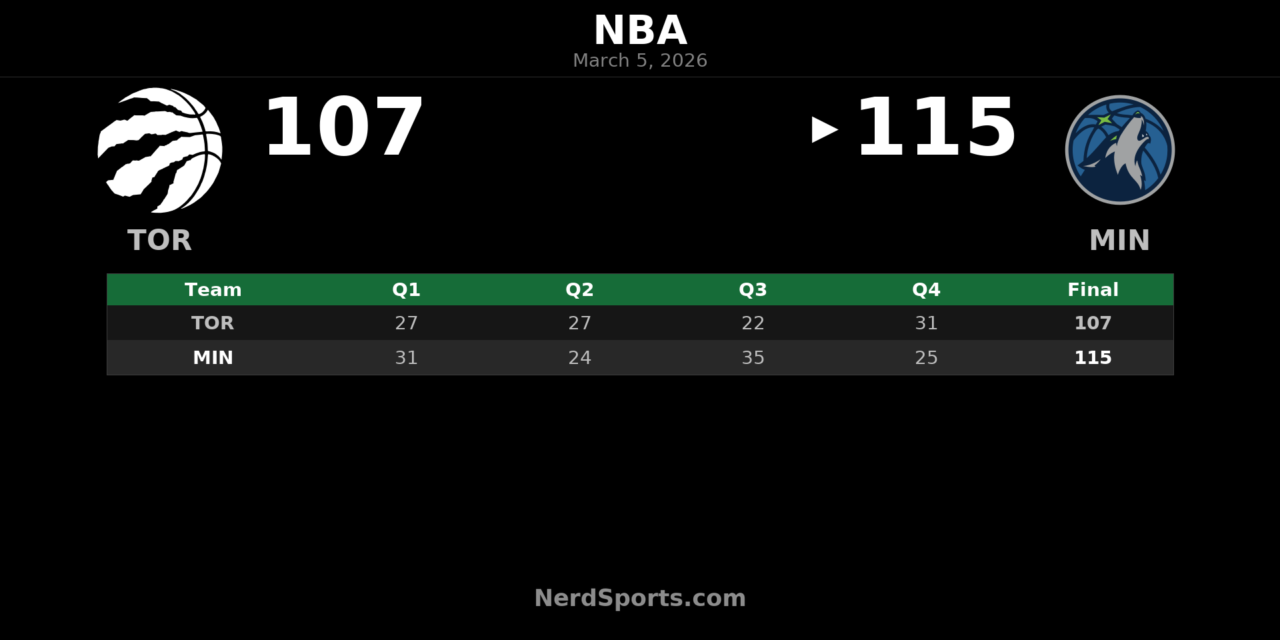
The Minnesota Timberwolves took control when it mattered most, delivering a strong third-quarter performance to pull away from the Toronto Raptors and come away with a 115-107 victory at Target Center on Thursday night. Before a crowd of 18,978, Minnesota outscored Toronto 35-22 in the third period to flip what had been a tight contest into a comfortable cushion, improving to 40-23 on the season with the win.
Quarter-by-Quarter Breakdown
First Quarter: Minnesota Takes Early Control
The Timberwolves set the tone from the opening tip, outpacing the Raptors 31-27 in the first quarter. Minnesota’s interior presence was evident early, as the Wolves pushed the pace and converted efficiently in the paint. Toronto hung around, getting contributions from their perimeter players, but Minnesota’s early lead gave the home team a foundation to build on.
Second Quarter: Raptors Respond and Level the Field
Toronto regrouped effectively in the second frame, outscoring Minnesota 27-24 to bring the halftime deficit down to just three points (55-54). The Raptors showed their resilience, spreading the ball well and generating quality looks on the offensive end. Immanuel Quickley’s playmaking kept the Toronto offense organized heading into the break, and the game looked very much like a toss-up through two quarters.
Third Quarter: Minnesota Seizes the Momentum
The third quarter was where Minnesota separated itself. The Timberwolves outscored Toronto 35-22 in a dominant 12-minute stretch, pushing their lead from three points at the half to a commanding 16-point advantage heading into the final frame. Rudy Gobert’s presence around the rim was a consistent factor, and Minnesota’s offense found its rhythm with precision ball movement and continued efficiency from the field.
Fourth Quarter: Toronto Makes a Push, Wolves Hold On
Credit the Raptors for refusing to fold. Toronto outscored Minnesota 31-25 in the fourth quarter, trimming the deficit and making things more interesting down the stretch. RJ Barrett led the charge for the visitors, keeping Toronto within reach late. Ultimately, though, Minnesota had enough in the tank to hold off the Raptors’ comeback attempt and secure the eight-point victory.
Key Performers
Rudy Gobert — Minnesota Timberwolves
Rudy Gobert was the standout performer of the night, earning game-high honors in the rating category with a line of 18 points, 12 rebounds, and 3 blocks. He also led all players in assists with 5 helpers, demonstrating an expanded offensive role. Gobert’s 12-rebound performance was critical in keeping Toronto off the boards, and his rim protection defined the tone of the game defensively.
Anthony Edwards — Minnesota Timberwolves
Anthony Edwards led all Minnesota scorers with 22 points, providing the offensive spark the Wolves needed in key moments. Edwards’ ability to create off the dribble and attack the basket kept the Raptors’ defense off-balance throughout the night. His scoring in the third quarter was particularly impactful as Minnesota built its decisive lead.
RJ Barrett — Toronto Raptors
RJ Barrett delivered the best individual effort for the Raptors, leading Toronto with 25 points and adding 6 rebounds. Barrett was especially active in the fourth quarter as Toronto worked to close the gap. His performance was a bright spot for a Raptors team that played hard until the final buzzer, though it ultimately was not enough to overcome Minnesota’s third-quarter advantage.
Immanuel Quickley — Toronto Raptors
Immanuel Quickley tied for the game lead in assists with 7, serving as the primary facilitator for the Raptors’ offense. His playmaking helped Toronto stay competitive through the first half and kept their offense moving in the second half as well. Quickley’s vision and decision-making were consistent bright spots for Toronto throughout the contest.
Game Analysis
This game came down to Minnesota’s third quarter, plain and simple. The Timberwolves shot 51.9 percent from the field for the game and connected on 13 of 31 three-point attempts (41.9%), displaying the kind of balanced offensive efficiency that makes them a difficult team to contain over a full 48 minutes. Their 24 assists on 42 made field goals pointed to a well-connected offensive unit that shared the ball effectively.
Toronto, for their part, was not far off statistically. The Raptors shot 50.0 percent from the field and hit 9 of 21 three-point attempts (42.9%), though the free throw line proved to be a point of difference — Toronto converted just 16 of 24 free throw attempts (66.7%) compared to Minnesota’s 18 of 23 (78.3%). In a game decided by eight points, those missed free throws were meaningful.
Gobert’s impact extended well beyond the box score. His positioning and physicality altered the Raptors’ approach in the paint, and his 12 rebounds helped ensure that Minnesota’s 41 total rebounds edged out Toronto’s 39. The Wolves controlled the glass just enough to complement their offensive efficiency.
Standings and Implications
With the win, the Minnesota Timberwolves improve to 40-23 overall, including a strong 22-11 mark at Target Center. They remain firmly positioned in the Western Conference playoff picture and continue to demonstrate the kind of complete, two-way basketball that makes them a genuine threat in the postseason. The Timberwolves are 18-12 on the road, underscoring their consistency regardless of venue.
The Toronto Raptors fall to 35-27 on the season but maintain a respectable 19-11 road record — a mark that speaks well of their competitive resilience away from home. Despite the loss, Toronto showed enough fight, particularly in the fourth quarter, to suggest they remain a dangerous team in the Eastern Conference playoff chase. Both teams will look to build on their respective strengths as the regular season continues to wind down.