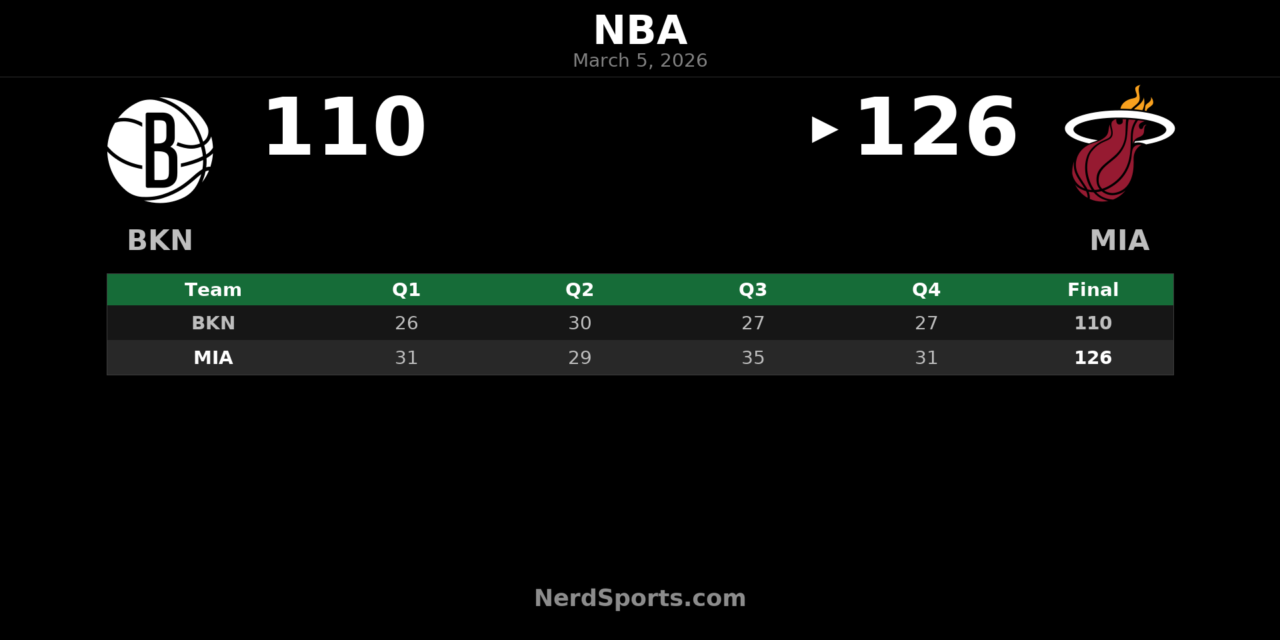
The Miami Heat came away with a convincing 126-110 victory over the visiting Brooklyn Nets on Thursday night at Kaseya Center, improving to 34-29 on the season. With a balanced offensive attack and an extraordinary defensive performance from center Kel’el Ware, Miami controlled the majority of the contest and never allowed Brooklyn to gain meaningful momentum after halftime. The win keeps the Heat firmly in the mix for postseason positioning in the Eastern Conference.
Quarter-by-Quarter Breakdown
First Quarter: Miami Sets the Tone Early
Miami wasted little time establishing its advantage at home, outscoring Brooklyn 31-26 in the opening frame. The Heat’s interior presence and ball movement gave the Nets early trouble, and Miami’s defense limited Brooklyn’s transition opportunities throughout the period. A five-point cushion after 12 minutes wasn’t commanding, but it signaled that the Heat were operating with purpose from the opening tip.
Second Quarter: Brooklyn Responds
Credit the Nets for rallying in the second quarter. Brooklyn outscored Miami 30-29 to trim the deficit and pull back within striking distance heading into halftime, with the Heat leading 60-56. Nolan Traore’s playmaking helped keep Brooklyn’s offense moving, and the Nets connected on several perimeter looks to stay competitive. It set up what appeared to be a potentially close second half.
Third Quarter: Heat Take Control
The third quarter was the turning point of the game. Miami outscored Brooklyn 35-27, its best offensive quarter of the night, to extend the lead to 95-83 entering the fourth. The Heat’s efficiency from the field in that stretch — combined with Ware’s presence in the paint on both ends — gave Miami a double-digit cushion that Brooklyn simply couldn’t recover from.
Fourth Quarter: Miami Holds Firm
With the lead well in hand, Miami maintained its composure down the stretch, outscoring the Nets 31-27 in the final period. Brooklyn continued to compete, but the gap was too wide. The final score of 126-110 reflected Miami’s consistent execution across 48 minutes.
Key Performers
Tyler Herro – Miami Heat
Tyler Herro led all Miami scorers with 25 points, providing the offensive punch the Heat needed at the guard position. Herro’s ability to create off the dribble and find his spots on the perimeter kept Brooklyn’s defense occupied throughout the night.
Kel’el Ware – Miami Heat
Ware was arguably the most impactful player on the floor, finishing with an eye-catching stat line of 16 points, 11 rebounds, 5 steals, and 7 blocks. The young center’s activity on the defensive end was a significant factor in limiting Brooklyn’s interior scoring, and his rebounding gave Miami additional possessions throughout the game. His performance earned him the top rating among all players in this contest.
Jaime Jaquez Jr. – Miami Heat
Jaime Jaquez Jr. led all players with 7 assists, serving as a connective force in Miami’s half-court offense. His ability to facilitate and find open teammates contributed directly to the Heat’s 29 total assists on the night, a reflection of the team’s fluid ball movement.
Michael Porter Jr. – Brooklyn Nets
Michael Porter Jr. delivered Brooklyn’s strongest individual performance, posting 27 points and 13 rebounds to lead the Nets in both categories. Porter was efficient and active, but Brooklyn couldn’t generate enough collective support around him to challenge Miami’s depth. He also earned the top player rating on the Nets’ side of the box score.
Nolan Traore – Brooklyn Nets
The young point guard Nolan Traore distributed the ball well for Brooklyn, finishing with a game-high 9 assists. Traore’s playmaking gave the Nets a functional offensive engine, though the team’s overall field goal shooting — 43.2 percent on 95 attempts — made it difficult to keep pace with a Miami squad that converted 52.7 percent of its field goal attempts.
Game Analysis
The field goal efficiency gap told much of the story in this one. Miami shot 52.7 percent from the field (48-of-91) compared to Brooklyn’s 43.2 percent (41-of-95). While the Nets actually attempted more three-pointers — 41 compared to Miami’s 27 — and connected at a higher rate (39.0 percent vs. 33.3 percent), their reliance on perimeter volume couldn’t offset the Heat’s advantage in the paint and at the free-throw line. Miami went 21-of-24 from the charity stripe at 87.5 percent, while Brooklyn converted just 12-of-18 attempts at 66.7 percent. That 9-point swing at the line proved consequential.
Ware’s defensive presence deserves particular attention. Seven blocks in a single game is an exceptional output for any player, and combined with five steals, his impact on Brooklyn’s shot selection was substantial. When a center can alter or contest shots with that frequency, it affects the entire defensive structure of the team around him.
Brooklyn’s 30 assists on 41 made field goals indicates the Nets moved the ball effectively — they simply couldn’t sustain the shooting efficiency needed to keep pace with a Miami team operating at a high level on both ends of the floor.
Standings and Implications
With the win, Miami improves to 34-29 overall and 20-11 at home, keeping the Heat well within the Eastern Conference playoff picture. Every game in March carries postseason weight, and a home victory over any opponent adds to that cushion. Brooklyn, meanwhile, falls to 15-47 on the year — a record that reflects the organization’s ongoing rebuild. The Nets now sit at 7-25 on the road, and with just over a quarter of the season remaining, their focus will increasingly shift toward player development and preparation for the upcoming offseason. For Miami, the message was clear: they remain a competitive, well-coached unit with the talent to outperform opponents in both halves of the game.