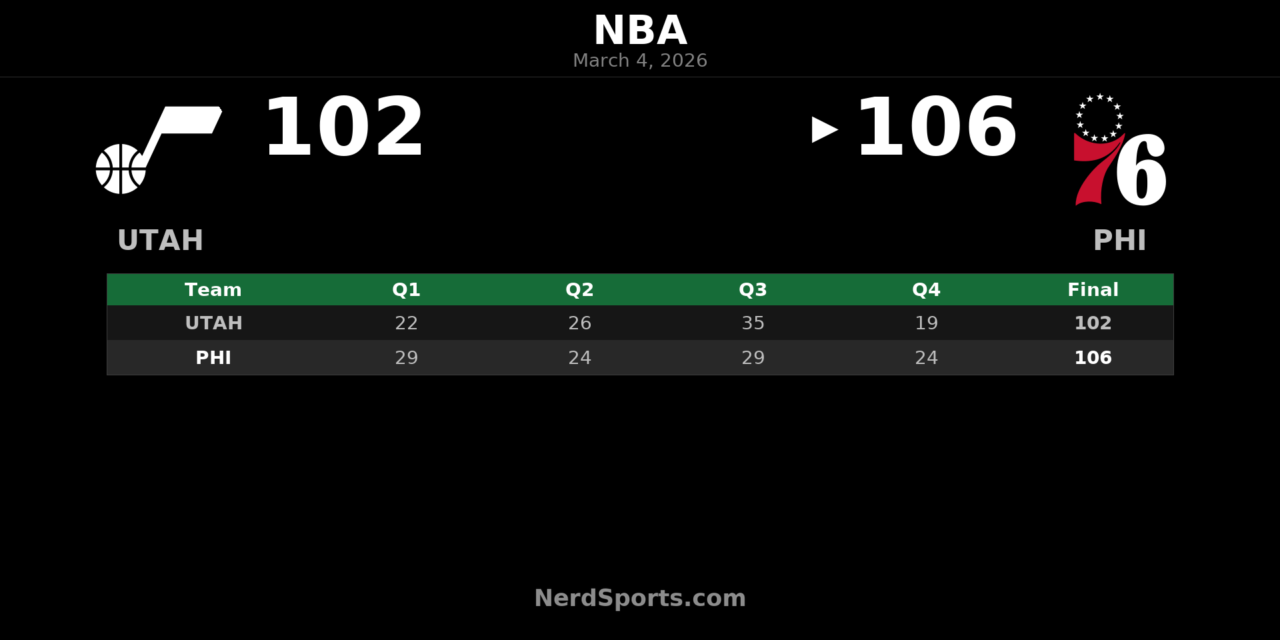
The Philadelphia 76ers came away with a hard-earned 106-102 victory over the Utah Jazz on Wednesday night at Xfinity Mobile Arena, improving to 34-28 on the season. It was not a clean wire-to-wire performance — Utah outscored Philadelphia in two of four quarters and took control of the third — but the 76ers steadied themselves in the final period, outscoring the Jazz 24-19 down the stretch to secure the four-point win in front of 18,386 fans.
Quarter-by-Quarter Breakdown
First Quarter: 76ers Take Early Control
Philadelphia set the tone early, outpacing Utah 29-22 in the opening period. The 76ers moved the ball effectively and established a seven-point advantage that gave the home crowd reason for early optimism. Utah struggled to find consistent offensive rhythm in the first 12 minutes, managing just 22 points on what would become a challenging shooting night overall.
Second Quarter: Jazz Cut Into the Lead
Utah responded in the second quarter, outscoring Philadelphia 26-24 to trim the deficit heading into halftime. The Jazz found better flow offensively, with their guards beginning to push the pace. Philadelphia led 53-48 at the break — a comfortable margin, but one that required attention given Utah’s second-quarter momentum.
Third Quarter: Jazz Take the Lead
The third quarter was Utah’s best stretch of basketball on the night. The Jazz outscored Philadelphia 35-29, taking the lead for the first time in the contest. Keyonte George was a driving force in that run, and Utah’s offensive energy was at its peak. Heading into the fourth, the Jazz held a narrow edge and appeared poised to pull away on the road.
Fourth Quarter: 76ers Reclaim Control
Philadelphia regrouped in the fourth and responded with a decisive 24-19 quarter to close out the game. The 76ers executed well in the half-court, earned trips to the free-throw line, and held Utah to just 19 points over the final 12 minutes. Maxey’s composure in the clutch proved to be the difference as Philadelphia took back the lead and did not relinquish it.
Key Performers
Tyrese Maxey — Philadelphia 76ers
Maxey led all 76ers scorers with 25 points and added 6 assists, serving as the primary offensive engine throughout the evening. His ability to create in the pick-and-roll and make decisions under pressure was central to Philadelphia’s fourth-quarter performance. Maxey also posted the team’s top assist total, reflecting his role as the primary playmaker.
Jabari Walker — Philadelphia 76ers
Walker delivered a standout performance on the boards, finishing with 22 points and 10 rebounds for a double-double. He led Philadelphia in both rebounds and overall game rating, providing consistent interior presence on both ends of the floor. Walker’s double-double gave the 76ers a reliable secondary option when Maxey faced defensive attention.
Keyonte George — Utah Jazz
George led all scorers on the night with 30 points, carrying Utah’s offense through stretches where the Jazz generated little from elsewhere. His third-quarter output was particularly significant in shifting the game’s momentum toward Utah. George’s 30-point effort was impressive, but the Jazz were unable to sustain that level of production as a team into the fourth quarter.
Kyle Filipowski — Utah Jazz
Filipowski led the Jazz on the glass with 11 rebounds, giving Utah a competitive showing in the rebounding department. The 76ers finished with 43 total boards to Utah’s 42, meaning the glass battle was nearly even — and Filipowski’s activity was a key reason why.
Game Analysis
This was a competitive, back-and-forth contest that came down to fourth-quarter execution. Philadelphia’s field goal percentage of 45.5% was meaningful but not dominant — the 76ers attempted 88 shots and converted 40, going 9-of-35 from three-point range (25.7%). The Jazz actually outperformed them from beyond the arc, shooting 30.8% on 39 attempts and making 12 threes. Where Philadelphia made up the difference was at the free-throw line and in points-per-possession efficiency in the final frame.
Utah shot a near-perfect 94.7% from the free-throw line (18-of-19), which speaks to their discipline at the stripe, but it was not enough to overcome Philadelphia’s fourth-quarter advantage. The Jazz’s 35-point third quarter was the high-water mark of their night, and when Philadelphia adjusted — forcing Utah into lower-efficiency possessions in the fourth — the home team was able to re-establish control.
Philadelphia’s 24 assists on 40 made field goals reflects a team that, at its best, moves the ball and creates open looks. Utah matched them with 22 assists, suggesting both teams were playing connected offensive basketball for much of the evening. The difference ultimately came down to which team executed better in the moments that mattered most.
Standings and Series Context
With the win, the Philadelphia 76ers move to 34-28 on the season, continuing to push for positioning in the Eastern Conference playoff race. Their home record sits at 17-16 while their road record is a strong 17-12, suggesting a team that has found ways to win in a variety of settings. For the Utah Jazz, the loss pushes their record to 18-44 — a difficult season that continues to reflect the challenges of a rebuilding roster. Utah falls to 7-23 on the road with the result. Despite the loss, Keyonte George’s 30-point performance offers a noteworthy data point in the development of one of the franchise’s young building blocks.