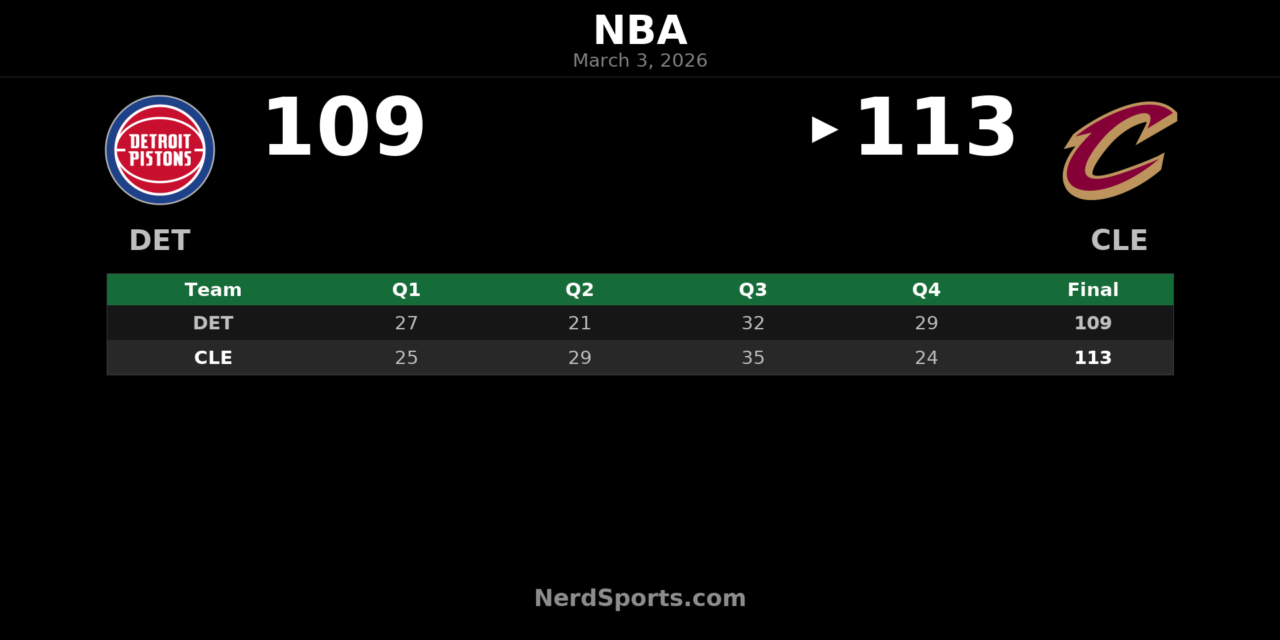
The Cleveland Cavaliers held off a persistent Detroit Pistons squad 113-109 on Tuesday night at Rocket Arena, improving to 39-24 on the season in a game that was competitive from wire to wire. Detroit, entering as one of the league’s elite teams at 45-15, put together a strong road performance but couldn’t quite overcome Cleveland’s second-quarter surge. Jaylon Tyson delivered a standout outing to pace the Cavaliers, while Jalen Duren and Cade Cunningham gave the Pistons every opportunity to come away with the road victory.
Quarter-by-Quarter Breakdown
First Quarter: Detroit Takes Early Control — DET 27, CLE 25
The Pistons set the tone early, outscoring the Cavaliers 27-25 in the opening frame. Detroit’s offense moved efficiently, and the road team held a slim two-point edge heading into the second quarter. Cleveland showed some resistance but was unable to fully contain Detroit’s rhythm through the first 12 minutes.
Second Quarter: Cavaliers Take Over — DET 21, CLE 29
Cleveland responded decisively in the second quarter, outscoring Detroit 29-21 to flip the script and take a 54-48 lead into halftime. The Cavaliers’ ball movement improved noticeably, and their perimeter shooting gave Detroit’s defense problems it hadn’t encountered in the first frame. That eight-point swing in the quarter proved pivotal to Cleveland’s overall margin.
Third Quarter: Both Offenses Deliver — DET 32, CLE 35
The third quarter was the highest-scoring period of the game, with Cleveland holding off Detroit’s push and outscoring the visitors 35-32. The Pistons made a concerted effort to reclaim the lead, and Duren was particularly active in the paint, but the Cavaliers responded each time Detroit began to close the gap. Cleveland carried a comfortable lead into the fourth.
Fourth Quarter: Pistons Make a Push — DET 29, CLE 24
Detroit outscored Cleveland 29-24 in the fourth quarter, making the final minutes tense. The Pistons narrowed what had been a more comfortable gap down to a four-point deficit, but Cleveland managed the clock and the possession battle well enough to protect the lead. When the final buzzer sounded, the Cavaliers had come away with a 113-109 victory.
Key Performers
Jaylon Tyson — Cleveland Cavaliers
Tyson led all Cavaliers scorers with 22 points and posted the team’s top efficiency rating on the night. The young guard was consistent throughout, providing Cleveland with reliable offense at key moments. His performance was a clear indicator of the depth the Cavaliers have developed over the course of this season.
James Harden — Cleveland Cavaliers
Harden directed the Cavaliers’ offense with precision, finishing with a team-high 7 assists. His ability to control tempo and make the right reads in the pick-and-roll kept Cleveland’s offense organized, particularly during the decisive second quarter run.
Craig Porter Jr. — Cleveland Cavaliers
Porter Jr. led all Cleveland players on the glass with 8 rebounds, giving the Cavaliers a steady interior presence and contributing to their overall rebounding effort across 48 minutes.
Jalen Duren — Detroit Pistons
Duren was the standout performer for Detroit, posting a double-double of 24 points and 14 rebounds — the top rebounding total of the night for either team. He was dominant in the paint and gave the Pistons a reliable interior anchor. Despite his exceptional individual outing, Detroit fell short as a unit.
Cade Cunningham — Detroit Pistons
Cunningham recorded a remarkable 14 assists to lead all players in that category on the night. His playmaking kept Detroit’s offense connected and created quality looks for teammates, though the Pistons ultimately could not convert at a high enough rate to overcome Cleveland’s advantage.
Game Analysis
From a statistical standpoint, Detroit actually shot the ball better from the field — posting a 50.6% field goal percentage compared to Cleveland’s 44.2%. The Pistons also held a significant rebounding advantage, pulling down 44 boards to Cleveland’s 38. On paper, those numbers tell a story that favors Detroit. What tilted the outcome in Cleveland’s favor was the Cavaliers’ volume from beyond the arc: they attempted 46 three-pointers and connected on 17 of them (37.0%), generating extra possessions worth than Detroit’s more paint-centric approach yielded. Detroit attempted just 24 threes, making 9.
The free throw line also played a role. Detroit attempted 29 free throws to Cleveland’s 26, with both teams shooting in the mid-to-upper 70% range. Neither team separated significantly at the stripe, making the three-point volume gap the clearest differentiator in the final margin.
Cleveland’s 27 assists on 38 made field goals reflected a team that shared the ball consistently throughout the night. Detroit also moved the ball well with 29 assists, but the Cavaliers’ ability to generate open looks from distance — and capitalize on them — proved to be the deciding factor in a game that was genuinely competitive from start to finish.
Standings and Series Implications
With the win, Cleveland improves to 39-24 overall and 21-11 at home at Rocket Arena. The Cavaliers continue to solidify their position in the Eastern Conference standings as the regular season approaches its final stretch. For Detroit, the loss drops them to 45-15 on the year — still an impressive mark and one of the best records in the league. The Pistons remain 21-8 on the road, demonstrating that this result was an outlier in an otherwise outstanding road campaign. Both teams figure to be significant factors in the Eastern Conference playoff picture, and Tuesday night’s four-point margin suggests any future postseason matchup between these two clubs would be well worth watching.