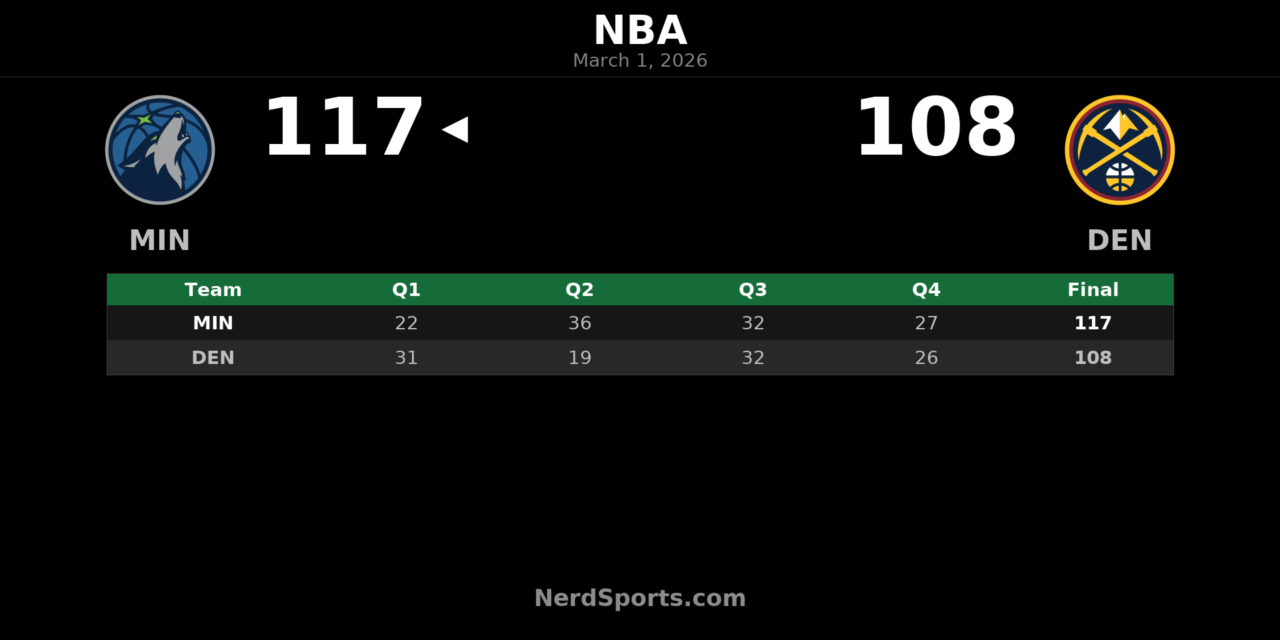
The Minnesota Timberwolves walked into Ball Arena on Sunday afternoon and left with a statement win. Despite being outscored 31-22 in the first quarter, Minnesota flipped the script with a scorching second period and held on for a 117-108 victory over the Denver Nuggets. Nikola Jokic delivered another near-triple-double — 35 points, 13 rebounds, and 9 assists — but it wasn’t enough to overcome a Timberwolves team that shot 54.1 percent from the field and connected on 14 three-pointers. The game, broadcast nationally on ABC, drew an attendance of 19,895 at Ball Arena.
Quarter-by-Quarter Breakdown
First Quarter: Denver Jumps Out Early (DEN 31, MIN 22)
The Nuggets came out sharp and set the tone quickly. Denver’s offense clicked from the opening tip, building a nine-point cushion by the end of the first twelve minutes. Jokic was a force early, operating efficiently in the post and in pick-and-roll situations. Minnesota struggled to find consistent offense and looked a step slow defensively, allowing Denver to dictate the pace.
Second Quarter: Minnesota’s Decisive Swing (MIN 36, DEN 19)
The Timberwolves’ second quarter was the story of the game. Minnesota outscored Denver 36-19 in the period — a 17-point swing that turned a nine-point deficit into an eight-point lead at halftime. The Wolves moved the ball with purpose, finishing the half with exceptional ball movement that translated into quality looks. Denver’s defense broke down repeatedly as Minnesota’s shooters caught fire from beyond the arc. By intermission, the Nuggets’ first-quarter cushion had completely evaporated.
Third Quarter: Teams Trade Blows (MIN 32, DEN 32)
Denver came out of the locker room with renewed energy and matched Minnesota stride-for-stride in the third quarter, with both teams scoring 32 points. Jokic continued to put pressure on the Wolves’ defense, and Denver’s supporting cast found some rhythm. However, Minnesota’s defense, anchored by Rudy Gobert inside, prevented the Nuggets from fully erasing the deficit. The Timberwolves entered the fourth quarter holding an eight-point advantage.
Fourth Quarter: Minnesota Holds On (MIN 27, DEN 26)
Denver made a push in the final period, outscoring Minnesota 26-27 in a competitive fourth quarter, but the Timberwolves were disciplined down the stretch. Minnesota managed the game clock effectively, executed in the half-court, and didn’t allow Denver to get close enough to threaten. The Nuggets, despite the heroic efforts of Jokic, couldn’t manufacture the stops necessary to mount a full comeback. Final score: Minnesota 117, Denver 108.
Key Performers
Nikola Jokic — Denver Nuggets (C)
In a losing effort, Nikola Jokic was once again the best player on the floor in terms of individual production. The three-time MVP finished with 35 points, 13 rebounds, and 9 assists — one assist shy of a triple-double. Jokic’s line speaks to his sheer dominance as an individual, but Denver needed more from the players around him. His supporting cast shot just 27.3 percent from three (6-of-22), and the team hit only 74.1 percent from the free-throw line on 27 attempts — factors that proved costly.
Anthony Edwards — Minnesota Timberwolves (G)
Anthony Edwards led the Timberwolves in scoring with 21 points and 6 assists, earning the game’s top rating on Minnesota’s side. Edwards provided timely buckets and kept the pressure on Denver’s perimeter defenders throughout the contest. His ability to create off the dribble opened up opportunities for teammates and helped fuel the game-changing second quarter.
Rudy Gobert — Minnesota Timberwolves (C)
Rudy Gobert was Minnesota’s engine on the boards, pulling down a game-high 15 rebounds. His interior presence gave the Timberwolves a significant edge in second-chance opportunities and served as a deterrent for Denver’s paint attacks. Gobert’s effort on the glass helped offset a free-throw performance that left points on the table — Minnesota shot just 57.9 percent (11-of-19) from the charity stripe.
Julius Randle — Minnesota Timberwolves (F)
Julius Randle quietly put together a strong floor-general performance, leading all players with 7 assists. His ability to operate from the elbow and find cutters and shooters kept Denver’s defense off-balance, particularly during that pivotal second quarter.
Game Analysis
The defining statistical story of this game was the three-point differential. Minnesota connected on 14-of-36 attempts (38.9%) from beyond the arc, while Denver managed just 6-of-22 (27.3%). That 28-18 edge in three-point scoring was the primary reason the Timberwolves were able to sustain their second-quarter momentum all the way through the final buzzer.
Minnesota’s ball movement was also a significant factor. The Timberwolves finished with 33 team assists compared to Denver’s 21 — a striking disparity that reflected how Minnesota created easy looks through ball rotation rather than forced isolation. Denver shot a respectable 48.2 percent from the field overall, but their three-point shooting troubles and an inability to generate clean looks in transition limited their ceiling.
Denver’s second-quarter defensive collapse is worth noting. Allowing 36 points in a single quarter against a disciplined half-court offense is not typical of Nuggets basketball, and it directly cost them the game. For all that Jokic accomplished on both ends of the floor, the Nuggets’ supporting cast simply didn’t provide enough complementary scoring or defensive resistance to keep Minnesota at bay.
Standings and Implications
With the win, the Minnesota Timberwolves improve to 38-23 on the season, strengthening their position in the Western Conference playoff picture. The Timberwolves are 18-12 on the road, showing they’re capable of winning in hostile environments — a critical quality heading into the postseason. Denver, meanwhile, falls to 37-24, remaining in the playoff hunt but absorbing a difficult home loss. The Nuggets will need to clean up their three-point shooting and provide Jokic with more help if they want to compete with teams of Minnesota’s caliber when the games matter most. Both franchises will look to regroup quickly in a Western Conference that continues to offer little margin for error.