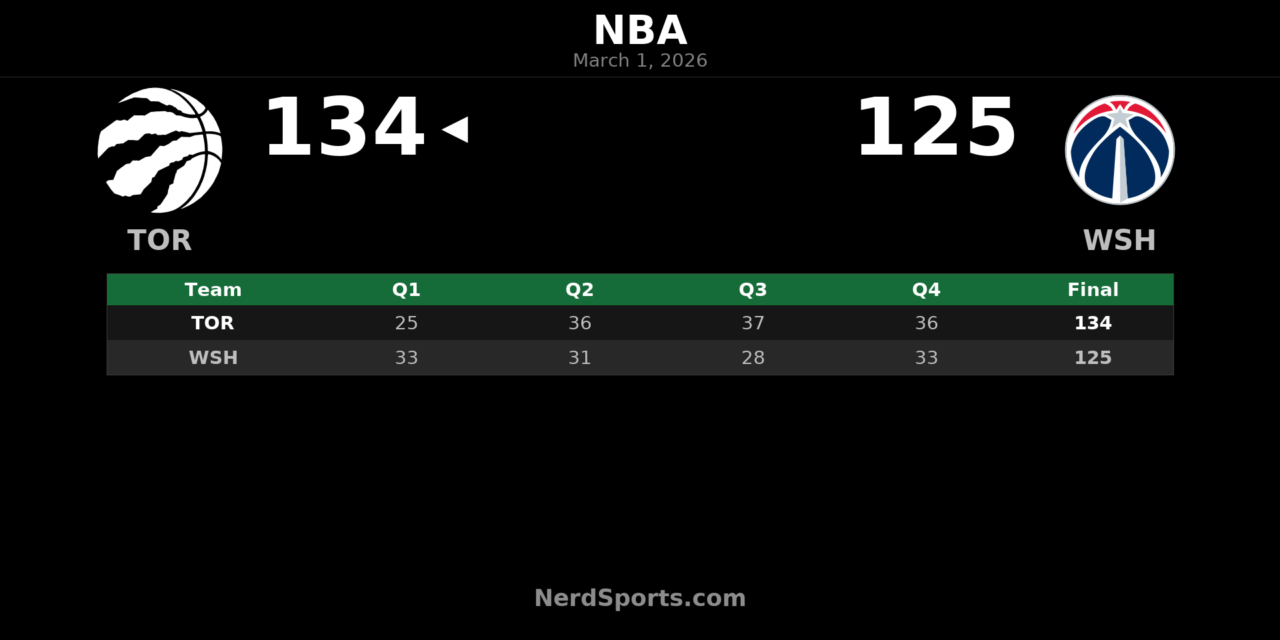
The Toronto Raptors arrived in Washington trailing early, but they left the nation’s capital with a convincing 134-125 victory over the Washington Wizards on March 1, 2026. After spotting the Wizards an eight-point first-quarter lead, Toronto flipped the script with three dominant quarters of basketball, outscoring Washington 109-92 over the final three periods to secure a road win that further solidifies their standing in the Eastern Conference playoff race. Immanuel Quickley was the engine behind the comeback, delivering one of the more complete performances of his season.
Quarter-by-Quarter Breakdown
First Quarter: Wizards Jump Out Early — TOR 25, WSH 33
Washington came out with purpose in the opening frame, outscoring Toronto 33-25 and setting an up-tempo tone at Capital One Arena. The Wizards’ ball movement was sharp and their three-point shooting was on from the jump. The Raptors struggled to find their offensive rhythm and were caught on the back foot defensively, giving up easy buckets in transition. It was a rare bright opening quarter for a Washington team that has found consistency hard to come by this season.
Second Quarter: Raptors Even the Ledger — TOR 36, WSH 31
Toronto responded in a significant way in the second quarter, outscoring the Wizards 36-31 to pull even by halftime. Quickley began to take command of the game, pushing the pace and finding open teammates with precise passes. The Raptors’ interior play improved as well, with Jakob Poeltl establishing a stronger presence around the rim. Washington still hung around, but the early energy that fueled their first-quarter burst had visibly faded.
Third Quarter: Toronto Takes Control — TOR 37, WSH 28
The third quarter was where the game was effectively decided. Toronto dropped 37 points in the period while holding Washington to just 28, building a lead that the Wizards would never seriously threaten to erase. The Raptors shot the ball efficiently, got to the free-throw line, and moved the ball with the kind of fluidity that made Washington’s defense look overmatched. Toronto’s collective assist total climbed steadily as the ball found open shooters and cutters with regularity.
Fourth Quarter: Raptors Close It Out — TOR 36, WSH 33
Washington showed some fight in the final frame, outscoring Toronto 33-36 in what was essentially a competitive but ultimately inconsequential quarter. The Wizards were not able to mount a serious challenge against a Raptors team that managed the clock and the game intelligently down the stretch. Toronto’s 36-point fourth quarter was a sign of confidence rather than complacency, as they kept the pedal down and never let Washington get within striking distance.
Key Performers
Immanuel Quickley, G — Toronto Raptors
Quickley was the clear standout performer on the night, finishing with a game-high 27 points and a game-high 11 assists. His ability to both score and create for others gave the Wizards’ defense no clean answer. He was the driving force behind Toronto’s second-quarter surge and never let Washington reestablish control. His rating of nearly 52.0 by ESPN’s measure was the best of any player on either team by a wide margin.
Jakob Poeltl, C — Toronto Raptors
Poeltl was a steady and important presence inside, pulling down a team-high 10 rebounds while providing the Raptors with reliable rim protection and post scoring. His double-digit rebound performance helped Toronto hold its own on the glass in a game where both teams finished tied at 35 boards apiece — a meaningful outcome given Washington’s home-court advantage.
Will Riley, G — Washington Wizards
For Washington, guard Will Riley led the team with 19 points and posted the Wizards’ best individual rating on the night. His effort was commendable and he showed flashes of the offensive skill that has made him an intriguing young piece for Washington’s rebuilding roster. He was the team’s most consistent offensive option throughout the game.
Bilal Coulibaly, G — Washington Wizards
Coulibaly led Washington in rebounds with five, contributing on the glass and flashing his defensive versatility. He remains one of the more promising young players on a Wizards team searching for an identity as they continue to rebuild.
Bub Carrington, G — Washington Wizards
Carrington paced the Wizards in assists with five, demonstrating his playmaking ability and willingness to involve teammates. His development as a facilitator has been one of the quiet storylines for Washington this season.
Game Analysis
The box score tells the story of two teams at very different points in their respective trajectories. Toronto’s 60.0 field goal percentage was exceptional and reflected a team that got to the spots it wanted, attacked mismatches confidently, and capitalized at the free-throw line — converting 23-of-27 attempts at an 85.2 percent clip. Washington, meanwhile, shot an impressive 53.4 percent from the field and went 16-of-34 from three-point range (47.1 percent), numbers that under normal circumstances would be enough to win most games. The difference came down to Toronto’s superior ball movement — the Raptors finished with 31 assists on 51 made field goals — and their ability to sustain that efficiency across all four quarters after the first.
Washington’s 23 assists on 47 made field goals is a respectable ratio, but the Wizards were outpaced at nearly every level once the first quarter ended. At 17,429 in attendance, Capital One Arena gave its home team reasonable support, but there was little the crowd could do as Toronto’s second and third quarter runs took the crowd out of the game.
Standings and Implications
With the win, the Toronto Raptors improve to 35-25 on the season, maintaining their position as a legitimate Eastern Conference playoff contender. Their road record of 19-10 is one of the better marks in the conference and speaks to a team that performs consistently regardless of venue. Washington, meanwhile, falls to 16-43, a record that reflects an ongoing rebuilding process. The Wizards’ 11-20 home record underscores the difficulties they have had protecting home court this season. For Toronto, every game between now and the end of the regular season carries real weight as they work to lock up a favorable playoff seeding. For Washington, the focus remains on player development and identifying the building blocks for future competitiveness.