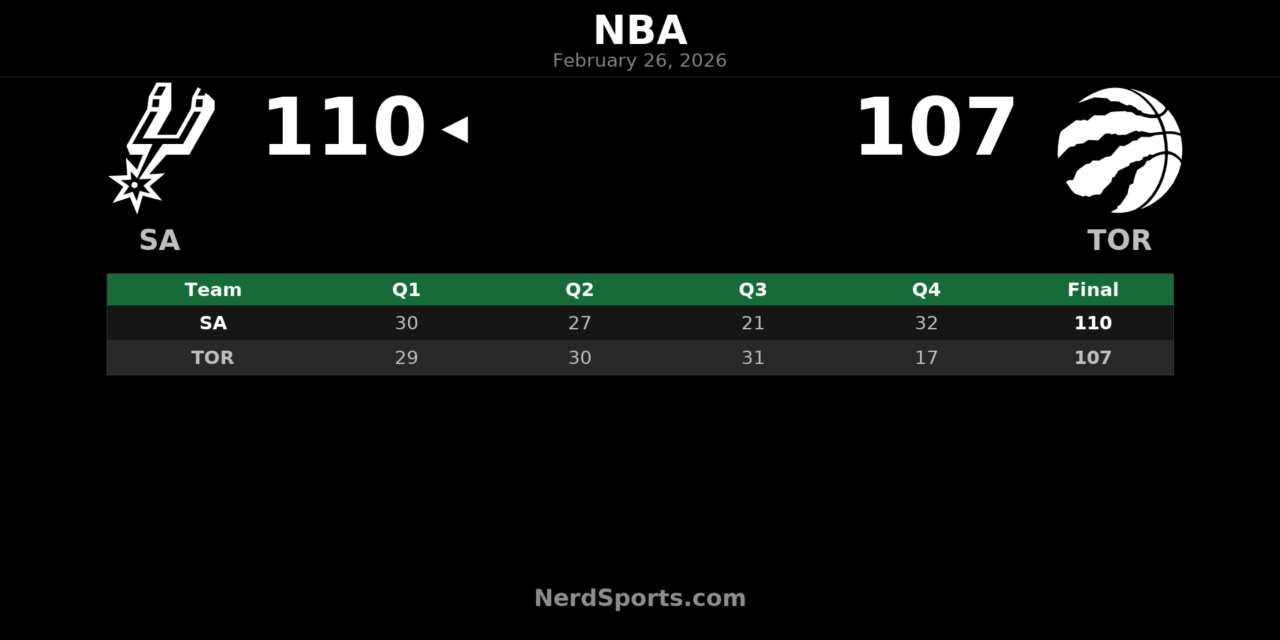
The San Antonio Spurs proved why they own the NBA’s best record on Wednesday night, engineering a stunning fourth-quarter comeback to defeat the Toronto Raptors 110-107 at Scotiabank Arena in front of 19,800 fans. Toronto controlled the middle two quarters and appeared poised to hand San Antonio a rare road loss, but the Spurs flipped the script with a dominant 32-17 final frame to escape Canada with a critical victory and improve to 42-16 on the season.
Quarter-by-Quarter Breakdown
Q1: Spurs Edge Out a Tight Open — SA 30, TOR 29
The game opened at a frenetic pace, with both offenses clicking from the jump. San Antonio pushed out to a one-point advantage after the first quarter, 30-29, powered by their perimeter attack. The Raptors kept it close thanks to solid interior play, setting the tone for what would be a competitive first half.
Q2: Raptors Flip the Script — SA 27, TOR 30
Toronto found its rhythm in the second quarter, outscoring San Antonio 30-27 to take a slim 59-57 lead into halftime. The Raptors’ defense tightened up, and their transition game began to generate easy looks. At the break, it felt like a genuine 50-50 contest with plenty of basketball left to play.
Q3: Toronto Surges Ahead — SA 21, TOR 31
The third quarter was the Raptors’ best stretch of the night and, ultimately, their undoing in terms of what came next. Toronto dominated the period 31-21, building what appeared to be a decisive advantage and heading into the fourth quarter with real momentum. Brandon Ingram was a force during this run, and Scotiabank Arena was buzzing with the prospect of an upset over the league-leading Spurs.
Q4: Spurs Close the Door — SA 32, TOR 17
Then came the fourth quarter. San Antonio flipped a switch and outscored Toronto 32-17 in the final 12 minutes — a swing of 15 points that turned a Raptors lead into a Spurs victory. The Spurs’ ball movement and three-point shooting were relentless down the stretch, and Toronto’s offense, so fluid in the third, stalled at the worst possible moment. San Antonio’s composure as a group was the defining factor in the closing minutes, as they converted enough key possessions to seal the 110-107 final.
Key Performers
Brandon Ingram — Toronto Raptors
Brandon Ingram delivered the most complete individual performance of the night, finishing as the statistical leader for both teams across multiple categories. The veteran forward recorded 20 points, 11 rebounds, and 4 assists, posting a double-double and logging the game’s top efficiency rating. Ingram was Toronto’s engine throughout, but even his efforts weren’t enough to hold off the fourth-quarter Spurs surge.
Devin Vassell — San Antonio Spurs
Devin Vassell led all scorers on the night with 21 points, earning game-high honors and the top efficiency rating among Spurs players. The guard was instrumental in San Antonio’s fourth-quarter push, providing the scoring punch the Spurs needed when it mattered most. Vassell’s ability to create and convert in high-leverage moments was a key reason this team sits atop the league standings.
Victor Wembanyama — San Antonio Spurs
Victor Wembanyama led all players on the floor with 8 rebounds, anchoring the Spurs’ interior defense and continuing to assert himself as one of the most impactful two-way players in the game. His rebounding presence was a stabilizing force, especially as San Antonio looked to protect the ball during their fourth-quarter run.
Dylan Harper — San Antonio Spurs
Rookie guard Dylan Harper was the engine of San Antonio’s offense from a playmaking standpoint, dishing out a game-high 7 assists. Harper’s ability to facilitate at a high level and keep the Spurs’ ball movement crisp contributed directly to their season-high 28 team assists on the night.
Game Analysis
The box score tells a story of two very different teams and two very different fourth quarters. Toronto was the better team for three quarters, outrebounding San Antonio 50-40 and getting to the free throw line more frequently (27 attempts to the Spurs’ 23). The Raptors also shot a respectable 85.2% from the charity stripe, converting 23 of 27.
But San Antonio’s three-point shooting was the decisive factor over the full 48 minutes. The Spurs connected on 17-of-39 from beyond the arc (43.6%), compared to Toronto’s more modest 8-of-23 (34.8%). That’s a nine three-pointer advantage that translated into a significant scoring edge, particularly in the fourth quarter when the Spurs’ shooters found their range at the exact moment Toronto’s defense was most vulnerable.
San Antonio’s 28 team assists on 40 made field goals highlighted their fluid, system-driven offense — nearly every made basket came with a helper. Toronto’s 17 assists on 38 makes suggests a heavier reliance on isolation and individual creation, which worked until the fourth quarter when the Spurs’ defensive attention began to wear on their shot-makers.
The Raptors will rue a fourth quarter where they managed just 17 points on what was likely a combination of shot selection breakdown and San Antonio’s ability to ramp up defensive intensity when the game was on the line. For a team sitting at 34-25, losses like this one — particularly at home — are difficult to absorb in the context of a tight playoff race.
Standings & Implications
With the victory, the San Antonio Spurs improve to 42-16, maintaining their grip on the top spot in their conference and cementing one of the most impressive records in the NBA this season. Their road mark of 21-10 underscores a team that wins anywhere and against anyone. For the Toronto Raptors, the loss drops them to 34-25, where maintaining their seeding position will require greater consistency down the stretch — particularly in their ability to close out games when they have a lead. Toronto’s road record of 18-10 remains solid, but at home (16-15), they continue to be a team that opponents view as vulnerable at Scotiabank Arena. The Raptors will need to solve their late-game execution issues if they want to compete with elite clubs come playoff time.