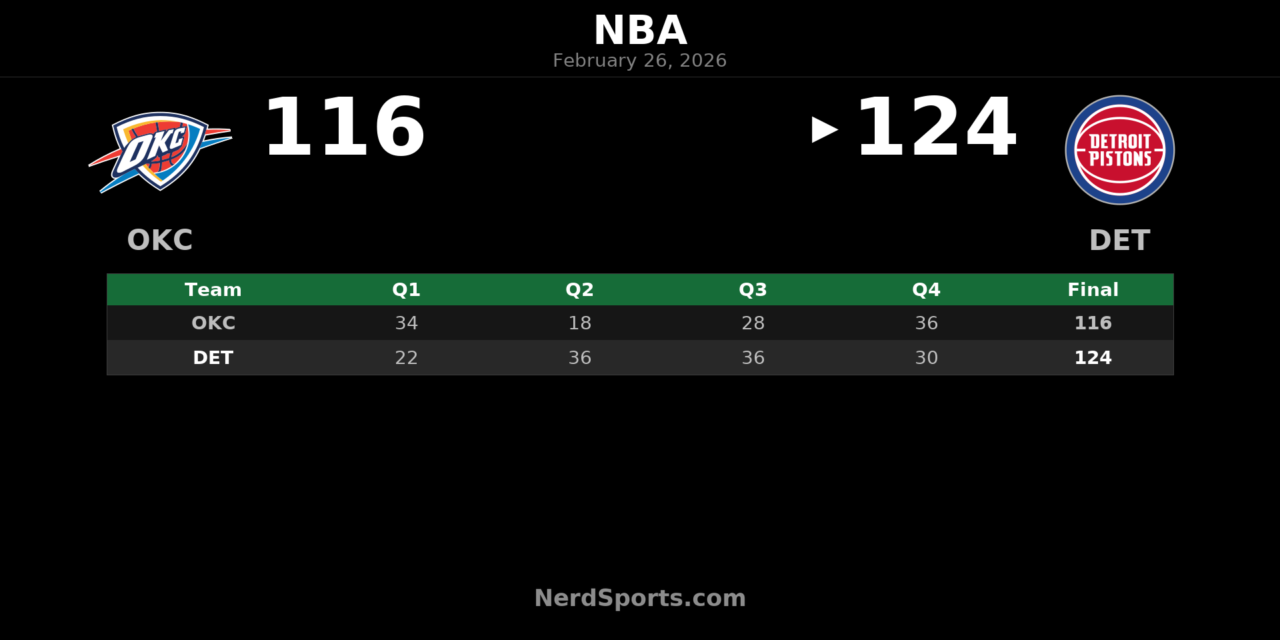
DETROIT — The Oklahoma City Thunder came into Little Caesars Arena on Wednesday night looking like they might run the Detroit Pistons off their own floor. They didn’t. Jalen Duren posted a dominant double-double and Cade Cunningham orchestrated the offense with surgical precision as the Detroit Pistons rallied from a 12-point first-quarter deficit to defeat the Thunder 124-116, improving to 43-14 on the season before a sold-out crowd of 20,062. It was a statement win for a Pistons squad that continues to prove it belongs among the NBA’s elite.
Quarter-by-Quarter Breakdown
Q1: OKC 34, DET 22 — Thunder Strike First
Oklahoma City came out of the gate on fire, building a 12-point lead after the first 12 minutes behind sharp three-point shooting. The Thunder attempted a high volume of threes throughout the night, and in the opening quarter those shots were falling. Detroit’s half-court defense was slow to adjust, and OKC’s ball movement made it difficult to contest looks consistently. The Pistons trailed 34-22 heading into the second quarter, facing an early hole that demanded an immediate response.
Q2: DET 36, OKC 18 — Detroit Flips the Script
The second quarter was all Pistons. Detroit outscored Oklahoma City 36-18 in the period — a jaw-dropping 18-point swing that completely reversed the game’s momentum. Detroit tightened defensively, forced OKC into difficult shot selections, and got out in transition. By halftime, the Pistons had turned a 12-point deficit into a 58-52 lead. It was a collective effort that showcased the team’s depth and resilience.
Q3: DET 36, OKC 28 — Pistons Extend the Lead
Detroit carried the momentum out of the locker room and continued to control the game in the third quarter, outscoring OKC 36-28 to push the lead into double digits. Duren was a force in the paint on both ends, and Cunningham kept the offense humming. Oklahoma City refused to fold and kept firing threes, but their conversion rate couldn’t keep pace with Detroit’s efficiency from the field. The Pistons led 94-80 heading into the final frame.
Q4: OKC 36, DET 30 — Thunder Make It Interesting
Oklahoma City mounted a fourth-quarter charge, outscoring Detroit 36-30 in the final period to make things uncomfortable late. The Thunder’s pressure and their ability to get to the free-throw line — where they shot an impressive 95.2% on the night — kept them in striking distance. But Detroit held firm when it mattered most, closing out the game without allowing OKC to close the gap entirely. The final score read 124-116, and the Pistons walked away with two crucial wins.
Key Performers
Jalen Duren, C — Detroit Pistons
Duren was the engine that powered Detroit’s comeback and controlled the interior all night. The young center led all scorers with 29 points and hauled in a game-high 15 rebounds, imposing his will on Oklahoma City’s frontcourt throughout the evening. His presence in the paint stretched OKC’s defense and created the kind of high-percentage looks that lifted Detroit’s field-goal percentage to 53.9% from the floor. It was the kind of performance that reinforces why Duren is one of the more impactful big men in the Eastern Conference.
Cade Cunningham, G — Detroit Pistons
Cunningham was the game’s top playmaker, finishing with 29 points, 13 assists, 3 steals, and 3 blocks — a stat line that earned him the highest game rating among all players. He orchestrated Detroit’s 36-point second quarter with composure and creativity, repeatedly finding open teammates and making the right reads out of ball-screen actions. His ability to affect the game in multiple phases — scoring, distributing, and defending — illustrates the all-around player he has grown into this season.
Jaylin Williams, F — Oklahoma City Thunder
In a losing effort, Jaylin Williams gave OKC everything it needed from its frontcourt. Williams paced the Thunder with 30 points and 11 rebounds, providing a double-double effort that kept Oklahoma City competitive through four quarters. His scoring and physicality were the bright spots in a night where OKC’s overall shooting efficiency from the field (40.6% on 96 attempts) ultimately proved insufficient against Detroit’s dominant paint presence.
Aaron Wiggins, G — Oklahoma City Thunder
Wiggins paced the Thunder in assists with 6 dimes, serving as a secondary playmaker for OKC. He was part of a Thunder offense that attempted 49 three-pointers on the night — an aggressive approach that produced 18 makes (36.7%) but couldn’t fully compensate for the team’s struggles inside the arc.
Game Analysis
This game came down to one defining contrast: interior dominance versus perimeter volume. Oklahoma City leaned heavily on three-point shooting, launching 49 attempts from beyond the arc — a total that reflects the Thunder’s offensive philosophy but also their difficulty generating efficient two-point looks against Detroit’s big men. Making 18 of those attempts is a solid rate, but the overall field-goal percentage of 40.6% on 96 shots simply couldn’t match Detroit’s 53.9% efficiency on 89 attempts.
Detroit’s rebounding advantage was equally decisive. The Pistons collected 52 boards compared to Oklahoma City’s 37 — a 15-rebound differential that translated directly into second-chance opportunities and fewer possessions for OKC. Duren’s 15 rebounds anchored that effort, and his ability to finish through contact helped Detroit convert at a high rate inside the paint.
The second quarter remains the story of this game. That 36-18 run didn’t happen by accident — it reflected Detroit’s ability to make halftime adjustments quickly and apply them in real time. The Pistons’ 29 team assists on 48 made field goals (a 60.4% assist rate) speaks to the ball movement and unselfishness that has defined this team’s identity throughout a remarkable season. OKC’s matching assist total (28) suggests both teams moved the ball well, but Detroit simply executed at a higher level in the middle two quarters when the game was decided.
The Thunder’s 95.2% free-throw shooting (20-of-21) was exceptional and helped them stay within striking distance during their fourth-quarter rally, but Detroit’s lead after three quarters — built on superior shot quality and relentless offensive rebounding — proved too large to fully overcome.
Standings and Implications
With the win, the Detroit Pistons improve to 43-14 overall, including a strong 23-7 at home and 20-7 on the road — one of the better road records in the league. This victory over a quality Western Conference opponent further solidifies Detroit’s standing as a legitimate championship contender in the Eastern Conference. For the Oklahoma City Thunder, the loss drops them to 45-15, still positioned near the top of the Western Conference standings. At 45 wins and counting, OKC remains a formidable force, but Wednesday’s performance — particularly the 40.6% shooting and the inability to contain Duren in the paint — will provide meaningful film study. Both teams have the talent and depth to go deep into the playoffs, and should they meet again in the postseason, this game will serve as a compelling preview of what that series might look like.