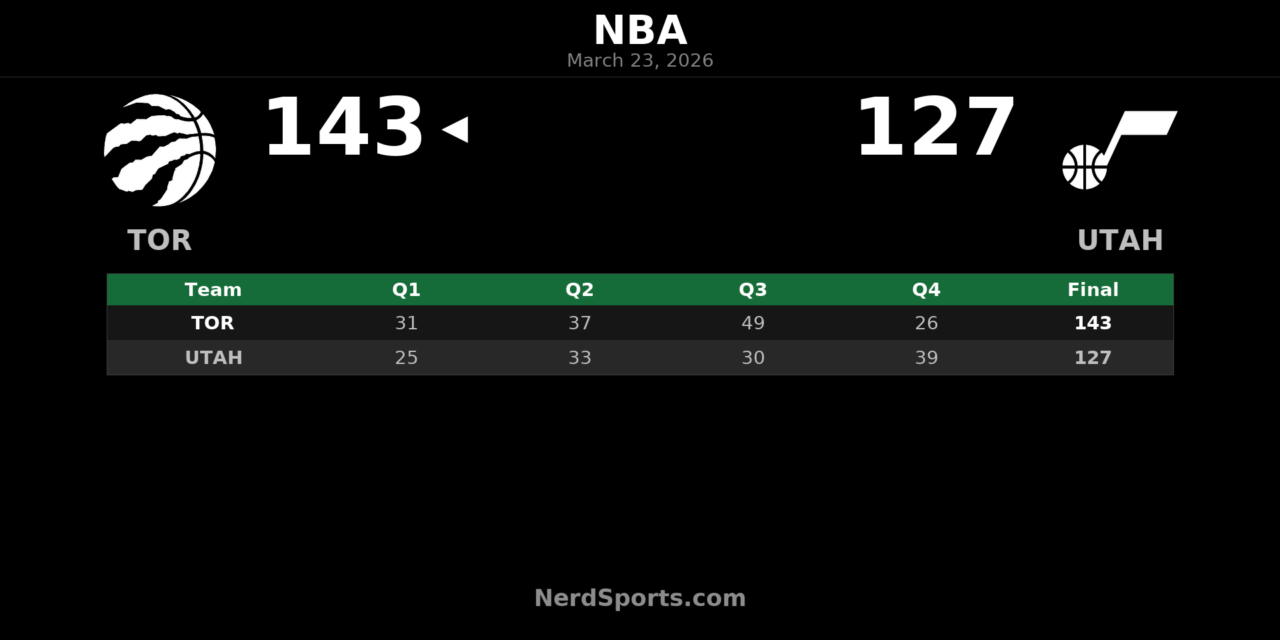
The Toronto Raptors came away with a 143-127 win over the Utah Jazz on Monday, March 23, 2026, at Delta Center in Salt Lake City, using a sharp offensive performance and a decisive third quarter to take control. Toronto led 68-58 at halftime before opening the second half with 49 points in the third, creating enough separation to hold off Utah’s late push. The Raptors improved to 40-31 with the road victory, while the Jazz dropped to 21-51.
Quarter-by-Quarter Breakdown
First Quarter: Toronto set the tone early by outscoring Utah 31-25 in the opening period. The Raptors moved the ball well from the start and found efficient looks, while the Jazz stayed within reach behind their own steady offense.
Second Quarter: Both teams continued to score in the second, but Toronto added slightly more separation with a 37-33 edge. That gave the Raptors a 68-58 halftime lead, with their offensive rhythm already showing in both the paint and from 3-point range.
Third Quarter: The game turned decisively in the third. Toronto put up 49 points in the period and outscored Utah 49-30, stretching the margin to 117-88 entering the fourth. The Raptors’ shot-making, pace, and passing overwhelmed the Jazz for much of the quarter, and that stretch ultimately decided the game.
Fourth Quarter: Utah responded with a stronger finish and won the fourth 39-26, but the deficit was too large to overcome. The Jazz continued to attack and get to the free throw line, while Toronto managed the closing minutes and secured the 16-point win.
Key Performers
Toronto Raptors:
RJ Barrett led Toronto with 27 points. Scottie Barnes delivered an all-around game with 20 points, 7 rebounds, and 10 assists, while Jamal Shead directed the offense with 15 assists. As a team, the Raptors shot 54-for-88 from the field (61.4%) and 20-for-37 from beyond the arc (54.1%), finishing with an impressive 49 assists on 54 made baskets.
Utah Jazz:
Ace Bailey led all scorers with 37 points and added 6 rebounds for Utah. Kyle Filipowski paced the Jazz on the glass with 8 rebounds, and Kennedy Chandler handed out 9 assists. Utah shot 47.0% from the field and made 13 3-pointers, while also generating offense at the free throw line by going 36-for-43.
Game Analysis
Toronto’s offensive efficiency was the defining factor. The Raptors consistently created quality shots, and their passing numbers reflected how well they operated throughout the night. Recording 49 assists is an exceptional total, and it aligned with the eye test: Toronto repeatedly moved the defense and found open shooters or cutters. The Raptors also made the most of their perimeter chances, hitting 20 3-pointers at a 54.1% clip.
Utah had productive individual performances and scored 127 points, which is usually enough to stay in contention. Bailey’s 37-point night stood out, and the Jazz were effective at drawing fouls and converting at the line. Still, the third quarter proved too costly. Allowing 49 points in a single period put Utah in a deep hole, even with a much better final quarter.
Another key number was overall shot efficiency. Toronto made 61.4% of its field goal attempts compared with Utah’s 47.0%, and that gap showed up most clearly during the middle stages of the game. Even though the Jazz finished with more rebounds and far more made free throws, Toronto’s combination of accuracy and playmaking gave it the edge from start to finish.
Closing Context
The result moved Toronto to 40-31, an important road win as the Raptors continue to strengthen their position in the Eastern Conference playoff race. For Utah, now 21-51, the game was another example of promising offensive moments being offset by defensive lapses, especially in a game-changing third quarter. With the regular season winding down, both teams will be watching how performances like this shape their final stretch and postseason outlook.