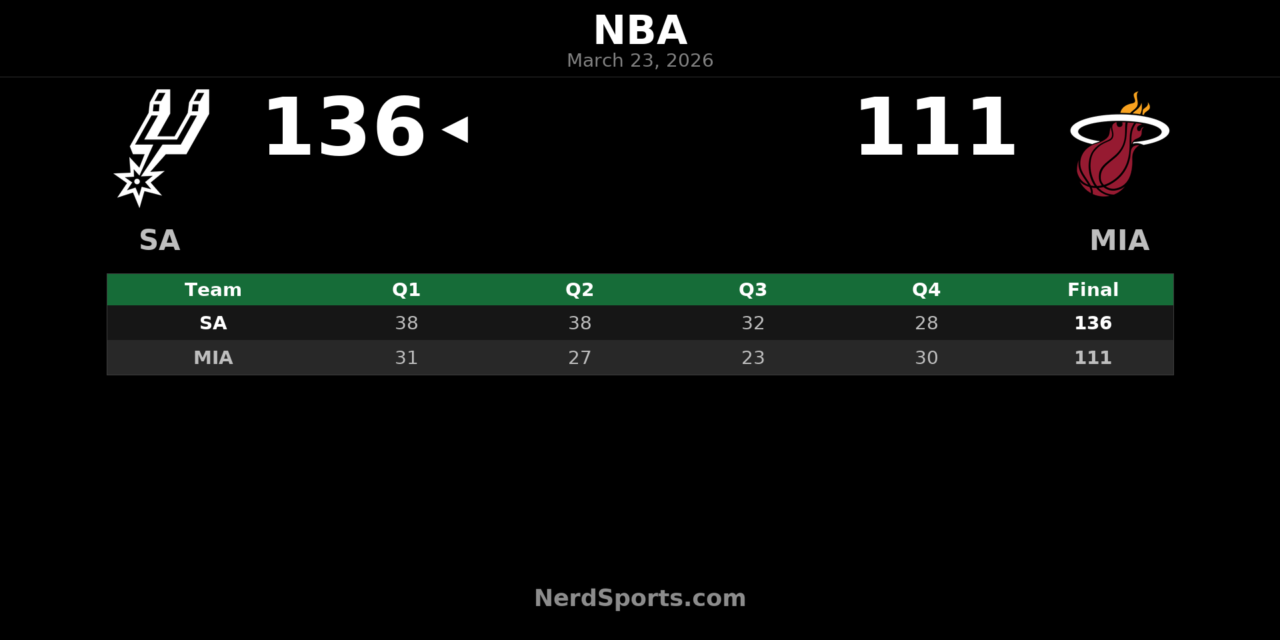
The San Antonio Spurs continued their strong late-season form on Monday night, coming away with a 136-111 road win over the Miami Heat at Kaseya Center. San Antonio set the tone with 38 points in each of the first two quarters, built a 76-58 halftime lead, and stayed in control the rest of the way. Victor Wembanyama led the Spurs with 26 points and 15 rebounds, while San Antonio’s balance, rebounding edge, and steady shot-making proved too much for Miami to overcome.
Quarter-by-Quarter Breakdown
First Quarter: San Antonio opened the game with pace and efficiency, putting up 38 points in the opening 12 minutes. Miami kept up for stretches and scored 31 of its own, but the Spurs were sharper offensively from the start and carried a 38-31 lead into the second quarter.
Second Quarter: The game shifted more clearly in San Antonio’s favor before halftime. The Spurs matched their first-quarter output with another 38-point period, while Miami managed 27. That gave San Antonio a 76-58 advantage at the break, with the visitors consistently creating second-chance opportunities and moving the ball well in the half court.
Third Quarter: Any chance of a Miami push was limited in the third. San Antonio outscored the Heat 32-23 in the quarter, stretching the margin to 108-81 heading into the fourth. The Spurs continued to control the glass and generate quality looks, while Miami struggled to string together stops.
Fourth Quarter: The Heat edged the final period 30-28, but the result was already well in hand. Miami showed some late offensive life, yet San Antonio remained composed and closed out a complete road performance to finish with 136 points.
Key Performers
San Antonio Spurs:
Victor Wembanyama delivered another standout performance with 26 points, 15 rebounds, and 5 blocks, leading San Antonio on both ends of the floor. Dylan Harper paced the playmaking effort with 6 assists as the Spurs finished with 33 assists as a team. Overall, San Antonio shot 47.5 percent from the field, hit 15 three-pointers, and added 25 made free throws.
Miami Heat:
Norman Powell led Miami with 21 points, while Tyler Herro added 18 points. Jaime Jaquez Jr. led the Heat with 6 assists, and Kel’el Ware pulled down a team-high 7 rebounds. Miami made 16 threes and shot an excellent 95.0 percent from the free-throw line, but the Heat were held to 40.4 percent shooting overall and were unable to keep pace after halftime.
Game Analysis
The biggest statistical difference came on the glass. San Antonio finished with a commanding 62-37 rebounding advantage, which helped create extra possessions and limited Miami’s opportunities to build momentum. That edge was especially important because the Heat were active from long range, attempting 50 three-pointers and making 16, but the Spurs consistently answered with efficient offense and control of the paint.
Ball movement was another major factor. San Antonio recorded 33 assists on 48 made field goals, a strong reflection of how comfortably the offense operated throughout the night. The Spurs were productive in every quarter, scoring 38, 38, and 32 points across the first three periods to gradually pull away. Miami had moments of offensive rhythm, but the Heat could not generate enough stops or secure enough defensive rebounds to turn the game into a competitive finish.
For the Heat, the shooting numbers tell part of the story. Miami attempted 94 shots and 50 three-pointers, but the 40.4 percent mark from the floor and the large rebounding deficit made it difficult to stay within striking distance. San Antonio’s size, activity, and overall execution gave the visitors control early and helped them maintain it for all 48 minutes.
Closing Context
The win moved San Antonio to 54-18 overall and 26-11 on the road, another strong result for one of the league’s top teams as the regular season moves toward its final stretch. Miami dropped to 38-34 and 23-14 at home, a result that adds pressure in the Eastern Conference playoff race. For the Spurs, this was another example of a team playing with consistency on both ends. For the Heat, the focus now shifts to responding quickly after a game in which they were outperformed in the areas that mattered most.