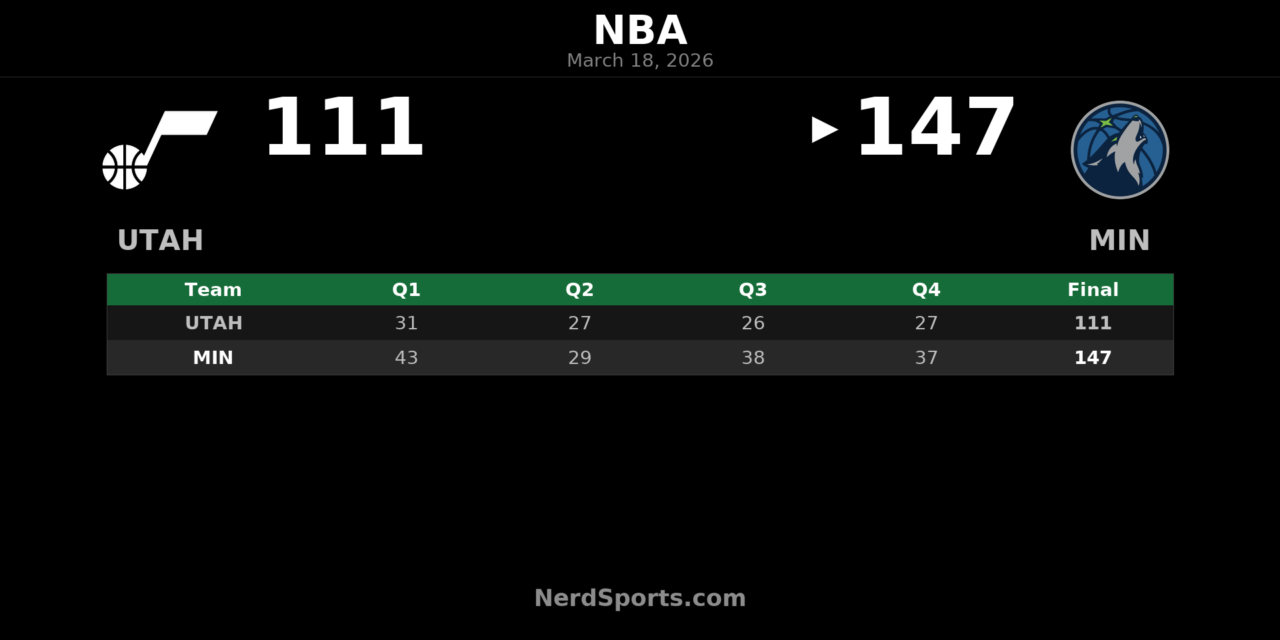
The Minnesota Timberwolves delivered a fast, efficient offensive performance on Wednesday night in Minneapolis, pulling away for a 147-111 win over the Utah Jazz at Target Center. Minnesota scored 43 points in the opening quarter, stayed in control through halftime, and widened the gap with a strong second half to improve to 43-27. Utah dropped to 20-49 despite a big scoring night from Brice Sensabaugh.
Quarter-by-quarter breakdown
First quarter: Both teams came out scoring, but Minnesota immediately set the pace. The Timberwolves put up 43 points in the opening 12 minutes while shooting with confidence and moving the ball cleanly. Utah stayed reasonably close behind 31 first-quarter points, yet Minnesota’s early rhythm gave the home side a 43-31 edge after one.
Second quarter: The Jazz found a little more stability offensively and matched stretches of Minnesota’s production, but the Timberwolves continued to create quality looks. Minnesota added 29 points in the quarter to Utah’s 27, pushing the halftime lead to 72-58. It was not a runaway yet, but the Timberwolves had firm control with their shot-making and passing.
Third quarter: Minnesota created the separation coming out of the break. The Timberwolves outscored Utah 38-26 in the third, turning a 14-point halftime margin into a 26-point lead entering the fourth. That stretch reflected the overall difference in the game: Minnesota generated efficient offense on one end and prevented Utah from building any sustained momentum on the other.
Fourth quarter: Any chance of a Utah rally disappeared quickly. Minnesota kept its foot on the pace and won the final quarter 37-27, closing out a 36-point result. Even with Sensabaugh continuing to score for Utah, the Timberwolves’ depth and ball movement were too much over the full 48 minutes.
Key performers
Minnesota Timberwolves:
Ayo Dosunmu led Minnesota with 23 points and added nine rebounds, six assists, and three steals in a highly efficient all-around performance. Rudy Gobert controlled the glass with 12 rebounds, while Julius Randle led the team with eight assists as Minnesota consistently found open shooters and cutters. The Timberwolves did not rely on one dominant scorer; instead, they spread the production across the lineup and kept pressure on Utah’s defense throughout the night.
Utah Jazz:
Brice Sensabaugh was the clear standout for Utah, leading all scorers with 41 points. He kept the Jazz offense moving for long stretches and was the main reason Utah remained competitive early. Andersson Garcia led the Jazz with eight rebounds, and Isaiah Collier finished with six assists, but Utah could not match Minnesota’s efficiency across the roster.
Game analysis
This game was decided by Minnesota’s offensive execution and overall balance. The Timberwolves shot 52-for-96 from the field, good for 54.2%, and hit 18-of-39 from three-point range, a 46.2% clip. They also moved the ball at a high level, finishing with 39 assists on 52 made field goals. That combination made it difficult for Utah to slow any one action because Minnesota had answers from multiple spots on the floor.
Utah’s offense had one major bright spot in Sensabaugh’s 41 points, but the team numbers were much tougher to overcome. The Jazz shot 43.0% overall, 33.3% from three, and 69.2% at the free-throw line. Even though both teams finished with 46 rebounds, Minnesota made far more of its possessions count because of superior shooting, cleaner playmaking, and stronger finishing from beyond the arc.
The quarter scoring also underlined Minnesota’s consistency. The Timberwolves scored at least 29 points in every quarter and reached 37 or more in three of the four periods. That steady output prevented Utah from making any meaningful push after halftime and allowed Minnesota to steadily expand the margin.
Closing context
The win moves Minnesota to 43-27 and strengthens its position in the Western Conference playoff race as the regular season continues to tighten. For Utah, now 20-49, the result reflected the challenge of keeping up with a playoff-level offense for four quarters, even on a night when Sensabaugh delivered one of the best individual scoring efforts of the game. If these teams meet again, the Jazz will look for more defensive resistance, while the Timberwolves will aim to carry this offensive rhythm into the next stretch of the schedule.