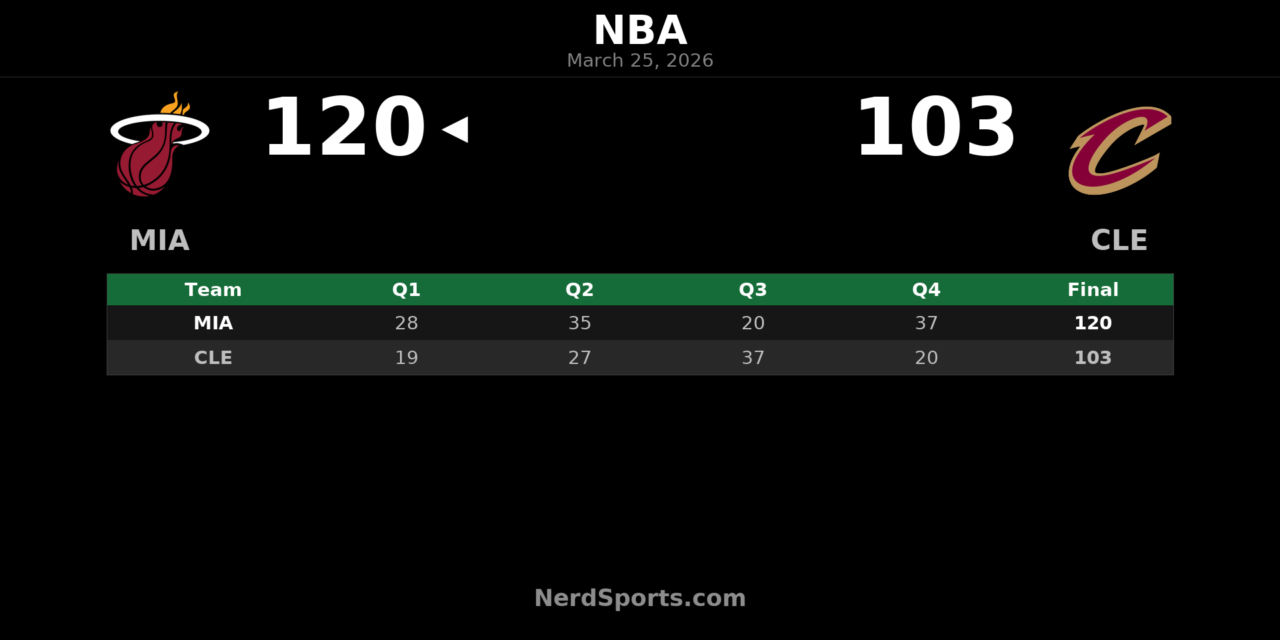
The Miami Heat came away with a 120-103 win over the Cleveland Cavaliers at Rocket Arena on Wednesday, March 25, using an efficient offensive night and a strong closing push to secure an important road result. Miami built a 17-point halftime lead, absorbed Cleveland’s third-quarter rally, and then took control again in the final period behind sharp ball movement, timely perimeter shooting, and steady production across the lineup.
Quarter-by-quarter breakdown
First quarter: Heat 28, Cavaliers 19
Miami set the tone early by outscoring Cleveland 28-19 in the opening quarter. The Heat generated quality looks, moved the ball well, and limited the Cavaliers’ rhythm on the other end. Cleveland struggled to find consistent efficiency in the period, and Miami’s early edge gave the visitors a solid starting point.
Second quarter: Heat 35, Cavaliers 27
The Heat expanded their lead before halftime with a 35-point second quarter. Miami continued to execute offensively, mixing interior scoring with perimeter shooting, while Cleveland had trouble stringing together stops. By the break, the Heat held a 63-46 advantage after shooting with confidence and keeping the Cavaliers on the back foot.
Third quarter: Cavaliers 37, Heat 20
Cleveland responded with its best stretch of the night in the third. The Cavaliers outscored Miami 37-20 in the quarter, with Donovan Mitchell leading the charge and the home crowd back in the game. Cleveland tightened its play at both ends, cut into the deficit quickly, and turned what had looked like a one-sided contest into a competitive game entering the fourth.
Fourth quarter: Heat 37, Cavaliers 20
Any momentum Cleveland built in the third was short-lived. Miami answered with its strongest closing period, outscoring the Cavaliers 37-20 in the fourth to pull away. The Heat regained control through efficient half-court execution, extra passes that led to open shots, and a composed finish that prevented Cleveland from making another serious push.
Key performers
Miami Heat
Norman Powell led Miami with 19 points, setting the pace in a balanced scoring effort. Kel’el Ware added 13 points and a team-high 11 rebounds for a double-double, while Bam Adebayo finished with a team-best seven assists and helped organize the offense. The Heat’s overall production stood out as much as any one individual performance, with 42 made field goals and 31 assists reflecting how well the group functioned together.
Cleveland Cavaliers
Donovan Mitchell led all scorers with 28 points and added six rebounds, carrying much of Cleveland’s offensive load. James Harden contributed nine rebounds and seven assists, helping initiate offense and keep possessions moving. Still, the Cavaliers shot 43.2% from the field and 32.4% from three-point range, numbers that made it difficult to complete the comeback after the big first-half deficit.
Game analysis
Miami’s offensive efficiency was the clearest difference in the game. The Heat shot 51.9% from the field, knocked down 18 of 45 attempts from three-point range, and matched that shot-making with strong distribution throughout the night. Their 31 assists on 42 made baskets highlighted a connected approach that consistently produced quality scoring opportunities.
Cleveland matched Miami on the glass at 40 rebounds apiece and showed real resilience in the third quarter, but the Cavaliers could not maintain that level over the full 48 minutes. The early 63 points allowed in the first half put them in a difficult position, and after investing energy in the comeback effort, they were unable to keep Miami from separating again in the fourth.
The fourth quarter underscored Miami’s control. After being outperformed in the third, the Heat quickly stabilized, executed cleanly, and closed the game with a 17-point final margin. Cleveland’s offense, which had surged in the third, slowed again in the closing period, while Miami’s spacing and decision-making remained steady.
Closing context
The win moved Miami to 39-34 on the season and gave the Heat a valuable road result as the Eastern Conference race continues to tighten late in March. Cleveland dropped to 45-28, and while the Cavaliers remain in a strong position in the standings, this was a missed opportunity at home after their third-quarter rally. With both teams in postseason positioning mode, Wednesday’s result added weight to the final stretch of the regular season.