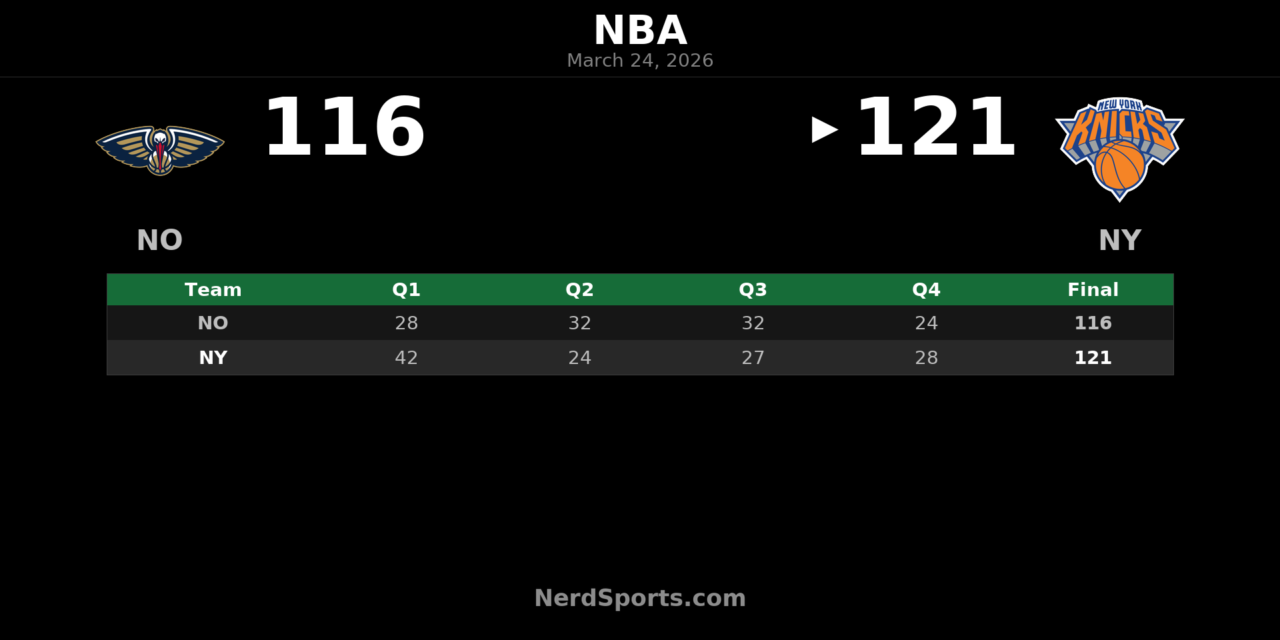
The New York Knicks came away with a 121-116 win over the New Orleans Pelicans on Tuesday, March 24, at Madison Square Garden, using a fast start and steady late execution to close out a competitive game. New York opened with a 42-point first quarter, gave back part of that cushion over the middle two periods, and then responded in the final minutes behind Jalen Brunson’s shot creation and a balanced offensive effort.
Quarter-by-quarter breakdown
First Quarter: The Knicks took control early with one of their best offensive stretches of the night, outscoring the Pelicans 42-28 in the opening period. New York moved the ball well, shot efficiently, and consistently found quality looks in both the half court and transition. That 14-point edge gave the home team immediate momentum and set the tone for the rest of the evening.
Second Quarter: New Orleans settled in and answered with a 32-24 quarter. The Pelicans tightened up offensively, shot the ball with confidence, and trimmed the deficit before halftime. Even with the push from the visitors, the Knicks carried a 66-60 lead into the break after doing enough to avoid letting the early advantage disappear completely.
Third Quarter: The Pelicans kept pressing after halftime and again outscored New York 32-27 in the third. Their offense remained productive, particularly from the perimeter, and they continued to chip away at the Knicks’ lead. By the end of the quarter, what had once been a double-digit New York margin had been reduced to a 93-92 game, setting up a close finish.
Fourth Quarter: In the final period, the Knicks regained some control with a 28-24 edge. New Orleans stayed within reach, but New York executed better in the closing stretch, getting the timely baskets and free throws it needed to hold off the comeback bid. The result was a five-point home win in a game that tightened considerably after the opening quarter.
Key performers
Jalen Brunson, Knicks: Brunson led New York with 32 points and seven assists, once again serving as the offensive organizer in the biggest moments. He finished as the game’s top scorer and helped the Knicks maintain composure when the Pelicans narrowed the margin.
Karl-Anthony Towns, Knicks: Towns led the Knicks with 14 rebounds and gave New York an important presence on the glass. His work inside helped the Knicks finish with a 41-34 rebounding advantage.
Team production, Knicks: New York’s overall offensive balance stood out. The Knicks shot 51.8% from the field, made 13 of 33 from three-point range, and recorded 29 assists on 44 made field goals. They also converted 20 of 22 free throws, a key detail in a game decided by five points.
Pelicans offense: New Orleans was effective offensively despite the loss, shooting 51.1% from the field and 44.1% from three while piling up 33 assists. The Pelicans’ ability to respond after the first quarter kept them in contention all night.
Game analysis
The clearest swing factor was New York’s opening quarter. Scoring 42 points in the first period gave the Knicks room to absorb New Orleans’ stronger play in the second and third quarters. Without that early burst, the Pelicans’ efficient offense may have put the game on a very different path.
Even though both teams shot above 51% from the field, the Knicks found their edge in a few important areas. They won the rebounding battle by seven, got to the foul line more often, and were highly efficient there at 90.9%. New York also took care of its scoring opportunities with strong ball movement, finishing with 29 assists and keeping the offense organized around Brunson’s decision-making.
For the Pelicans, the positives were real. They recovered well from a difficult start, scored at least 24 points in every quarter, and made 15 three-pointers. Their 33 assists reflected a connected offensive performance. Still, the early deficit and New York’s late-game execution proved difficult to overcome on the road.
Closing context
The win moved the Knicks to 48-25 overall and 27-9 at home, another strong result as they continue to strengthen their position in the Eastern Conference playoff race. For the Pelicans, the loss dropped them to 25-48 and 9-26 on the road. New Orleans showed resilience after falling behind early, but New York’s first-quarter advantage and steadier finish ultimately made the difference at Madison Square Garden.