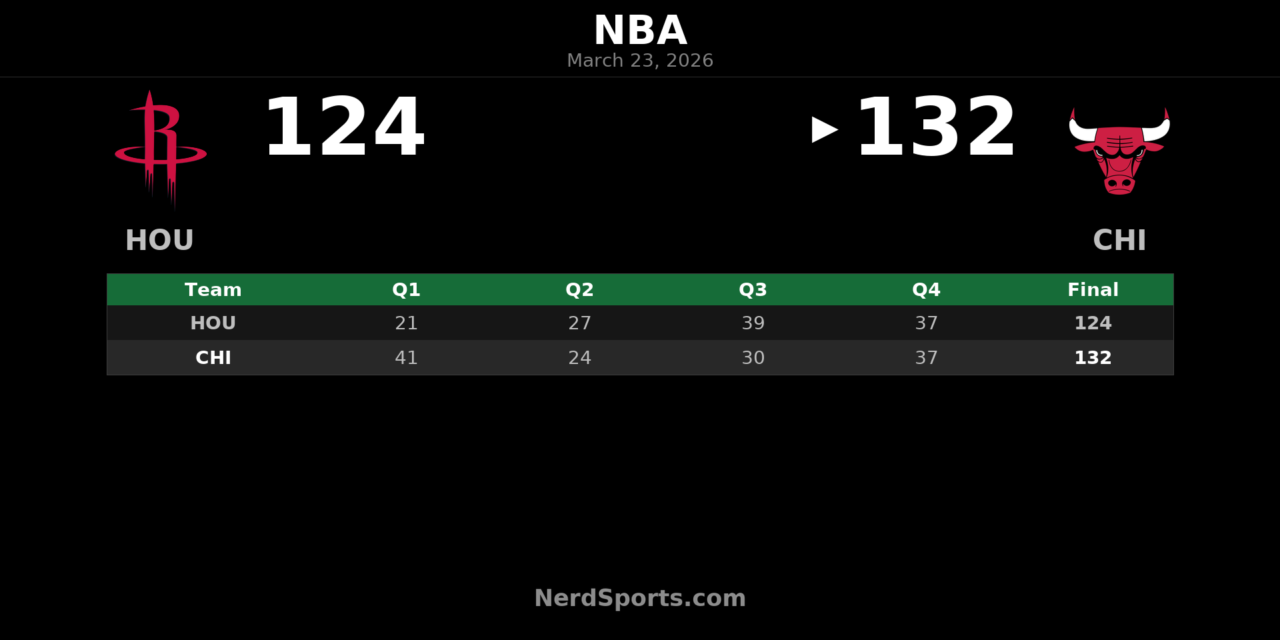
The Chicago Bulls opened Monday night with their sharpest stretch of the game and carried that momentum the rest of the way, earning a 132-124 win over the Houston Rockets at United Center. Chicago built a 20-point lead after one quarter, then had just enough offense late to hold off Houston’s push. The Bulls improved to 29-42 with the home victory, while the Rockets dropped to 43-28 despite strong performances from Kevin Durant and Alperen Sengun.
Quarter-by-quarter breakdown
First quarter
Chicago took control early with a 41-21 opening period that set the tone for the night. The Bulls moved the ball cleanly, found rhythm from three-point range, and consistently turned early possessions into quality looks. Houston struggled to match that pace in the first 12 minutes, and the 20-point gap immediately put the Rockets in catch-up mode.
Second quarter
The Rockets responded with a steadier second quarter and outscored Chicago 27-24 before halftime. Houston began to settle into the game offensively, cutting into the deficit in small increments, but the Bulls still went to the break with a 65-48 lead. That cushion remained important as the game shifted into a more competitive second half.
Third quarter
Houston made its biggest move in the third, putting up 39 points and trimming the margin with improved shot-making and stronger interior production. Durant and Sengun helped the Rockets generate efficient offense, while Chicago’s lead was reduced as the visitors won the quarter 39-30. Even so, the Bulls entered the fourth quarter ahead 95-87, preserving a workable advantage.
Fourth quarter
The final period was played evenly at 37-37, which was enough for Chicago to finish the job. Houston continued to pressure the Bulls, but Chicago answered with timely baskets and avoided a full collapse after its early lead was challenged. The Bulls maintained enough separation throughout the closing minutes to secure the eight-point result.
Key performers
Collin Sexton led Chicago with 25 points, giving the Bulls a reliable scoring presence in a game that required offense from multiple spots. Josh Giddey directed the attack with 15 points, seven rebounds, and 13 assists, and his playmaking was central to Chicago’s 30-assist night. Leonard Miller added a team-high nine rebounds as the Bulls finished with a 45-41 edge on the glass.
Chicago’s team numbers told the story of its offensive success. The Bulls shot 50.0 percent from the field, connected on 19 of 38 from three-point range, and made 23 of 28 free throws. Their perimeter efficiency stood out in particular, especially compared with Houston’s 11-of-41 showing from beyond the arc.
For Houston, Durant led all scorers with 40 points and kept the Rockets within range through the second half. Sengun delivered one of the most complete lines of the night with 33 points, 13 rebounds, and 10 assists, recording a triple-double while serving as Houston’s main interior creator. The Rockets shot a solid 53.3 percent overall and finished with 27 assists, but missed opportunities at the foul line and from three proved costly.
Game analysis
The biggest separator was Chicago’s start. Scoring 41 points in the first quarter gave the Bulls enough margin to absorb Houston’s later adjustments. Against a Rockets team that eventually found offensive rhythm, that early burst changed the shape of the game and forced Houston to spend the rest of the night chasing the scoreboard.
Chicago also gained a clear advantage from long range. The Bulls made 19 three-pointers at a 50.0 percent clip, while Houston hit just 26.8 percent from deep. That difference more than offset the Rockets’ stronger overall field-goal percentage. In a game where both teams moved the ball well and scored efficiently in stretches, the Bulls’ shot profile was more productive.
Free throws were another meaningful factor. Chicago went 23-for-28 at the line, while Houston finished 15-for-24. In an eight-point game, those missed chances mattered. The Bulls were not perfect defensively after halftime, but their spacing, ball movement, and execution in key moments gave them enough to hold off a playoff-caliber opponent.
Closing context
The result moved Chicago to 29-42 and gave the Bulls a positive home performance against one of the Western Conference’s stronger teams. For Houston, now 43-28, the loss highlighted how difficult it is to recover from a slow opening on the road, even with standout efforts from Durant and Sengun. With the regular season winding down, both teams will look at this game as a reminder of how important first-quarter execution can be in shaping the rest of the night.