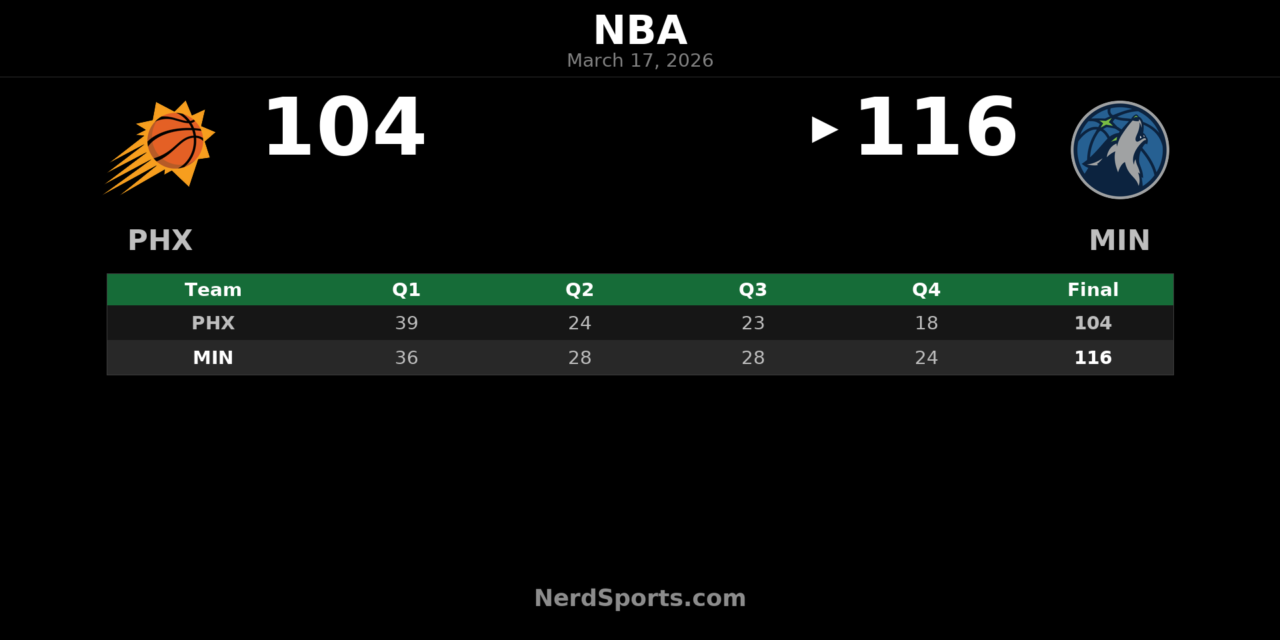
The Minnesota Timberwolves turned a difficult first quarter into a steady, complete win on Tuesday night, coming away with a 116-104 victory over the Phoenix Suns at Target Center. Phoenix opened with 39 points in the first period and briefly controlled the pace, but Minnesota responded with balanced offense, stronger work on the glass, and consistent execution over the final three quarters. Julius Randle led the way with 32 points as the Timberwolves improved to 42-27, while the Suns fell to 39-30.
Quarter-by-quarter breakdown
First quarter: Phoenix came out sharp offensively and put up 39 points in the opening 12 minutes, taking a 39-36 lead after one. Devin Booker set the tone for the Suns, and Minnesota had to keep scoring just to stay within range. The Timberwolves did enough offensively to avoid a larger deficit, which proved important later in the game.
Second quarter: Minnesota began to settle in on both ends and edged Phoenix 28-24 in the period. That trimmed the Suns’ lead and sent the teams into halftime tied at 63-63. The Timberwolves looked more comfortable in the half court, moved the ball well, and started to make their rebounding advantage matter.
Third quarter: This was the turning point. Minnesota outscored Phoenix 28-23 in the third and took a 91-86 lead into the fourth. The Timberwolves continued to get quality looks inside and maintained better control of the possession game, while the Suns’ efficiency dipped after their strong opening quarter.
Fourth quarter: Minnesota closed with another strong defensive stretch, outscoring Phoenix 24-18 in the final period. The Timberwolves held the Suns to 18 points in the quarter, finished key possessions, and gradually created enough separation to secure the 12-point result.
Key performers
Timberwolves:
Julius Randle delivered 32 points and seven rebounds, leading Minnesota’s offense throughout the night. Rudy Gobert gave the Timberwolves a major interior presence with 19 rebounds, helping Minnesota finish with a 49-40 edge on the glass. Kyle Anderson led the team with six assists as Minnesota totaled 28 assists on 43 made field goals.
Suns:
Devin Booker led all Phoenix scorers with 34 points and added six rebounds. Oso Ighodaro paced the Suns on the boards with 10 rebounds, while Collin Gillespie handed out seven assists. Phoenix had solid three-point production with 13 made threes, but it was not enough to offset a 38.1 percent night from the field overall.
Game analysis
Minnesota’s path to this win was built on efficiency and control after the first quarter. The Timberwolves shot 51.2 percent from the field compared with 38.1 percent for Phoenix, a gap that shaped the game even though the Suns attempted more shots. Minnesota also created extra value through its rebounding, especially with Gobert anchoring the effort, and turned good ball movement into high-quality looks around the floor.
Phoenix had the early burst and stayed connected from three-point range at 35.1 percent, but the Suns could not sustain their first-quarter offensive rhythm. After scoring 39 in the opening period, they were limited to 65 total points over the final three quarters. Minnesota, meanwhile, was much steadier from start to finish after the early deficit, scoring at least 24 points in every quarter and taking control with back-to-back 28-point periods in the middle of the game.
The free-throw line did not dramatically swing the outcome, but Minnesota’s 21 made free throws and stronger interior play helped reinforce the difference. In a game between two teams with close records entering the night, the Timberwolves looked more consistent over 48 minutes.
Closing context
The result moved Minnesota to 42-27 and strengthened its position in the Western Conference race, while Phoenix dropped to 39-30 as the standings continue to tighten heading into the final stretch of the regular season. For the Timberwolves, this was the kind of home win that can matter in a crowded playoff picture: weather an early push, adjust, and finish with control. For the Suns, the challenge now is finding more offensive consistency after a promising start on the road.