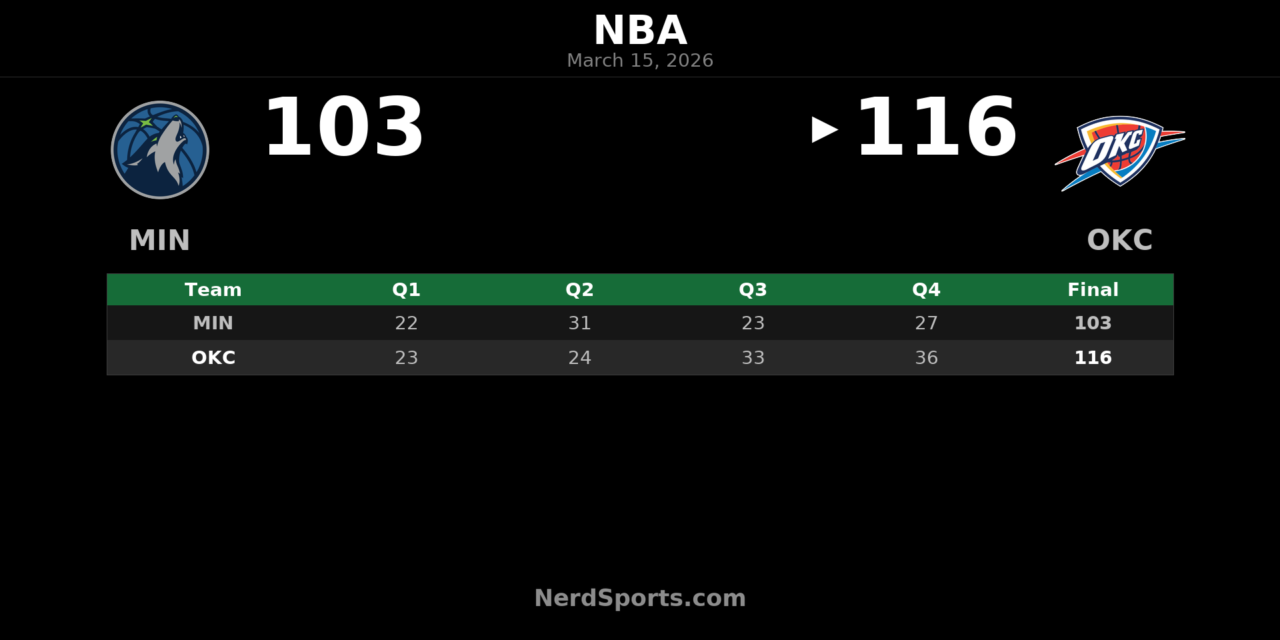
The Oklahoma City Thunder used a strong second half to come away with a 116-103 win over the Minnesota Timberwolves on Sunday at Paycom Center. After trailing by six at halftime, Oklahoma City steadily took control in the third quarter and then pulled away in the fourth, improving to 53-15 on the season. Minnesota dropped to 41-27 despite a big offensive night from Julius Randle.
Quarter-by-Quarter Breakdown
First Quarter: Oklahoma City opened with a narrow edge, taking the first quarter 23-22. Neither team created much separation early, with both defenses keeping the pace measured and the shot-making fairly even.
Second Quarter: Minnesota put together its best stretch before halftime, outscoring the Thunder 31-24 in the period. The Timberwolves found better rhythm offensively and carried a 53-47 lead into the break, putting pressure on Oklahoma City to respond in the second half.
Third Quarter: The game shifted after halftime. Oklahoma City outscored Minnesota 33-23 in the third, turning a six-point deficit into an 80-76 lead entering the fourth. The Thunder generated better ball movement in the period and began to create more quality looks from the perimeter.
Fourth Quarter: Oklahoma City finished the game with its most productive offensive quarter, outscoring Minnesota 36-27 over the final 12 minutes. The Thunder maintained their pace on offense, got timely stops, and extended the margin late to secure the 13-point result.
Key Performers
Oklahoma City Thunder:
Chet Holmgren led Oklahoma City with 21 points and added nine rebounds and three steals, providing production on both ends. Shai Gilgeous-Alexander directed the offense with 10 assists, helping the Thunder finish with 28 as a team. Isaiah Hartenstein added important work on the glass with a team-high 12 rebounds.
Minnesota Timberwolves:
Julius Randle led all scorers with 32 points while also contributing seven rebounds and six assists. Donte DiVincenzo paced Minnesota on the boards with nine rebounds. The Timberwolves shot a solid 46.8% from the field and 45.5% from three-point range, but they could not match Oklahoma City’s late-game execution.
Game Analysis
The biggest difference was Oklahoma City’s second-half control. After scoring 47 points in the first half, the Thunder delivered 69 after the break and showed much better offensive flow. Their 28 assists reflected that improvement, especially compared with Minnesota’s 18.
Even though both teams made 15 three-pointers, Oklahoma City created its advantage through pace, volume, and possession pressure. The Thunder attempted 101 field goals compared with 77 for Minnesota, a major gap that helped offset the Timberwolves’ better overall shooting percentage. Oklahoma City’s work over four quarters also showed at the free-throw line, where it made 17 of 19 attempts.
Minnesota had efficient stretches and enough perimeter accuracy to stay in range, but the Thunder’s third-quarter response changed the tone of the game. Once Oklahoma City moved in front, it kept the pressure on with consistent scoring and stronger playmaking.
Closing Context
The win moved Oklahoma City to 53-15 and added another strong home result to its 29-7 record at Paycom Center. For Minnesota, now 41-27, the loss was a missed chance against one of the West’s top teams, though Randle’s performance offered a clear positive. With the regular season entering its final stretch, games like this carry added weight for conference seeding and playoff positioning.