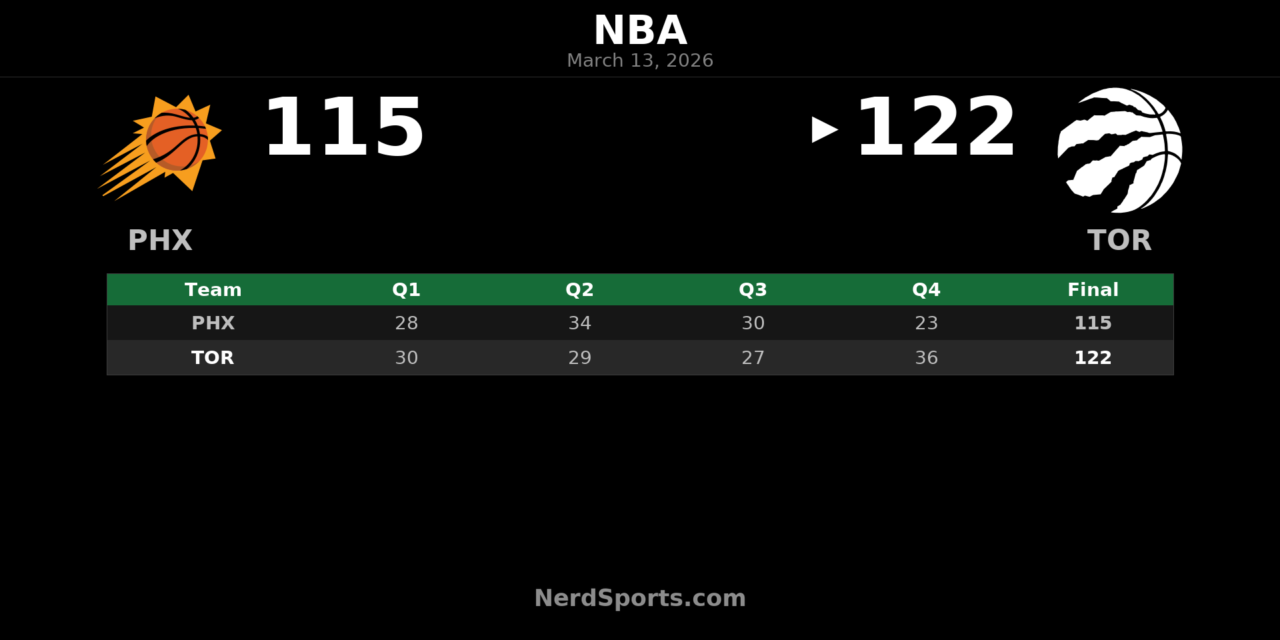
The Toronto Raptors came away with a hard-earned 122–115 victory over the Phoenix Suns on Friday night at Scotiabank Arena, improving to 37–29 on the season. Brandon Ingram was the standout performer of the evening, delivering 36 points and 7 rebounds in front of 19,195 fans. Toronto trailed for stretches in the middle quarters but responded with a commanding 36-point fourth quarter to pull away for the win.
Quarter-by-Quarter Breakdown
First Quarter: Raptors Take Early Control
Toronto opened the game with purpose, outscoring Phoenix 30–28 in the first quarter. The Raptors established an early rhythm and kept the Suns’ offense in check, setting a composed tone heading into the second period.
Second Quarter: Suns Flip the Script
Phoenix responded with its best offensive quarter of the game, putting up 34 points in the second period to outscore Toronto 34–29 and take a narrow halftime advantage. The Suns’ perimeter attack — they finished the game 18-of-42 from three — created consistent problems for the Raptors’ defense in the first half. Phoenix held a slim edge heading into the locker room, 62–59.
Third Quarter: Suns Maintain the Edge
The third quarter followed a similar pattern, with Phoenix outscoring Toronto 30–27 to extend its lead to six points, 92–86, heading into the final frame. The Suns appeared to be in position to secure a road win, but the Raptors had other plans.
Fourth Quarter: Raptors Take Control
Toronto put together a decisive fourth quarter, outscoring Phoenix 36–23 to close out the game. The Raptors shot 53.5 percent from the field for the game and hit 14-of-27 three-pointers — an efficient 51.9 percent — giving them more than enough firepower to overcome the deficit. Phoenix, limited to just 23 points in the final period, could not keep pace as Toronto pulled away for the seven-point victory.
Key Performers
Brandon Ingram – Toronto Raptors
Ingram was Toronto’s engine throughout the night, leading all scorers with 36 points and adding 7 rebounds. His ability to create offense at multiple levels was central to the Raptors’ success, and he earned the game’s top efficiency rating. Ingram’s performance in the fourth quarter, in particular, helped Toronto regain and hold the lead when it mattered most.
Jamal Shead – Toronto Raptors
Point guard Jamal Shead facilitated Toronto’s offense with a team-high 8 assists, helping the Raptors rack up 25 total assists on the night. His ability to distribute the ball and keep the offense moving was a key factor in Toronto’s efficient shooting performance.
Sandro Mamukelashvili – Toronto Raptors
Mamukelashvili led the Raptors on the glass with 8 rebounds, contributing to Toronto’s significant edge in that category. The Raptors outrebounded the Suns 44–35, a margin that proved crucial in maintaining possession and limiting Phoenix’s second-chance opportunities.
Jalen Green – Phoenix Suns
Green was the bright spot for Phoenix, leading the Suns with 34 points and earning the team’s top efficiency rating. Despite his efforts, Green could not overcome a 36-point fourth quarter from the hosts. The Suns as a team struggled from the free-throw line, connecting on just 21-of-30 attempts (70.0 percent), which left points on the board at critical moments.
Grayson Allen – Phoenix Suns
Allen directed Phoenix’s offense with a team-high 6 assists, working to keep the Suns’ attack organized. Royce O’Neale led Phoenix on the boards with 6 rebounds, though neither player could generate enough support to offset Toronto’s fourth-quarter surge.
Game Analysis
This game came down to efficiency and fourth-quarter execution. Toronto’s 53.5 percent field goal percentage was a significant advantage over Phoenix’s 46.9 percent, and the Raptors’ three-point shooting — 51.9 percent on 27 attempts — was a decisive factor. While the Suns elected to operate at a higher volume from deep (42 three-point attempts), their 42.9 percent accuracy, though respectable, could not match Toronto’s precision.
The rebounding disparity was equally telling. Toronto’s nine-board advantage (44–35) limited Phoenix’s opportunities to generate second-chance points and helped the Raptors control the flow of the game’s final stages. Ingram’s 36-point output also gave Toronto a reliable scoring option that the Suns had no clear answer for, particularly in the decisive fourth quarter when Phoenix’s offense went relatively quiet.
The Suns’ foul trouble also played a role — 30 free throw attempts suggest Toronto was aggressive getting to the line, and while Phoenix converted 21 of those attempts, the 70 percent clip left meaningful points off the board during a game decided by seven.
Standings and Series Implications
With the victory, the Toronto Raptors move to 37–29 on the season, maintaining a strong 18–16 home record and an impressive 19–13 mark on the road. The Raptors continue to position themselves in the mix in the Eastern Conference as the regular season winds down.
The loss drops the Phoenix Suns to 39–28 overall. Despite holding a stronger overall record, the Suns fall to 17–15 on the road with this defeat. With the postseason approaching, Friday’s result serves as a reminder that Phoenix will need to tighten up its fourth-quarter performance against well-organized opponents. Both teams will look to bounce back quickly as the stretch run intensifies.