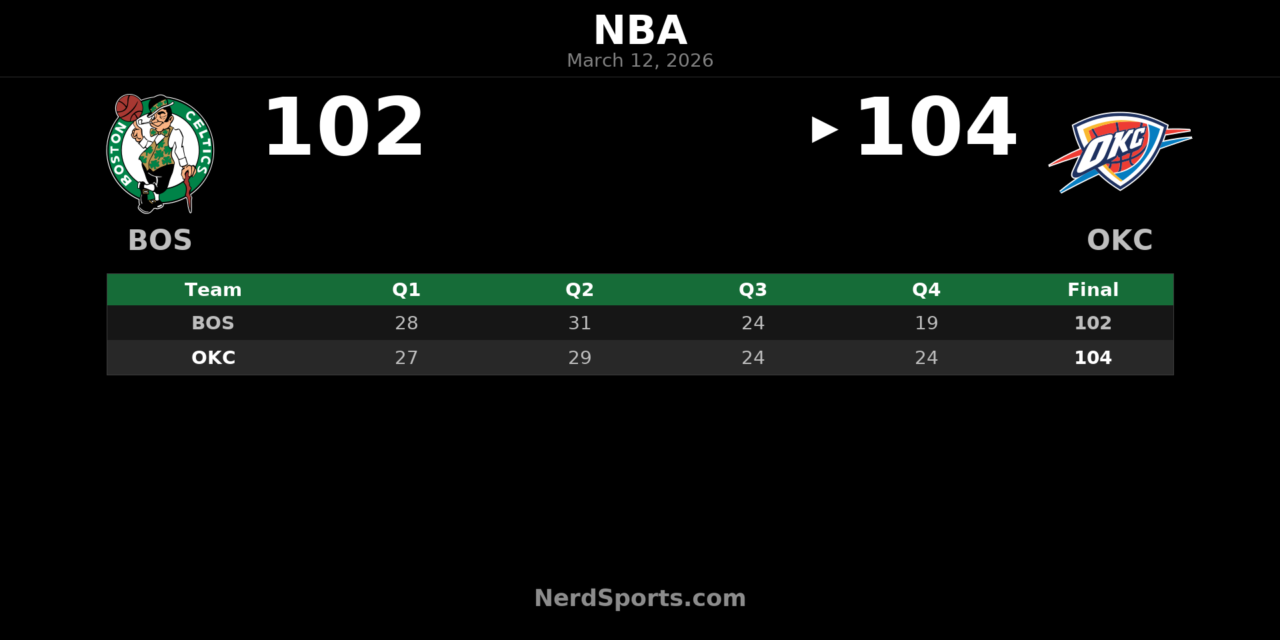
In one of the more compelling matchups of the 2025-26 NBA regular season, the Oklahoma City Thunder came away with a narrow 104-102 victory over the Boston Celtics at Paycom Center on Thursday night, March 12, 2026. Before an attendance of 18,203, Shai Gilgeous-Alexander turned in a 35-point, 9-assist performance to help OKC take control in the fourth quarter and hold off a Celtics squad that led for much of the first three periods. With the win, the Thunder improved to an impressive 52-15 on the season — one of the best records in the NBA.
Quarter-by-Quarter Breakdown
First Quarter: Celtics Take an Early Edge, 28-27
Boston came out of the gate with purpose, outpacing Oklahoma City 28-27 through twelve minutes of play. The Celtics moved the ball crisply and attacked the rim effectively, keeping the Thunder on their heels early. OKC stayed within striking distance thanks to steady contributions from their starters, but Boston’s energy gave them a slim one-point advantage heading into the second.
Second Quarter: Celtics Extend the Lead, 59-56 at Halftime
Boston continued to hold the edge in the second quarter, outscoring Oklahoma City 31-29 to take a 59-56 lead into the locker room. The Celtics shot efficiently in the first half and held a modest but meaningful advantage heading into the break. Jaylen Brown was particularly active in generating offense and keeping Boston’s attack organized.
Third Quarter: Teams Split, 83-80 Boston
The third quarter was a back-and-forth affair with neither team gaining a meaningful advantage. Both sides scored 24 points in the period, keeping Boston’s three-point lead intact at 83-80 entering the final frame. The Thunder began asserting more defensive pressure, and Gilgeous-Alexander started finding his rhythm at a higher rate as the period wore on.
Fourth Quarter: Thunder Take Control, 24-19
Oklahoma City’s decisive response came in the fourth quarter, where the Thunder outscored the Celtics 24-19 to ultimately take the game. OKC’s defense tightened considerably in the closing minutes, limiting Boston’s opportunities at the rim and forcing difficult looks from the perimeter. Gilgeous-Alexander was central to the Thunder’s late-game execution, helping his team take and protect the lead down the stretch for the 104-102 final.
Key Performers
Shai Gilgeous-Alexander — OKC: 35 PTS, 6 REB, 9 AST, 3 BLK
Gilgeous-Alexander was the standout performer of the evening. Leading all scorers with 35 points, he also contributed 9 assists — tying him for the team lead — along with 6 rebounds and 3 blocked shots. His presence was felt on both ends of the floor, and his ability to take over the fourth quarter proved to be the difference in a two-point game. It was a complete, efficient outing from one of the league’s elite guards.
Chet Holmgren — OKC: 9 REB (Team-High)
Holmgren led the Thunder on the glass with 9 rebounds, providing a steady interior presence throughout the contest. His activity on the boards helped Oklahoma City compete for possessions against a Boston team that actually out-rebounded OKC on the night, 44 to 39.
Jaylen Brown — BOS: 34 PTS, 6 REB, 7 AST
Brown was exceptional in defeat, delivering 34 points, 6 rebounds, and 7 assists for Boston. He was the primary offensive engine for the Celtics all evening and kept the team competitive late into the fourth quarter. Despite his strong individual output, Boston could not quite match OKC’s closing performance when it mattered most.
Neemias Queta — BOS: 10 REB (Team-High)
Queta led all players with 10 rebounds, anchoring Boston’s interior presence. The Celtics as a team pulled down 44 boards — five more than Oklahoma City — but were ultimately unable to convert that advantage into a win.
Game Analysis
This was a game defined by efficiency, execution under pressure, and the contrast between the two teams’ fourth-quarter approaches. Boston carried a lead through three quarters with the aid of a sharp free-throw performance — the Celtics connected on 19 of 20 free throws (95.0%), which was a notable edge in a two-point game. Oklahoma City, meanwhile, converted just 13 of 17 attempts (76.5%) from the line.
Where OKC found its edge was in field-goal efficiency. The Thunder shot 47.6% from the floor compared to Boston’s 40.2%, and while the Celtics made more three-pointers (13 of 42, 31.0%) than the Thunder (11 of 44, 25.0%), Oklahoma City’s superior two-point scoring and team playmaking — 22 assists to Boston’s 20 — helped compensate. The Thunder’s ability to generate quality looks inside the arc proved to be the deciding factor in a game where both teams attempted a high volume of threes.
Defensively, Oklahoma City’s fourth-quarter adjustments were pivotal. Holding Boston to just 19 points in the final period — after the Celtics had averaged roughly 28 points per quarter in the first three — reflected a meaningful shift in how the Thunder guarded the perimeter and protected the paint in crunch time.
Standings and Series Implications
With the win, the Oklahoma City Thunder move to 52-15 on the season, continuing to position themselves among the top contenders in the Western Conference. Their 28-7 home record at Paycom Center underscores how formidable they are on their own floor. The Boston Celtics, now 43-23, remain well within the top tier of the Eastern Conference but will need to address their fourth-quarter efficiency going forward as the playoff picture sharpens. This was a quality road test for Boston, and the performance of Jaylen Brown offers reason for optimism — but it was ultimately Oklahoma City’s night behind a standout effort from Gilgeous-Alexander.