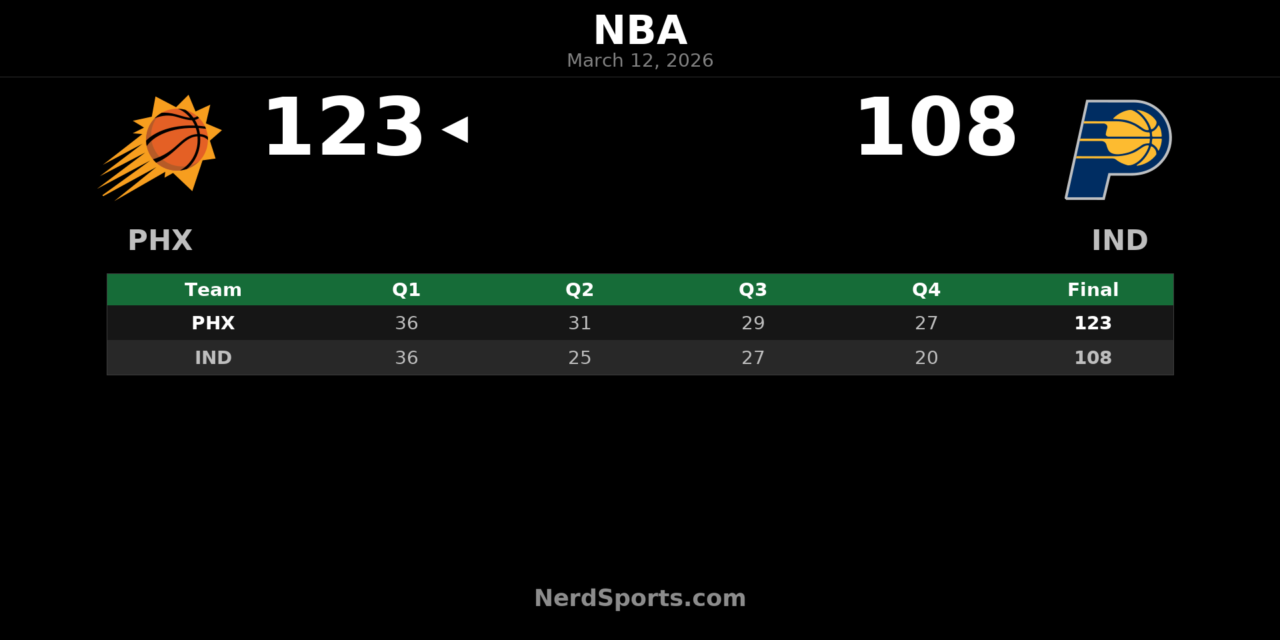
The Phoenix Suns arrived at Gainbridge Fieldhouse on Thursday night and left Indianapolis with a convincing 123-108 victory over the Indiana Pacers, pushing their winning streak to four games while Indiana’s losing skid extended to a painful 11 straight. Devin Booker was the centerpiece of the effort, delivering one of his most complete performances of the season, while a strong supporting cast ensured the Suns never needed to look over their shoulder in the second half.
Quarter-by-Quarter Breakdown
First Quarter: Even Start — PHX 36, IND 36
Despite the talent gap between the two teams in the standings, the opening quarter was as close as it gets. Both sides finished the first period level at 36 apiece, with Indiana’s home crowd keeping the energy high inside Gainbridge Fieldhouse. The Pacers were competitive on both ends, matching Phoenix possession by possession and giving no early indication of the separation that would follow.
Second Quarter: Suns Take Control — PHX 31, IND 25
The second quarter is where Phoenix began to assert itself. Outscoring Indiana 31-25 in the period, the Suns took a 67-61 lead into halftime. Phoenix’s offense found a rhythm, converting at a higher rate from the field while the Pacers began to struggle with their shot selection, attempting a high volume of threes and connecting on just 30% across the game. The six-point halftime cushion was modest, but it marked a clear shift in momentum.
Third Quarter: Suns Extend the Lead — PHX 29, IND 27
Indiana showed some resistance in the third quarter, keeping the deficit from growing dramatically, but Phoenix’s consistent offense prevented any real comeback attempt. The Suns outscored the Pacers 29-27 in the period, pushing their advantage to eight points heading into the final frame. Every time Indiana appeared ready to string together a run, Phoenix responded with a composed scoring sequence of its own.
Fourth Quarter: Suns Pull Away — PHX 27, IND 20
The final quarter effectively closed the door on any Pacers comeback. Phoenix outscored Indiana 27-20 in the fourth, turning an eight-point lead into the final 15-point margin. Indiana’s offense stalled, managing just 20 points in the closing period, and the Suns executed efficiently down the stretch to secure the comfortable win.
Key Performers
Devin Booker — 43 Points, 7 Rebounds, 5 Assists (PHX)
Booker was the standout performer of the night by a significant margin, leading all scorers with 43 points to go along with 7 rebounds and 5 assists. His efficiency was evident across all areas of his game, and his ability to generate his own shot kept Indiana’s defense constantly occupied. Booker’s rating was comfortably the highest of any player on the floor, reflecting the breadth of his impact beyond just scoring.
Jalen Green — 36 Points (PHX)
Complementing Booker’s night was Jalen Green, who delivered 36 points of his own to give Phoenix one of the most prolific scoring duos of the 2025-26 season on a single night. The combination of Booker and Green accounting for 79 points between them gave Indiana’s defense no manageable solution, and their combined output was the primary engine behind Phoenix’s 52.3% field goal percentage as a team.
Andrew Nembhard — 23 Points (IND)
For Indiana, Andrew Nembhard was the brightest spot on a difficult night, leading the Pacers with 23 points and earning the team’s top performance rating. His effort reflected the type of competitive individual play that Indiana has shown even amid its losing run, though it was not enough to offset the collective production Phoenix brought to the floor.
Jalen Slawson — 8 Rebounds (IND)
Jalen Slawson led Indiana on the glass with 8 rebounds, offering some interior presence on a night when the Pacers were outrebounded overall 40-36 by the visiting Suns.
Kam Jones — 6 Assists (IND)
Guard Kam Jones led Indiana with 6 assists, providing the most playmaking distribution for a Pacers squad that finished with 24 team assists compared to Phoenix’s 21.
Game Analysis
The story of this game was ultimately one of sustained offensive quality from Phoenix. The Suns shot 52.3% from the field compared to Indiana’s 45.1%, and while both teams attempted a significant number of three-pointers — Indiana led in attempts with 40 — Phoenix was considerably more selective, launching 32 attempts and connecting on 40.6% of them. Indiana’s 30% mark from beyond the arc on 40 attempts was a significant drag on their offense and a recurring theme throughout the night.
Phoenix’s front-loaded star power in Booker and Green created matchup challenges that Indiana’s depleted roster was simply unable to address consistently. That said, the Pacers’ first-quarter effort showed they remain competitive in stretches. The issue is sustainability — Indiana could not maintain that level across 48 minutes, particularly against a Phoenix offense operating at full efficiency.
Free throws were a difference-maker as well. Indiana attempted more free throws (25 to 22) and converted at a higher rate (88.0% to 81.8%), but the Suns’ superior field goal shooting more than offset that advantage. Phoenix’s 40-36 edge on the glass also helped limit Indiana’s second-chance opportunities.
Standings and Series Implications
With the win, the Phoenix Suns improve to 39-27 on the season, continuing to position themselves firmly in the playoff picture with their current four-game winning streak. Their road record of 17-14 underscores their ability to perform away from home, and Thursday’s result adds to a stretch of form that will factor meaningfully into seeding conversations over the final weeks of the regular season.
For the Indiana Pacers, the loss extends a deeply concerning 11-game skid that has cemented their standing at the bottom of the NBA standings at 15-51. The Pacers’ home record of 10-23 reflects ongoing struggles even at Gainbridge Fieldhouse, and with the lottery picture coming into sharper focus, Indiana’s attention will increasingly turn toward the offseason. Thursday’s attendance of 16,470 showed fans are still showing up, and individual performances like Nembhard’s give the organization something to build on — even if the wins remain elusive right now.