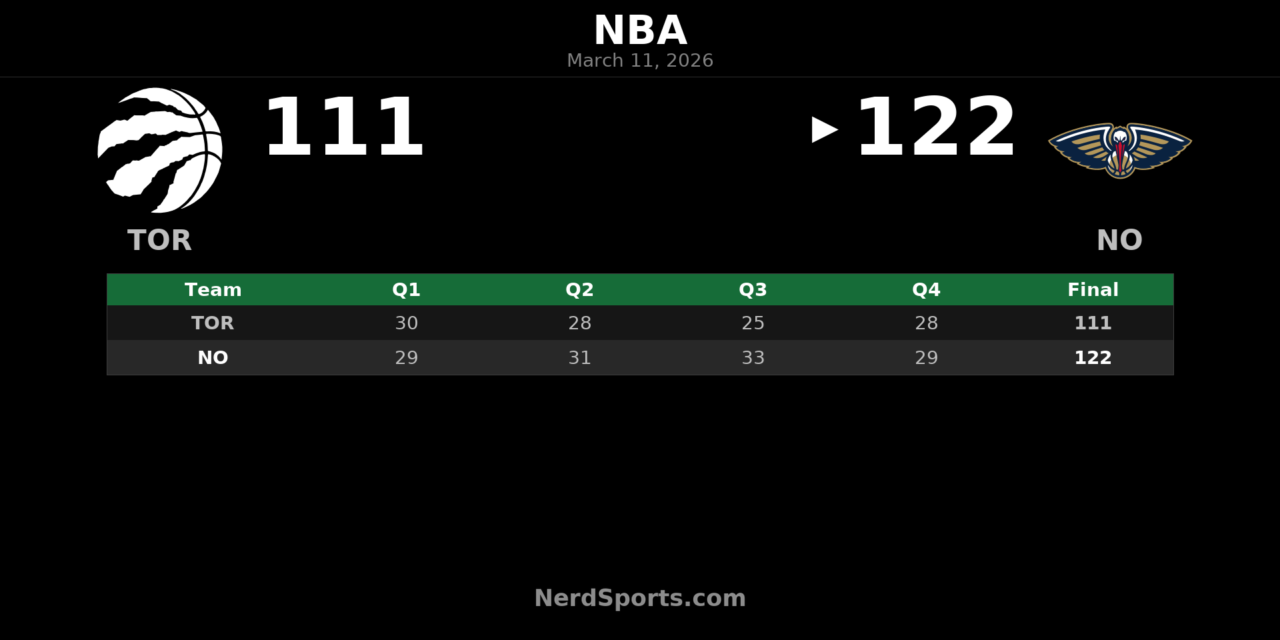
Pelicans Come Away with a 122-111 Win Over the Raptors
The New Orleans Pelicans delivered a composed, well-rounded performance at Smoothie King Center on Wednesday night, outscoring the Toronto Raptors 122-111 to claim a convincing home victory in front of 16,568 fans. Trey Murphy III led the charge with 28 points, while the Pelicans steadily took control after a tight first quarter and never relinquished the lead. New Orleans shot 51.1 percent from the field and connected on 14 of 29 three-point attempts, making it a difficult night for a Raptors squad that struggled with efficiency as the game progressed.
Quarter-by-Quarter Breakdown
First Quarter: Raptors Jump Out Early, 30-29
Toronto came out with energy in the opening frame, outpacing New Orleans 30-29 in a closely contested first quarter. The Raptors moved the ball effectively and found consistent looks, setting a high-tempo tone. The Pelicans kept pace but found themselves trailing by a single point heading into the second.
Second Quarter: Pelicans Respond, Take the Lead, 31-28
New Orleans flipped the script in the second quarter, outscoring Toronto 31-28 to claim a two-point halftime lead at 60-58. The Pelicans’ interior presence grew more impactful, and their ball movement — which would eventually produce 27 team assists on the night — began to take shape. Toronto’s three-point volume remained high, but the conversion rate started to falter.
Third Quarter: Pelicans Pull Away, 33-25
The third quarter was where New Orleans firmly took control. The Pelicans outscored Toronto 33-25, pushing their halftime advantage from two points to a commanding ten-point lead heading into the final frame. The Raptors attempted 44 three-pointers on the night, many during this stretch, but finished at just 31.8 percent from beyond the arc — a significant factor in their inability to keep pace.
Fourth Quarter: Raptors Respond, But Pelicans Hold On, 29-28
Toronto showed resilience in the fourth, nearly matching New Orleans quarter-for-quarter with a 28-29 final frame. The Raptors trimmed the deficit at moments but could never fully bridge the gap built up in the third. New Orleans held steady, managed the clock, and came away with the 11-point final margin.
Key Performers
Trey Murphy III — New Orleans Pelicans
Murphy III was the standout performer of the evening, leading all scorers with 28 points while adding 7 rebounds and 3 steals. His rating of 48.35 was the highest on the floor, reflecting his impact on both ends of the game. Murphy’s ability to score efficiently and contribute defensively made him the clear catalyst for New Orleans throughout the contest.
Yves Missi — New Orleans Pelicans
The young center anchored the Pelicans’ frontcourt, pulling down a game-high 10 rebounds. Missi’s presence in the paint helped New Orleans hold a significant advantage on the boards, finishing with 49 team rebounds compared to Toronto’s 43.
Dejounte Murray — New Orleans Pelicans
Murray was the engine of New Orleans’ offense in a distributor role, leading the Pelicans with 6 assists. His playmaking kept the offense organized and helped generate the team’s 27 assists on 45 field goals made — a hallmark of a well-connected offensive night.
Immanuel Quickley — Toronto Raptors
Quickley was Toronto’s most productive player, leading the Raptors with 25 points and 6 rebounds. His rating of 42.70 reflected a solid individual effort in a losing cause. Despite his output, it wasn’t enough to offset Toronto’s struggles with field goal efficiency — the Raptors shot just 41.5 percent overall.
Brandon Ingram — Toronto Raptors
Ingram contributed as Toronto’s primary facilitator, distributing a team-high 5 assists. His all-around involvement kept the Raptors’ offense connected, though the team’s overall shooting performance limited their ability to sustain scoring runs against a Pelicans squad playing with rhythm.
RJ Barrett — Toronto Raptors
Barrett led the Raptors with 7 rebounds, providing a steady presence on the glass. While his rebounding gave Toronto some secondary opportunities, the team’s inability to convert those looks ultimately proved costly.
Game Analysis
The defining difference in this game was efficiency versus volume. The Toronto Raptors attempted 94 field goals — six more than New Orleans — yet scored 11 fewer points. Their reliance on the three-point shot (44 attempts, 31.8 percent conversion) worked against them as the game wore on, especially when compared to the Pelicans’ more measured approach of 29 three-point attempts at a notably higher 48.3 percent clip.
New Orleans also made the most of their interior opportunities. With Yves Missi commanding the paint and the Pelicans posting a 49-43 rebounding advantage, New Orleans consistently found second-chance opportunities and cleaner looks near the basket. Their 51.1 percent field goal percentage reflected a team that was selective and purposeful with its shots.
The third quarter was the pivotal stretch. The Pelicans outscored Toronto by eight points in that period alone, and the Raptors — despite their best efforts in the fourth — were unable to fully recover. Toronto’s willingness to shoot their way back into the game with threes was understandable given the deficit, but the shots simply did not fall at a rate that would allow a full comeback.
Trey Murphy III’s performance was a microcosm of the Pelicans’ night as a whole: efficient, impactful, and disciplined. He created problems in space and made Toronto pay for defensive lapses while also contributing on the other end with three steals. Murray’s facilitation and Missi’s rebounding gave New Orleans a complete team effort that the Raptors could not match collectively.
Standings and Series Implications
With the win, the New Orleans Pelicans improve to 22-45 on the season, boosting their home record to 13-21. While the Pelicans continue to navigate a challenging season, home victories like this one offer a measure of momentum and development for a young roster. The Toronto Raptors, meanwhile, fall to 36-29 overall — a record that still positions them firmly in the Eastern Conference playoff picture. At 19-13 on the road, Toronto remains a capable away team, but this result is a small step back in their push to solidify their postseason standing. Both teams will continue their respective pursuits as the regular season nears its final stretch.