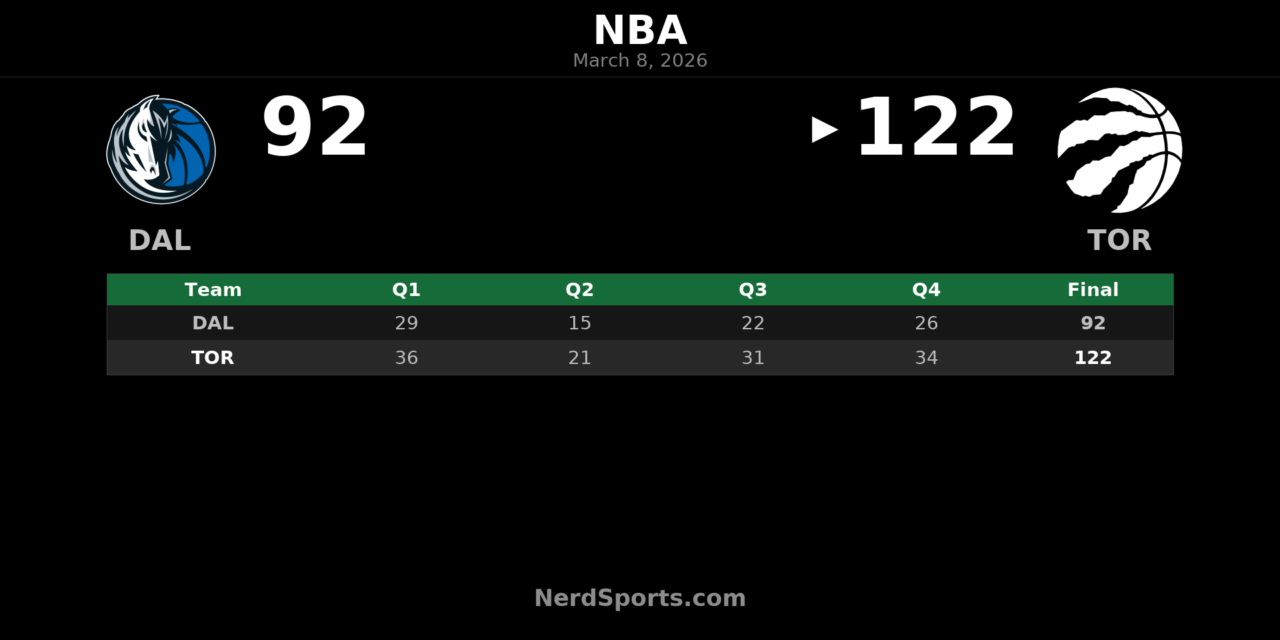
The Toronto Raptors delivered a complete, wire-to-wire performance on Sunday evening at Scotiabank Arena, coming away with a commanding 122-92 victory over the Dallas Mavericks. Led by a 31-point effort from RJ Barrett and 39 team assists on 48 made field goals, Toronto controlled the game in every phase, outpacing a Dallas squad that struggled to generate consistent offense all night. The win moves Toronto to 36-27 on the season, a record that places them firmly in the Eastern Conference playoff picture.
Quarter-by-Quarter Breakdown
First Quarter: Toronto Sets the Tone Early
The Raptors wasted no time establishing their presence at home, outscoring the Mavericks 36-29 in the opening frame. Toronto’s ball movement was crisp from the jump, and Dallas had difficulty finding a defensive answer. The seven-point cushion built in the first quarter served as the foundation for everything that followed.
Second Quarter: Raptors Extend Their Lead
The second quarter told an even clearer story. Toronto outscored Dallas 21-15, pushing the halftime lead to 57-44. The Mavericks managed just 15 points in the period — their lowest-scoring quarter of the night — as Toronto’s defense tightened and limited clean looks from the perimeter. Dallas connected on just 5-of-30 three-point attempts for the game, and much of that inefficiency was on display here.
Third Quarter: Raptors Take Full Control
Any hope of a Dallas comeback was effectively set aside in the third quarter. Toronto posted 31 points to Dallas’s 22, stretching the lead to a comfortable margin entering the final frame. The Raptors’ 50.5 percent field goal shooting kept the offense humming, and the Mavericks’ 39.8 percent clip from the floor left them too far behind to mount a serious run.
Fourth Quarter: Raptors Close It Out
With the game well in hand, Toronto continued to execute in the fourth quarter, outscoring Dallas 34-26 to reach the final score of 122-92. The 30-point margin of victory reflected the consistency of the Raptors’ effort across all 48 minutes, as no individual quarter went Dallas’s way.
Key Performers
RJ Barrett — Toronto Raptors
Barrett was Toronto’s offensive centerpiece on Sunday, leading all scorers with 31 points along with 6 rebounds. His performance earned the game’s top efficiency rating and set the tone for a Raptors offense that operated with purpose and precision throughout. Barrett has steadily emerged as one of Toronto’s most reliable contributors this season, and Sunday’s showing reinforced that standing.
Immanuel Quickley — Toronto Raptors
Quickley was the engine behind Toronto’s remarkable assist total, dishing out a game-high 8 assists. His ability to push the pace and find teammates in transition contributed significantly to a Raptors team that recorded 39 assists as a unit — a number that speaks to their collective commitment to ball movement over isolation play.
Jakob Poeltl — Toronto Raptors
Poeltl anchored Toronto’s interior presence, pulling down a team-high 10 rebounds. His work on the boards helped offset a night when Dallas actually out-rebounded Toronto 48-41, ensuring the Raptors maintained possession and second-chance opportunities where it mattered.
Daniel Gafford — Dallas Mavericks
Gafford provided Dallas’s most well-rounded individual effort, posting 21 points and 11 rebounds for a double-double. He was the Mavericks’ leading scorer and top rebounder, doing much of his damage in the paint where he proved difficult to contain. However, Gafford’s production was not enough to shift the overall trajectory of a lopsided contest.
Cooper Flagg — Dallas Mavericks
The rookie distributed the ball effectively, leading Dallas with 6 assists. Flagg continued to show playmaking instincts beyond his years, though the Mavericks’ overall offensive inefficiency — particularly from three-point range — limited how much his facilitation could contribute to the final outcome.
Game Analysis
The story of this game was Toronto’s offensive efficiency meeting Dallas’s offensive inconsistency. The Raptors shot 50.5 percent from the field and registered 39 assists on 48 made baskets, a ratio that reflects a team playing genuinely connected basketball. Their 10-of-36 three-point shooting (27.8 percent) was not particularly strong, but their ability to generate high-percentage looks near the basket — aided by Quickley’s playmaking and Barrett’s scoring gravity — more than compensated.
Dallas, meanwhile, shot just 39.8 percent from the field and a concerning 16.7 percent from three (5-of-30). That three-point number is the most telling statistic of the night. The Mavericks took 30 attempts from beyond the arc and converted only five, which placed enormous pressure on their mid-range and interior game to carry the offensive load — a burden too heavy to sustain over four quarters against a focused Raptors defense. Dallas’s 22 team assists also paled in comparison to Toronto’s 39, indicating a significant gap in ball movement and decision-making throughout the contest.
Toronto’s home crowd of 19,800 at Scotiabank Arena was treated to a well-organized, high-effort performance that reflected the kind of basketball the Raptors have been building toward as the season’s final stretch approaches.
Standings and Series Implications
With the victory, Toronto improves to 36-27, moving solidly in the right direction in the Eastern Conference playoff race. Particularly noteworthy is the Raptors’ 19-11 road record, which is among the better away marks in the conference — but their home performance Sunday was a reminder that Scotiabank Arena can be a challenging environment for visiting teams as well. Dallas, now at 21-43, continues to navigate a difficult season. The Mavericks’ 7-24 road record highlights the challenges they face away from home, and Sunday’s result was consistent with that pattern. For both teams, with the regular season winding down, the next several weeks will be critical — Toronto in securing a favorable playoff seed, and Dallas in evaluating where the roster stands heading into the offseason.