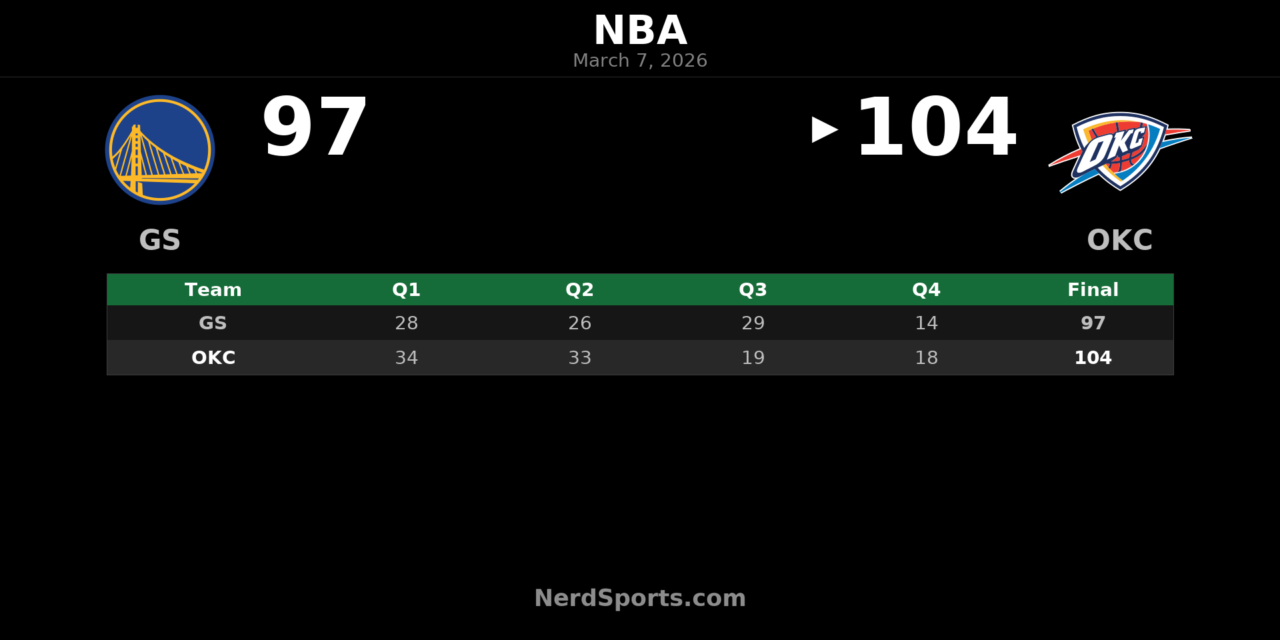
The Oklahoma City Thunder came away with a 104-97 victory over the Golden State Warriors on Saturday night at Paycom Center, improving to an impressive 50-15 on the season. Shai Gilgeous-Alexander led all scorers with 27 points and five assists, providing the steady offensive production OKC needed to hold off a Warriors squad that kept the game competitive deep into the fourth quarter. Before a crowd of 18,203, the Thunder leaned on a dominant first half, a resilient fourth quarter, and a near-perfect performance from the free throw line to secure the win on national television on ABC.
Quarter-by-Quarter Breakdown
First Quarter: Thunder Set the Tone Early
Oklahoma City came out focused and took a 34-28 lead after the first quarter. The Thunder’s offense moved efficiently, while the Warriors — despite putting up 28 points of their own — found themselves trailing from the opening minutes. OKC’s ball movement and attention to detail on defense helped establish a six-point advantage heading into the second period.
Second Quarter: Thunder Extend the Lead at Halftime
The Thunder continued to control the pace in the second quarter, outscoring Golden State 33-26 to take a commanding 67-54 lead into halftime. A 13-point advantage at the break reflected OKC’s ability to sustain their offensive rhythm while limiting the Warriors’ transition opportunities. The Thunder’s 24 assists on 33 made field goals — a team stat that was taking shape throughout the first half — pointed to unselfish, well-constructed basketball.
Third Quarter: Warriors Respond with Their Best Period
Golden State came out with renewed energy in the third quarter, posting their best offensive output of the game at 29 points, compared to just 19 for the Thunder. The Warriors gradually pulled themselves back into contention, trimming what had been a double-digit deficit. The Warriors’ 45 three-point attempts over the full game reflected their willingness to keep stretching defenses, and their third-quarter shooting gave them a pathway back into the contest heading into the final 12 minutes.
Fourth Quarter: Thunder Close It Out
With the margin tightened after three quarters, Oklahoma City responded by outscoring Golden State 18-14 in the fourth to secure the 104-97 final. The Thunder’s composure under pressure was evident, particularly at the free throw line where OKC converted 23-of-24 attempts (95.8%) on the night. That efficiency proved crucial in closing out a game in which the Warriors had rallied to make things uncomfortable. Golden State, meanwhile, shot just 61.1% from the charity stripe (11-of-18), a disparity that ultimately widened the margin in OKC’s favor.
Key Performers
Shai Gilgeous-Alexander — Oklahoma City Thunder
Gilgeous-Alexander was the standout performer on the floor, leading all scorers with 27 points to go along with five assists. His ability to create offense in both structured half-court sets and in transition remained central to everything Oklahoma City did offensively. SGA also posted the game’s highest player rating, underlining his overall impact across both ends of the floor.
Jaylin Williams — Oklahoma City Thunder
Jaylin Williams delivered a strong performance on the glass, pulling down a game-high 14 rebounds. His presence in the frontcourt gave OKC a reliable interior anchor and contributed to the team’s 42 total rebounds on the night. Williams’ rebounding work proved particularly valuable in disrupting Golden State’s second-chance opportunities.
Gui Santos — Golden State Warriors
Santos was Golden State’s most productive player on the night, finishing with 22 points and 11 rebounds for a near double-double that earned him the team’s top player rating. The forward was a consistent source of offense for the Warriors and showed the kind of two-way engagement that gave the visitors their best chance of closing the gap.
Gary Payton II — Golden State Warriors
Gary Payton II contributed on the boards with a team-high 12 rebounds, bringing energy and physicality in his minutes. His rebounding helped Golden State out-rebound the Thunder 47-42 on the night — though OKC’s superior efficiency from the field and free throw line more than offset that disparity.
Brandin Podziemski — Golden State Warriors
Podziemski paced Golden State’s playmaking with a game-high 6 assists, helping to facilitate a Warriors offense that generated 28 assists on the night. His vision and movement in the open court gave Golden State’s offensive system some of its best moments, particularly in the third quarter.
Game Analysis
This game came down to two key factors: Oklahoma City’s free throw execution and their ability to weather the Warriors’ third-quarter run without panicking. The Thunder’s 95.8% free throw rate (23-of-24) was a testament to their poise in critical moments, and it stood in stark contrast to Golden State’s 61.1% mark (11-of-18) — a difference of 12 points from the line that essentially decided the contest.
From a shooting standpoint, both teams had a challenging night from the field. OKC shot 42.3% overall and 35.7% from three on 42 attempts. Golden State attempted an even higher volume from deep (45 threes) but connected at just 31.1%, a rate that limited their ability to fully capitalize on their third-quarter momentum. The Warriors’ willingness to launch from distance is a structural element of their offense, but on this night, the volume didn’t translate into the efficiency needed to pull ahead.
OKC’s 24 assists on 33 made field goals reflected the team’s ball movement philosophy under their coaching staff, and it helped the Thunder maintain offensive rhythm even when individual possessions broke down. Golden State also moved the ball well with 28 assists, but their field goal total (36 made on 88 attempts) and free throw struggles were ultimately the deciding factors.
The third-quarter swing — Golden State outscored Oklahoma City 29-19 — will serve as a reminder that this Thunder team is not immune to stretches where opponents take control. However, the measured response in the fourth quarter, limiting the Warriors to just 14 points, demonstrated the kind of defensive resilience that has defined OKC’s season.
Standings and Series Implications
With the victory, the Oklahoma City Thunder move to 50-15 on the season — a milestone that underscores their position as one of the NBA’s elite teams in 2025-26. Their home record now sits at 26-7 at Paycom Center, where they have made winning a consistent expectation. For the Golden State Warriors, the loss drops them to 32-31, keeping them in the thick of the Western Conference play-in conversation. At the halfway point of the 82-game schedule’s second half, Golden State will need to find greater consistency — particularly from the free throw line and in finishing close games — to secure a playoff position. Oklahoma City, meanwhile, continues to build a strong case as a top contender in the West as the regular season approaches its final stretch.