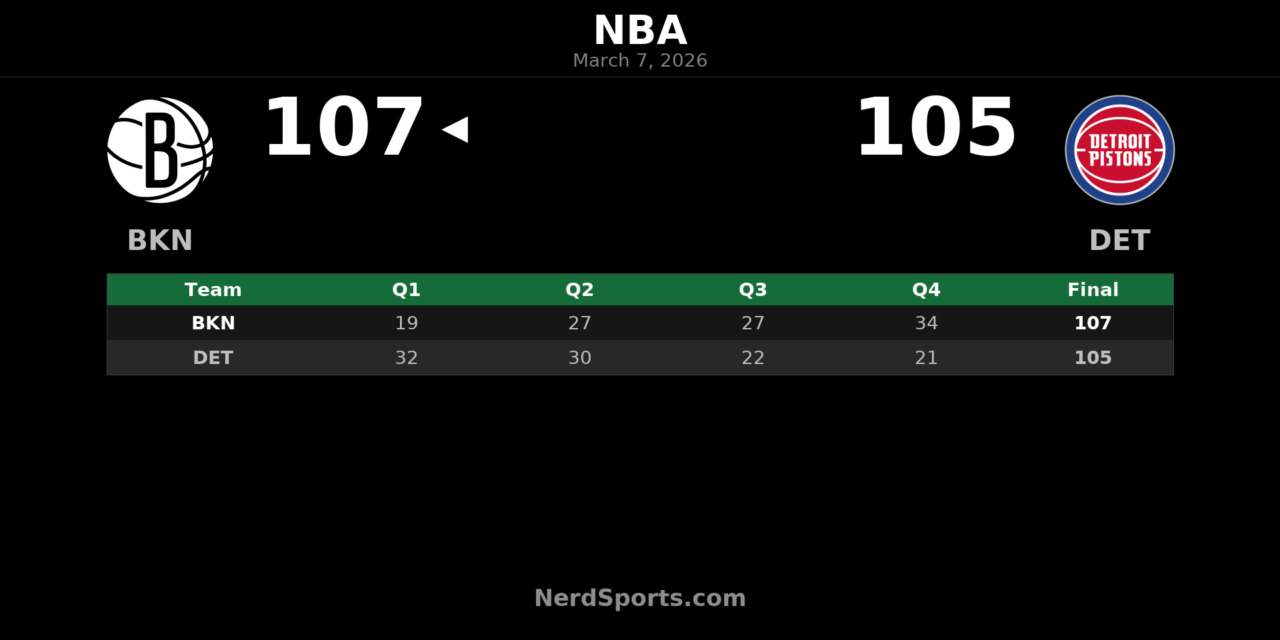
In one of the more unlikely results of the NBA’s Saturday slate, the Brooklyn Nets came away with a 107-105 road victory over the Detroit Pistons at Little Caesars Arena in front of 20,062 fans. Detroit came out with purpose, building a substantial early lead, but Brooklyn steadily closed the gap and outscored the Pistons 61-43 over the final two quarters to secure the win. Michael Porter Jr. was the engine of the rally, finishing with a 30-point, 13-rebound double-double that carried Brooklyn to a result that few would have predicted after the opening period.
Quarter-by-Quarter Breakdown
First Quarter: Detroit Takes Control
Detroit’s home crowd had plenty to cheer about early. The Pistons outscored the Nets 32-19 in the first quarter, establishing a 13-point advantage and setting a high-energy tone inside Little Caesars Arena. The Pistons were sharp from the floor and engaged defensively, putting Brooklyn firmly on the back foot right from the opening tip.
Second Quarter: Nets Respond, but Detroit Holds On
Brooklyn showed more life in the second quarter, outscoring Detroit 27-30 — a much tighter margin, though the Pistons continued to lead. Detroit took a 62-46 advantage into halftime, holding a 16-point cushion and appearing to be in a comfortable position to protect home court. Brooklyn had trimmed some of the deficit but still had significant ground to cover.
Third Quarter: Nets Cut Into the Lead
The third quarter marked a turning point. Brooklyn matched Detroit’s second-quarter output, posting 27 points while holding the Pistons to just 22. The Nets were tightening defensively and finding more offensive rhythm, cutting what had been a double-digit lead down to a manageable margin heading into the fourth. At 84-73, Brooklyn was very much still in the game.
Fourth Quarter: Brooklyn Takes Over
The final period told the story. Brooklyn outscored Detroit 34-21 in the fourth quarter, taking control of a game they had trailed for most of three quarters. The Nets converted free throws at a near-perfect rate and made the key plays down the stretch to pull ahead and hold off any Detroit response. Detroit could not replicate the efficiency that defined their first-half performance, and Brooklyn capitalized fully, closing out a 107-105 victory.
Key Performers
Michael Porter Jr. — Brooklyn Nets
Porter Jr. delivered the performance of the night. The Brooklyn forward led all scorers with 30 points while adding 13 rebounds for a commanding double-double. His ability to stay productive across all four quarters — and particularly in the pivotal second half — was central to Brooklyn’s comeback. Porter Jr. was also the team’s top rebounder, giving Brooklyn an edge on the glass that proved significant over the course of the game.
Tobias Harris — Detroit Pistons
Harris led Detroit in scoring with 18 points, providing the veteran presence the Pistons needed offensively. While the team’s output slowed considerably in the second half, Harris remained one of the more consistent contributors for a Detroit squad that could not sustain its first-half level.
Jalen Duren — Detroit Pistons
Duren was a force on the boards, pulling down 14 rebounds to go with 17 points and 3 blocks. He earned the team’s top efficiency rating and showed the kind of interior presence that has defined his development this season. Despite his strong individual effort, Detroit was ultimately outrebounded 45-37 by the Nets as a team.
Daniss Jenkins — Detroit Pistons
Jenkins was the Pistons’ top playmaker in the stat sheet, dishing out 9 assists. He helped Detroit generate offense through the halfcourt, but the Pistons struggled to maintain their first-quarter rhythm as the game progressed.
Day’Ron Sharpe — Brooklyn Nets
Sharpe led the Nets in assists with 4, contributing to a Brooklyn offense that totaled 20 assists on the night. His presence at center helped support Porter Jr. and kept Detroit’s interior defense occupied in key moments.
Game Analysis
The numbers tell a compelling story. Detroit shot 42.4 percent from the field and made 10 of 26 three-point attempts — a solid 38.5 percent clip. Their early dominance was real and earned. But the Pistons’ free throw shooting (74.2 percent, 23-of-31) left points on the table in a game decided by two possessions.
Brooklyn, by contrast, was exceptional at the free throw line — converting 27 of 28 attempts for a remarkable 96.4 percent. That near-perfect efficiency in a two-point game is the defining statistical footnote of the night. The Nets also outrebounded the Pistons 45-37, which gave them additional possessions when they needed them most in the fourth quarter.
Detroit’s collapse in the final period, where they managed just 21 points on what was presumably a fatigued or disrupted offensive execution, raises questions about fourth-quarter consistency for a team with genuine playoff aspirations. The Pistons entered the night at 45-17 — one of the better records in the league — so this was far from a trend-setting performance, but it is a reminder that even top teams must close games cleanly when opponents make adjustments.
For Brooklyn, this was a meaningful result regardless of the standings context. Porter Jr.’s performance underscored his ability to carry a team when engaged, and the Nets’ second-half defensive effort gave the victory real credibility.
Standings and Series Context
With the win, Brooklyn moves to 16-47 on the season — still among the league’s lower-tier records, but a road win against a 45-win team is worth noting. The Nets improve to 8-25 on the road, and this result will be one of their more notable away performances of the year.
Detroit falls to 45-17 overall and 24-8 at home following the loss. The Pistons remain in strong shape for playoff positioning, but the fourth-quarter defensive breakdown and free throw struggles are areas to monitor as the postseason picture sharpens. With fewer than 20 games remaining for most teams, every home loss carries added weight, and the Pistons will look to respond quickly as the regular season winds toward its conclusion.