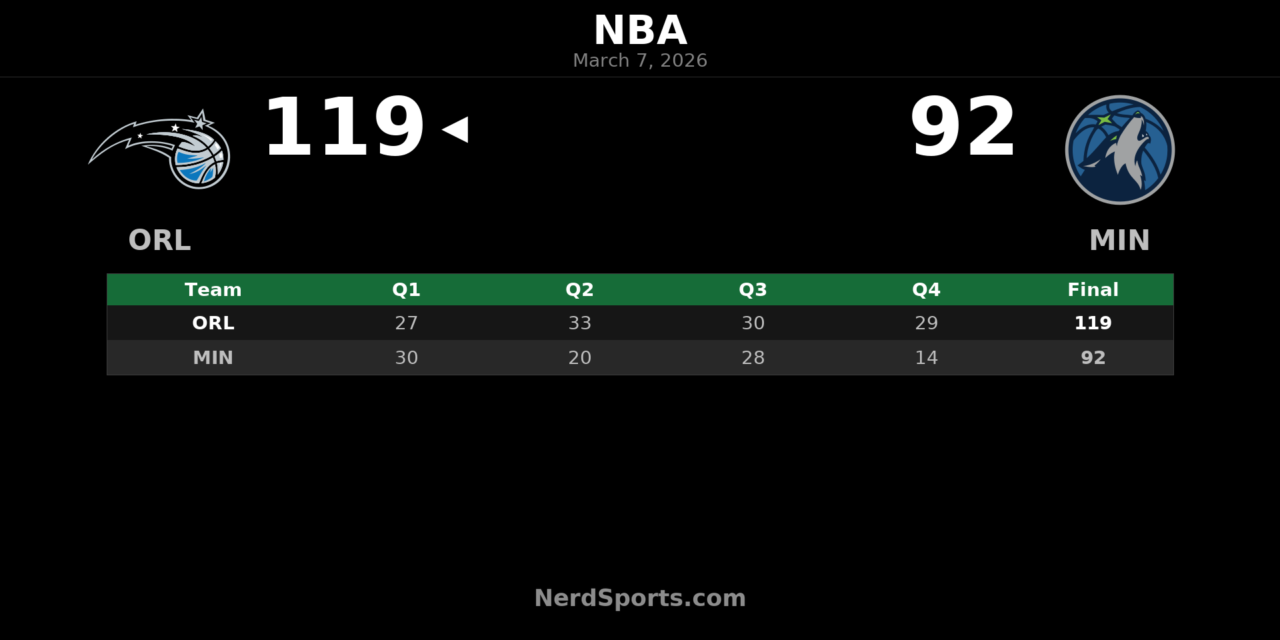
The Orlando Magic came into Target Center on Saturday night and left with a decisive 119-92 road victory over the Minnesota Timberwolves, improving to 34-28 on the season. After a competitive first quarter, Orlando took control with a blistering second period and never relinquished the lead, handing Minnesota a lopsided loss in front of 18,978 fans in Minneapolis. Anthony Edwards led all scorers with 34 points for the Wolves, but it wasn’t enough to overcome a Magic team that was sharper, deeper, and more efficient across three of the game’s four quarters.
Quarter-by-Quarter Breakdown
First Quarter: Minnesota Sets the Tone Early
Minnesota came out with energy, outscoring Orlando 30-27 in the opening frame. The Timberwolves moved the ball well and got out in transition, establishing what looked like a promising rhythm for the home crowd. Orlando kept pace but trailed by three heading into the second quarter, with both teams playing at an up-tempo pace.
Second Quarter: Orlando Takes Control
The second quarter was the defining stretch of the game. The Magic outscored Minnesota 33-20, turning a three-point deficit into a 10-point halftime lead of 60-50. Orlando’s ball movement — which would finish with a game-high 28 assists — became evident as the Magic attacked Minnesota’s defense with precision. The Timberwolves went cold from the field, shooting poorly from both mid-range and behind the arc during the period. Minnesota’s inability to respond to the Magic’s offensive surge ultimately decided the game’s trajectory.
Third Quarter: Orlando Maintains the Advantage
Minnesota made a push in the third, outscoring Orlando by just two points, 28-30, as Edwards continued to generate offense. But the Timberwolves could not fully close the gap, and Orlando held steady. The Magic’s rebounding advantage — they finished with 58 boards to Minnesota’s 37 — kept second-chance opportunities out of Minnesota’s hands and allowed Orlando to reset and maintain possession.
Fourth Quarter: Magic Close it Out
Any remaining hope for a Minnesota comeback evaporated in the fourth quarter. Orlando outscored the Wolves 29-14 in the final frame to seal the comfortable 27-point final margin. Minnesota’s offense, which had already struggled at 35.7% from the field for the game, went nearly silent down the stretch. The Magic’s defense held firm and their offense continued to generate quality looks, closing out the victory without drama.
Key Performers
Desmond Bane — Orlando Magic
Desmond Bane led all scorers with 30 points and added 4 assists in a standout performance for the Magic. The guard was efficient and consistent throughout, providing Orlando with a reliable offensive engine to complement the interior presence of Banchero. Bane’s ability to create both off the dribble and as a catch-and-shoot option gave Minnesota’s defense multiple problems to solve simultaneously.
Paolo Banchero — Orlando Magic
Paolo Banchero posted 25 points and a game-high 15 rebounds, earning the top efficiency rating for the Magic. Banchero’s presence on the glass was a major factor in Orlando’s +21 rebounding advantage. He was a consistent threat in the mid-post and on the offensive glass, and his rebounding helped turn defensive stops into transition opportunities throughout the night.
Anthony Edwards — Minnesota Timberwolves
Anthony Edwards led Minnesota with 34 points, finishing as the game’s overall leading scorer and topping the Timberwolves’ individual stat sheet. Edwards was clearly willing and competitive, but Minnesota’s 35.7% field goal percentage as a team underscored how difficult it was for the Wolves to generate sustained offensive production beyond their star guard. Julius Randle paced the team with 9 rebounds, while Bones Hyland distributed 4 assists off the bench.
Game Analysis
The numbers tell a clear story. Orlando held a massive edge in field goal percentage — 46.2% to Minnesota’s 35.7% — and dominated the glass 58-37. The Magic’s 28 assists versus Minnesota’s 17 reflects how much more fluidly Orlando’s offense operated throughout the night. Minnesota’s heavy reliance on three-point attempts (40 attempts, 22.5% conversion rate) backfired significantly; the Wolves could not generate enough easy baskets at the rim to compensate for a cold shooting night from range. Orlando, by contrast, balanced its attack across all areas and consistently found open looks through patient ball movement. The second quarter was the turning point. Minnesota’s offense stalled at a critical moment, and Orlando capitalized efficiently. Once the Magic established a double-digit halftime lead, Minnesota never found the consistent offensive rhythm needed to mount a meaningful challenge.
Standings and Implications
With the win, the Orlando Magic improve to 34-28, keeping themselves well within the Eastern Conference playoff picture as the season approaches its final stretch. The road victory is particularly valuable — Orlando improves to 14-16 away from home — and a win of this quality against a Western Conference playoff team will do plenty for the Magic’s confidence heading into the final weeks. Meanwhile, Minnesota falls to 40-24. The Timberwolves remain in a strong position in the Western Conference standings, but this performance highlighted some offensive inconsistencies that will need to be addressed. Games broadcast nationally on Prime Video carry an added layer of visibility, and Saturday’s result was not the statement either team’s home fans were hoping for from the Wolves. Both teams will have opportunities to respond quickly as the regular season winds toward the postseason.