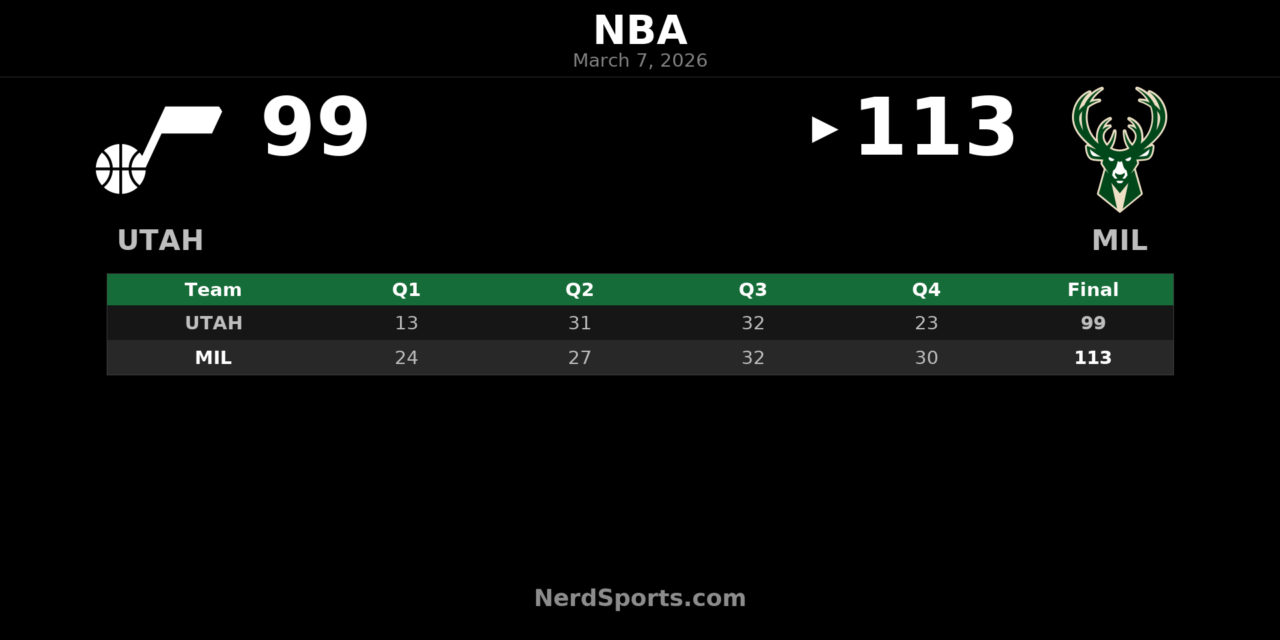
The Milwaukee Bucks came away with a 113-99 victory over the Utah Jazz on Saturday night at Fiserv Forum, improving to 27-35 on the season. Giannis Antetokounmpo set the tone with a commanding all-around performance, and while the Jazz made things competitive through the middle quarters, Milwaukee’s first-quarter advantage proved to be the decisive foundation for the win. An announced crowd of 16,020 watched the Bucks close out the game with a strong fourth quarter to secure the 14-point final margin.
Quarter-by-Quarter Breakdown
First Quarter: Milwaukee Takes Early Control
The Bucks came out with purpose in the opening frame, outscoring the Jazz 24-13. Milwaukee’s offense moved efficiently and their defense kept Utah’s offense in check, setting an early tone that gave the home team a comfortable double-digit cushion heading into the second period. The Jazz struggled to find consistent looks, connecting on a limited number of field-goal attempts as Milwaukee dictated the pace.
Second Quarter: Jazz Cut Into the Lead
Utah responded with its best offensive quarter of the night, posting 31 points in the second period to Milwaukee’s 27. The Jazz outpaced the Bucks in this stretch, trimming the deficit to 51-44 at halftime. Guard Keyonte George provided a scoring spark for Utah’s offense, helping the team find a rhythm that had been absent in the first quarter. Milwaukee still held a seven-point lead at the break, but the Jazz had demonstrated they could generate offense in volume.
Third Quarter: Deadlock in the Third
The third quarter produced a virtual standoff. Both teams scored 32 points apiece, with neither side able to gain meaningful separation. The Jazz continued to push, keeping the game within reach, while Milwaukee worked to maintain its advantage. At the end of three quarters, the Bucks led 83-76, and the contest remained very much in play.
Fourth Quarter: Bucks Pull Away to Seal It
When it mattered most, Milwaukee delivered. The Bucks outscored the Jazz 30-23 in the final period, pushing the lead back out to a comfortable margin and closing out the win at 113-99. Utah’s offense, which had carried the team through the middle two quarters, couldn’t sustain its output down the stretch, and Milwaukee capitalized on every opportunity to extend the gap and secure the victory.
Key Performers
Giannis Antetokounmpo — Milwaukee Bucks
Antetokounmpo was Milwaukee’s best player on both ends of the floor. He led all scorers in the game with 27 points, added 9 rebounds, distributed 8 assists, and recorded an impressive 4 steals. His rating of 52.25 reflected just how much of an impact he made across the box score. Giannis controlled the game’s rhythm on the offensive end while consistently disrupting Utah’s ball-handlers on defense.
Ryan Rollins — Milwaukee Bucks
Rollins led all players in rebounds with 11, providing Milwaukee with a strong presence on the glass from the guard position. His rebounding effort contributed to the Bucks finishing with 48 total boards and helped limit second-chance opportunities for a Utah team that attempted 90 field goals on the night.
Ousmane Dieng — Milwaukee Bucks
Dieng led Milwaukee’s offense in assists with 9, functioning as a reliable distributor throughout the contest. His playmaking helped keep the Bucks’ ball movement fluid, contributing to the team’s 33-assist total — a number that reflected the collective approach Milwaukee employed offensively.
Keyonte George — Utah Jazz
George led the Jazz in scoring with 22 points and was Utah’s most consistent offensive option throughout the night. He played a significant role in the second-quarter surge that brought the Jazz back within striking distance at halftime. Even so, Milwaukee’s defensive adjustments in the fourth quarter limited the Jazz’s ability to threaten the Bucks’ lead in the closing stages.
Kyle Filipowski — Utah Jazz
Filipowski was Utah’s most complete player on the stat sheet, recording 14 points, 11 rebounds, and 6 assists. His double-double and team-high assist total made him the Jazz’s most well-rounded contributor, and his effort in the paint helped Utah claim the overall rebounding edge (53 to 48) despite the loss.
Game Analysis
Milwaukee’s opening-quarter performance was ultimately the story of this game. The Bucks’ 24-13 advantage in the first period gave them a cushion that the Jazz could never fully erase, even during their strong second and third quarters. Milwaukee finished shooting 48.2% from the field on 85 attempts, compared to Utah’s 34.4% on 90 attempts — a significant efficiency gap that tells the story of this contest plainly. The Bucks’ 33 assists on 41 made field goals underscored a ball-movement-focused offensive approach, and their 15-of-44 performance from three-point range (34.1%) provided enough perimeter production to complement their interior work.
For Utah, the free-throw line was a relative bright spot — the Jazz converted 25 of 29 attempts (86.2%) — but their 24.5% three-point shooting on 49 attempts was a key factor in the overall scoring gap. The Jazz simply could not sustain the efficiency required to overcome the early deficit. The 90 field-goal attempts indicate Utah was generating possessions, but converting just 31 of them was not enough to put prolonged pressure on Milwaukee’s lead when it mattered in the fourth quarter.
Standings and Series Implications
With the win, the Milwaukee Bucks move to 27-35 overall, holding a 15-16 home record at Fiserv Forum this season. The victory keeps the Bucks in the mix for positioning in the Eastern Conference standings as the regular season heads into its final stretch. For the Utah Jazz, the loss drops them to 19-45, a mark that reflects the challenges of a rebuilding season. Utah’s road record now sits at 8-24. Both teams will continue to look ahead as the March schedule progresses, with the Bucks hoping to build on this performance and the Jazz working toward developing their younger core for future seasons.