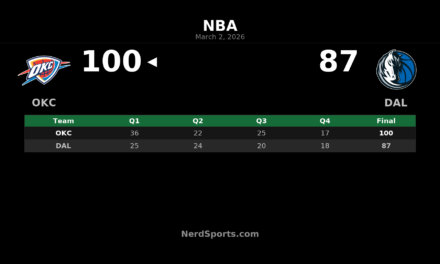
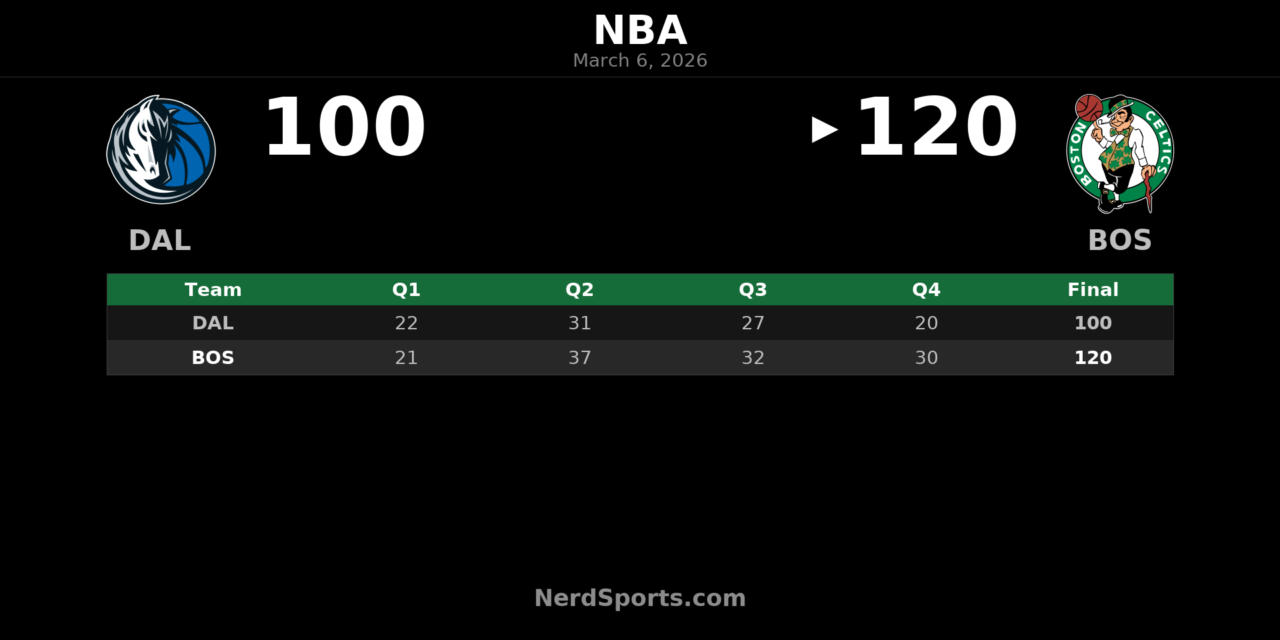
The Boston Celtics delivered a convincing performance at TD Garden on Friday night, outscoring the Dallas Mavericks 120-100 to improve to 42-21 on the season. Before a sellout crowd of 19,156, Boston took control of the game in the second quarter and never looked back, steadily widening the margin through the second half to come away with a comfortable 20-point victory. Jaylen Brown was the engine of the offense all night, while Neemias Queta provided an imposing presence on the boards that gave the Celtics a decisive advantage in the paint.
Quarter-by-Quarter Breakdown
First Quarter: Dallas Edges Ahead, 22-21
The opening period was tightly contested, with Dallas holding a slim 22-21 advantage after 12 minutes. Both teams found their offensive rhythm early, and the Mavericks’ perimeter shooting gave them just enough to lead after one. Boston showed discipline in keeping the deficit to a single point heading into the second.
Second Quarter: Celtics Take Control, 37-31
The second quarter was the turning point of the game. Boston outscored Dallas 37-31 in the period — a dominant quarter that flipped the lead and gave the Celtics a 58-53 advantage at halftime. The Celtics’ offense operated with efficiency, generating ball movement that produced open looks, while their defense began to limit Dallas’s transition opportunities. Boston entered the locker room with a five-point cushion and the clear momentum advantage.
Third Quarter: Boston Extends the Lead, 32-27
The Celtics maintained their edge through the third quarter, outscoring Dallas 32-27 to push their lead to 90-80 heading into the final frame. Dallas kept pace at times, but Boston’s depth and defensive rotations made sustained Mavericks runs difficult to sustain. Cooper Flagg remained active for Dallas, but the Celtics’ collective effort kept any potential comeback from gaining traction.
Fourth Quarter: Celtics Close It Out, 30-20
Any remaining uncertainty evaporated in the fourth quarter. Boston outscored Dallas 30-20 in the final period, pulling away methodically to seal the 120-100 final. With the starters maintaining their focus and the bench contributing, the Celtics made a statement in the closing minutes, finishing with their best quarter of the game.
Key Performers
Jaylen Brown — Boston Celtics
Brown was Boston’s standout performer from start to finish. He led all scorers with 24 points, added 7 rebounds, and distributed 7 assists to complete a well-rounded effort. His rating of 43.7 was easily the highest on either team. Brown’s ability to create for teammates as well as himself made him a consistent problem for Dallas’s defense throughout all four quarters.
Neemias Queta — Boston Celtics
The Portuguese center had a standout game on the glass, pulling down a team-high 15 rebounds to anchor Boston’s interior presence. His performance on the boards was a key factor in Boston’s substantial rebounding advantage — 58 to 45 — which translated directly into second-chance opportunities and limiting Dallas to single possessions.
Klay Thompson — Dallas Mavericks
Thompson led Dallas in scoring with 19 points, providing the most consistent offensive output for the Mavericks on the night. His perimeter shooting kept Dallas within range in the early going, but the Mavericks were unable to generate enough production elsewhere to challenge Boston’s depth.
Cooper Flagg — Dallas Mavericks
The rookie forward continued to show his all-around capability, recording 16 points, 8 rebounds, and 6 assists — the most well-rounded statline on the Dallas side. Flagg led the Mavericks in both rebounds and assists, demonstrating the kind of versatility that gives Dallas a foundation to build around. Even in a losing effort, his performance stood out.
Game Analysis
The final score reflects what was ultimately a tale of two teams operating at very different levels of efficiency and depth. Boston shot 47.5 percent from the field on 99 attempts and connected on 16 of 48 three-point attempts (33.3%). The Celtics also generated 29 assists, a strong indicator of their ball movement and team-oriented offense throughout the night.
Dallas shot a respectable 40.0 percent from beyond the arc (14-of-35) but could only manage 40.9 percent from the field overall, and their rebounding deficit proved insurmountable. The Mavericks were outrebounded by 13, and Boston’s ability to control the glass — particularly through Queta’s 15-rebound effort — created a consistent edge in terms of possessions and second chances.
The game’s defining stretch was Boston’s second quarter, where the Celtics outpaced Dallas by six points to flip the game on its head. From that point forward, Dallas was always chasing. Brown’s dual role as scorer and facilitator kept the offense balanced, and the Celtics’ bench production in the fourth quarter allowed the lead to grow to its largest margin of the night.
Standings and Implications
With the win, the Boston Celtics improve to 42-21 overall, maintaining a strong position in the Eastern Conference standings as the regular season moves into its final stretch. Their balanced 21-10 home record and 21-11 road record reflect the kind of consistent two-way play that makes them a serious Eastern Conference contender. For the Dallas Mavericks, the loss drops them to 21-42 on the season — a difficult position with limited room for error as the playoff picture becomes clearer. Cooper Flagg’s development remains a silver lining for Dallas’s long-term outlook, but in the near term, the Mavericks will need to find more consistent contributions around their young building blocks to remain competitive down the stretch.