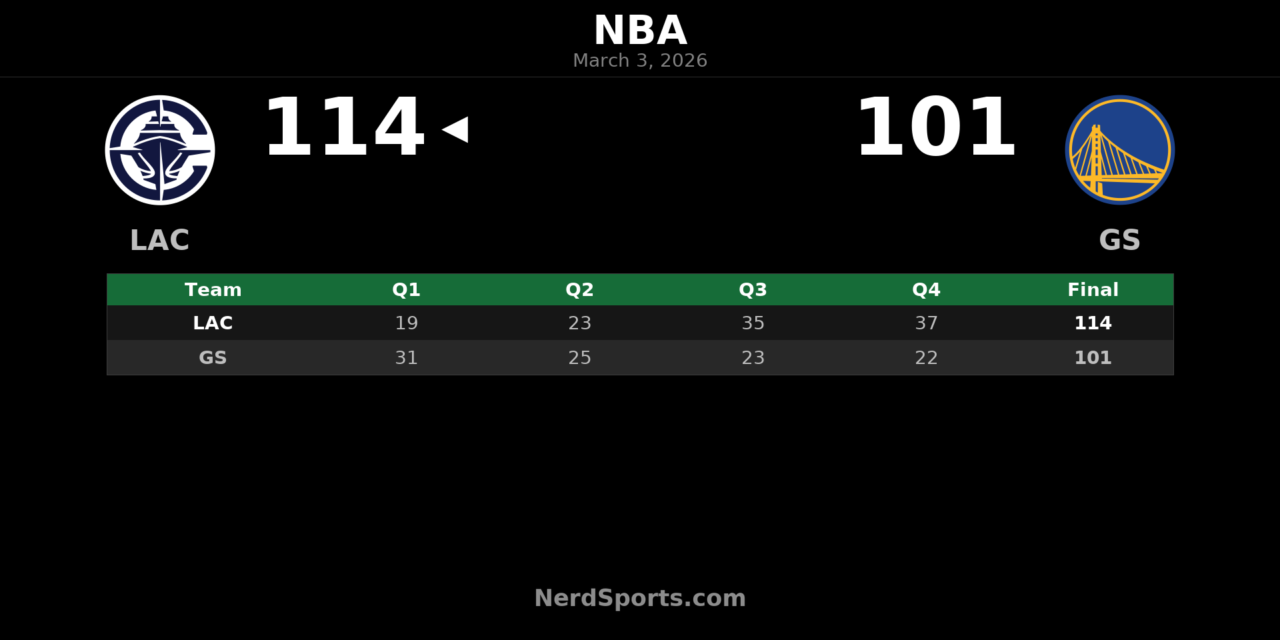
The LA Clippers came into Chase Center trailing by 12 at halftime and left San Francisco with a convincing 114-101 victory over the Golden State Warriors on Sunday night. Powered by a dominant second half that saw them outscore Golden State 72-45 over the final two quarters, the Clippers flipped the script in impressive fashion before a crowd of 18,064. Kawhi Leonard led the charge with a composed, efficient performance, while the Warriors were unable to sustain the energy that gave them an early advantage.
Quarter-by-Quarter Breakdown
Q1 — Warriors 31, Clippers 19
Golden State came out with exceptional pace in the opening frame, posting 31 first-quarter points to take an early 12-point lead. The Warriors moved the ball efficiently and shot at a strong clip, putting LA on its heels from the opening tip. The Clippers struggled to find their footing defensively and could not match Golden State’s rhythm in those early minutes.
Q2 — Warriors 25, Clippers 23
The second quarter was more competitive, with both teams exchanging baskets at a steady rate. Golden State continued to hold the lead, outscoring LA 25-23 to take a 56-42 advantage into the locker room at halftime. The Warriors appeared in control, but the Clippers showed signs of settling in as the half wore on.
Q3 — Clippers 35, Warriors 23
Everything changed after the break. The Clippers returned from halftime with renewed purpose, outpacing Golden State 35-23 in the third quarter to completely erase the deficit and take a slim lead into the fourth. LA’s interior game became far more effective, and their ability to get to the free-throw line — where they converted at a 91.3% clip for the game — proved critical. Golden State’s offense stalled, and they could not keep pace with the Clippers’ second-half surge.
Q4 — Clippers 37, Warriors 22
The fourth quarter put the result beyond doubt. Los Angeles continued to pull away, posting 37 points to Golden State’s 22 in the final frame to seal a 114-101 final. The Warriors had no answer for the Clippers’ rhythm, and the game’s outcome was decided well before the final buzzer. Golden State’s field goal shooting fell apart down the stretch as LA consistently found open looks and quality shots in the paint.
Key Performers
Kawhi Leonard — LA Clippers
Kawhi Leonard was the game’s top-rated performer, finishing with a game-high 23 points and 8 rebounds. He was in command throughout, using his size, footwork, and composure to consistently find quality scoring opportunities. Leonard’s ability to draw fouls and convert at the line proved especially valuable in the second half as the Clippers built their lead. He received a game-high ESPN rating of 44.9, reflecting his all-around impact on the win.
Yanic Konan Niederhauser — LA Clippers
The Clippers’ center, Yanic Konan Niederhauser, led all players on both rosters in rebounding with 9 boards. His presence in the paint helped LA secure a significant rebounding advantage — the Clippers finished with 52 total rebounds compared to Golden State’s 40 — which played a major role in the Clippers’ second-half dominance.
Kris Dunn — LA Clippers
Kris Dunn orchestrated the LA offense with 7 assists, the most by any player in the game. His ability to push the tempo and find teammates in advantageous spots helped the Clippers generate quality looks throughout the second half.
Brandin Podziemski — Golden State Warriors
Podziemski led the Warriors in scoring with 22 points and added 7 rebounds, finishing as Golden State’s highest-rated player with a 34.55 ESPN rating. He was one of the few bright spots for the home team, doing his best to keep the Warriors competitive as LA took control in the second half.
Gui Santos — Golden State Warriors
Forward Gui Santos put together a solid rebounding performance, leading the Warriors with 11 boards. His work on the glass was a positive individual effort, though it was not enough to offset the team’s overall rebounding deficit against the Clippers.
Draymond Green — Golden State Warriors
Draymond Green led Golden State in assists with 6, continuing his role as the team’s primary facilitator and defensive anchor. Despite his contributions, the Warriors’ offense as a whole could not maintain the efficiency they demonstrated in the opening quarter.
Game Analysis
The numbers tell a clear story of two very different halves. In the first half, the Warriors looked sharp, shooting well and moving the ball to build a 14-point lead. But in the second half, the Clippers outperformed Golden State at every level. Los Angeles shot 49.4% from the field for the game compared to the Warriors’ 38.7%, and their 91.3% free-throw accuracy on 23 attempts gave them a reliable secondary scoring avenue. The Clippers were also far superior on the boards, outrebounding Golden State 52-40, a margin that translated into extra possessions and points.
Golden State’s three-point volume — 48 attempts — may have contributed to some of their offensive inconsistency. While they connected on 17 threes at a 35.4% clip, that high volume of deep attempts without complementary interior scoring left them vulnerable when shots stopped falling. The Clippers, by contrast, attempted far fewer threes (31) and relied more heavily on two-point field goals and free throws, shooting 42-for-85 overall. It was a more balanced and sustainable offensive approach, particularly in a road environment.
Standings and Series Implications
With the victory, the LA Clippers improve to 28-31 on the season (13-18 on the road), while the Warriors drop to 31-29 overall (19-12 at home). Both teams are navigating the competitive Western Conference landscape with meaningful stakes still on the line. For the Warriors, the home loss is a missed opportunity to build on their advantage in the standings, while the Clippers pick up a valuable road win that keeps them within striking distance as the regular season moves into its final stretch. This game aired nationally on Peacock and NBCSN, giving both franchises a prime-time platform — and it was the Clippers who made the most of the spotlight.