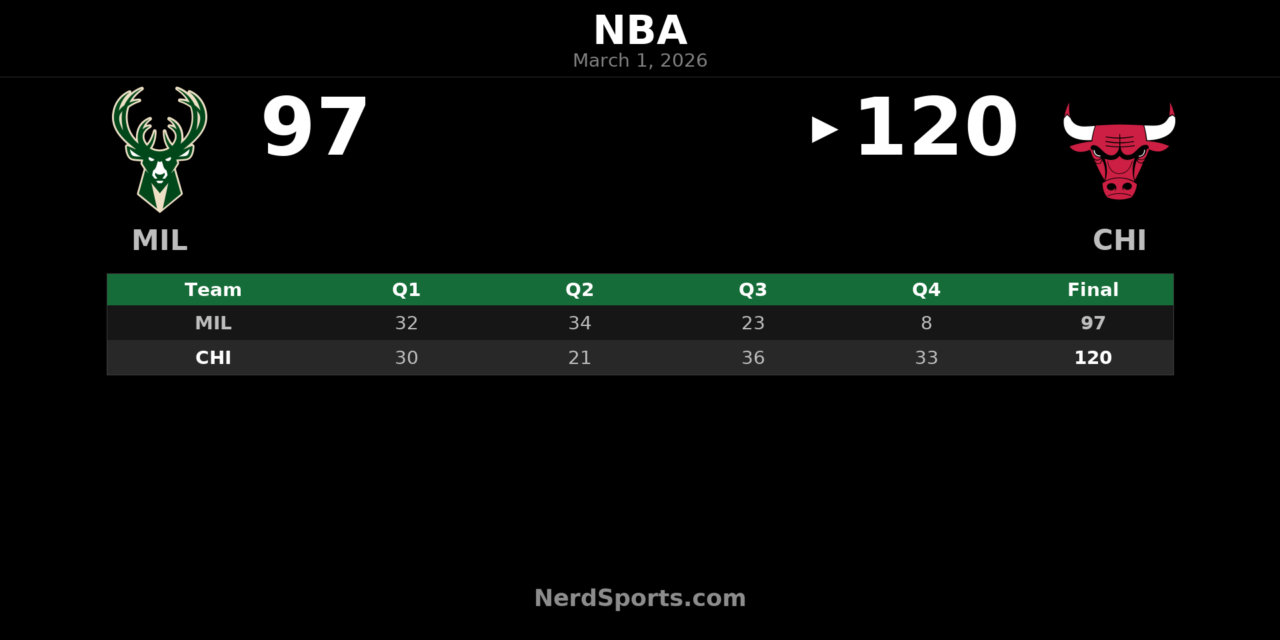
The Chicago Bulls authored one of their most complete second-half performances of the season on Sunday night, overcoming a 15-point halftime deficit to dismantle the Milwaukee Bucks 120–97 at a sold-out United Center. Before a crowd of 20,749, Josh Giddey delivered a masterful triple-double, Collin Sexton led all scorers, and Chicago’s defense turned a competitive game into a rout over the final 24 minutes.
Quarter-by-Quarter Breakdown
First Quarter: Bucks Draw First Blood (MIL 32 – CHI 30)
Milwaukee came out with purpose in the opening period, building an early rhythm and taking a two-point edge heading into the second quarter. The Bucks moved the ball well offensively and held a slight advantage on the boards, but Chicago stayed within arm’s reach, trailing by just two after 12 minutes.
Second Quarter: Milwaukee Seizes Control (MIL 34 – CHI 21)
The second quarter was where Milwaukee did its most significant damage. Outscoring Chicago 34–21 in the period, the Bucks pushed their halftime lead to 15 points (66–51), exploiting defensive breakdowns and getting easy looks in transition. Chicago’s offense stalled, and the United Center fell quiet heading into the locker room.
Third Quarter: Bulls Begin Their Comeback (CHI 36 – MIL 23)
Whatever adjustments Chicago’s coaching staff made at halftime paid immediate dividends. The Bulls outscored Milwaukee 36–23 in the third quarter — their best quarter of the night — to trim the deficit to just two points entering the fourth. The United Center energy shifted dramatically as Chicago’s defense began forcing turnovers and its offense found an efficient rhythm.
Fourth Quarter: Chicago Takes Over (CHI 33 – MIL 8)
The final quarter belonged entirely to the Bulls. Chicago’s 33–8 fourth-quarter explosion was a clinic in sustained defensive pressure and opportunistic offense. Milwaukee’s offense nearly went dark, managing just eight points as the Bucks shot poorly and struggled to generate quality looks. The Bulls turned what had been a two-point deficit entering the fourth into a dominant 23-point final margin.
Key Performers
Josh Giddey — Chicago Bulls
Giddey was the engine of Chicago’s comeback, finishing with 20 points, 14 rebounds, and 10 assists for a triple-double that earned him the game’s top performance rating. The Australian guard controlled the pace in the second half, making smart decisions with the ball and crashing the boards relentlessly. His 14 rebounds and 10 assists were both game highs, underscoring how central he was to Chicago’s offensive operation.
Collin Sexton — Chicago Bulls
Sexton led all scorers with 22 points, providing the offensive punch off the perimeter that kept Milwaukee’s defense from sagging too heavily on Giddey. His ability to create in isolation and off pick-and-roll action was a consistent problem for Milwaukee’s guards throughout the second half.
Bobby Portis — Milwaukee Bucks
Portis was Milwaukee’s most productive player on the night with 18 points and earned the team’s top performance rating. Playing in the building where he spent the first several years of his career, Portis was a bright spot in an otherwise difficult night for the Bucks. He was limited by a lack of support as Milwaukee’s offense collapsed in the second half.
Jericho Sims — Milwaukee Bucks
Sims led Milwaukee with 11 rebounds, providing some interior presence, but the Bucks as a team were badly outrebounded by Chicago’s 50-to-45 margin — a reflection of how thoroughly the Bulls controlled the boards in the second half.
Ryan Rollins — Milwaukee Bucks
Rollins led Milwaukee with 7 assists, showing some playmaking ability, but the Bucks’ overall offense — finishing at just 36.8 percent from the field — did not give him much to work with.
Game Analysis
The numbers tell a clear story about what decided this game. Chicago shot 51.2 percent from the field compared to Milwaukee’s 36.8 percent, a disparity that became especially pronounced in the second half. The Bulls hit 18 of 49 three-point attempts (36.7%), while Milwaukee connected on just 13 of 46 (28.3%) — a significant edge given how heavily both teams relied on the arc.
Perhaps the most telling statistic, however, is the fourth-quarter scoring differential. Milwaukee’s eight fourth-quarter points represent a near-complete offensive collapse. Chicago’s defense, which had been susceptible in the first half, tightened considerably after halftime, forcing contested shots and limiting second-chance opportunities. The Bulls won the rebounding battle 50–45 and finished with 34 assists to Milwaukee’s 26, reflecting a more cohesive offensive approach, particularly down the stretch.
For the Bulls, this was the kind of comeback win that can reinvigorate a team in the stretch run. For Milwaukee, the fourth quarter will require serious examination — eight points on 95 field-goal attempts for the game, including a near-shutout in the final 12 minutes, is the kind of performance that raises real questions about the Bucks’ consistency.
Standings and Series Implications
With the victory, Chicago improves to 25–36 on the season (16–17 at home), keeping alive a modest push in the lower tier of the Eastern Conference playoff picture. Milwaukee falls to 26–33, a record that reflects the inconsistency that has defined their season. The Bucks’ road record now sits at 12–19 after Sunday’s loss. Both teams remain in the mix for play-in positioning, but this result is a setback for Milwaukee’s efforts to stabilize in the standings. Chicago, meanwhile, showed enough fight and depth in the second half to suggest they are capable of making noise down the stretch, particularly with Giddey playing at this level.