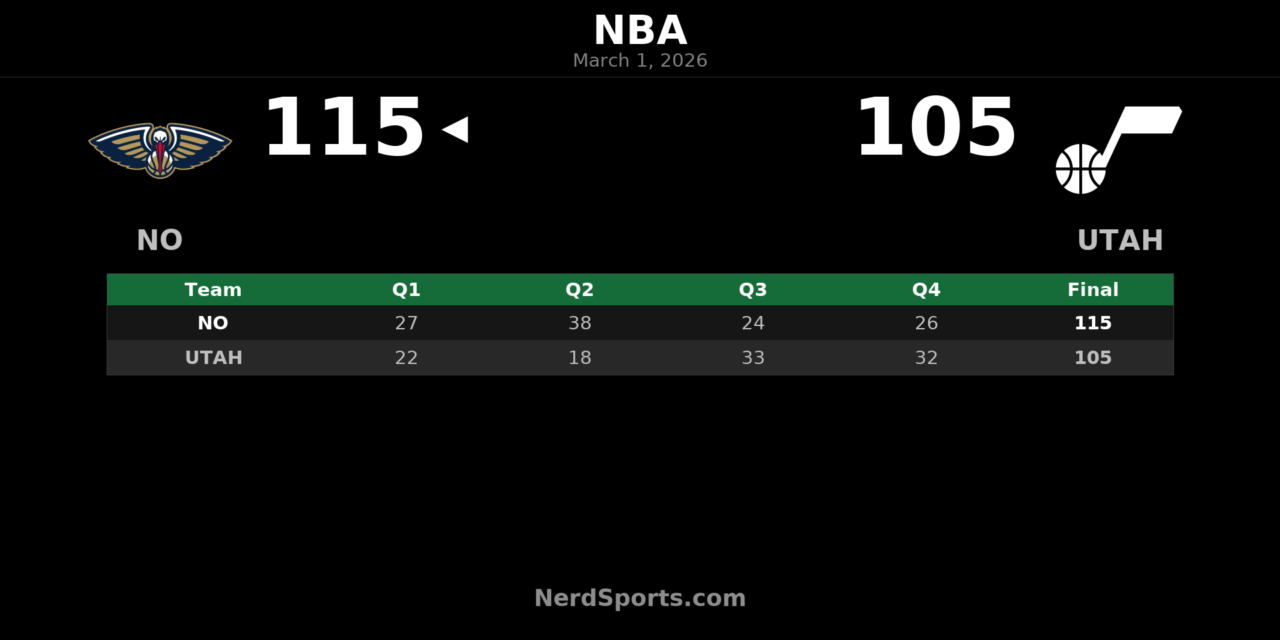
The New Orleans Pelicans walked out of Delta Center with a 115-105 victory over the Utah Jazz on Saturday night, improving to 19-42 on the season with a road win fueled by a dominant second quarter and balanced offensive contributions. Before a crowd of 18,186 in Salt Lake City, New Orleans built a 20-point halftime advantage that proved too large for Utah to fully erase, despite a spirited second-half push from the home side.
Quarter-by-Quarter Breakdown
First Quarter: Pelicans Set the Tone Early
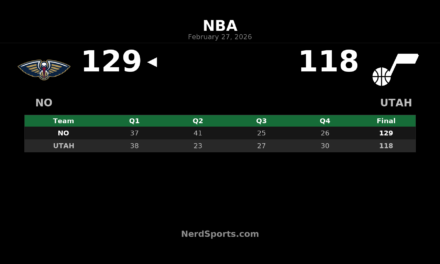
New Orleans came out sharp from the opening tip, outscoring Utah 27-22 in the first quarter. The Pelicans moved the ball efficiently and attacked the paint consistently, establishing an early rhythm that kept the Jazz defense scrambling. Utah showed flashes offensively but couldn’t match New Orleans’ pace through the first 12 minutes.
Second Quarter: New Orleans Goes on a Tear
The second quarter was the defining stretch of the game. The Pelicans erupted for 38 points — their highest-scoring quarter of the night — while limiting Utah to just 18. That 20-point frame ballooned the halftime deficit to 65-40 in favor of New Orleans. The Jazz shot a difficult 34.4 percent from the field overall, and a significant chunk of that damage was done in the second quarter when their offense simply couldn’t generate clean looks.
Third Quarter: Jazz Show Some Fight
Utah responded with their best quarter of the game in the third period, outscoring New Orleans 33-24 to trim the deficit considerably. The Jazz’s energy off the bench picked up, and they began finding more success in the paint. However, New Orleans continued to make enough plays to prevent any real momentum swing that might threaten their lead.
Fourth Quarter: Pelicans Close It Out
Utah kept pressing in the fourth, outscoring New Orleans 32-26, but the Jazz never got close enough to make the final minutes truly tense. The Pelicans were disciplined down the stretch, managing the game clock and their possessions to secure the 10-point final margin.
Key Performers
Saddiq Bey — New Orleans Pelicans
Saddiq Bey was the Pelicans’ leading scorer on the night, finishing with 24 points and 6 assists. The veteran forward was efficient on both ends of the floor and served as New Orleans’ primary offensive catalyst throughout the contest. His ability to create off the dribble and knock down perimeter shots kept the Jazz defense honest all night.
Jeremiah Fears — New Orleans Pelicans
Rookie guard Jeremiah Fears put together an impressive all-around performance, leading all players with 11 rebounds in addition to his offensive contributions. Fears’ ability to control the glass from the guard position was a notable factor in New Orleans’ dominant rebounding night — the Pelicans finished with a remarkable 58 total rebounds compared to Utah’s 40.
Herbert Jones — New Orleans Pelicans
Herbert Jones anchored New Orleans’ playmaking from the wing, dishing out a team-high 7 assists. Jones’ decision-making in the half-court offense helped the Pelicans post 32 total assists on the night, a reflection of their ball movement and team-oriented approach.
Isaiah Collier — Utah Jazz
Isaiah Collier was the clear standout for Utah, finishing with a team-high 21 points and 7 assists to go along with the game’s highest individual rating for a Jazz player. The young guard showed his offensive versatility and ability to create for teammates, but his efforts weren’t enough to overcome Utah’s early hole and their team-wide shooting struggles (34.4 percent from the field on 96 attempts).
Ace Bailey — Utah Jazz
Rookie Ace Bailey led the Jazz on the boards with 8 rebounds, showing the physicality and motor that has made him an intriguing developmental prospect. Bailey continued to demonstrate the kind of effort plays that give Utah fans reasons for optimism looking ahead.
Game Analysis
The box score tells the story clearly: this game was decided in the second quarter. New Orleans’ 38-18 second-period advantage gave them enough cushion to weather Utah’s second-half surge. The shooting disparity was also stark — the Pelicans shot 45.9 percent from the field compared to the Jazz’s 34.4 percent, and New Orleans attempted 11 fewer field goals (85 vs. 96) while scoring 10 more points, indicating far better shot quality and efficiency. The Pelicans’ 58-40 rebounding edge further amplified the discrepancy, giving New Orleans consistent second-chance opportunities throughout the night.
On the three-point line, New Orleans went 15-of-44 (34.1%) while Utah converted just 12-of-43 (27.9%), a meaningful gap that added to the scoring differential. Utah’s free-throw shooting was actually the more efficient of the two (81.8% vs. 75.9% for New Orleans), but the Jazz simply couldn’t generate efficient enough offense over four quarters to make it matter.
Credit should be given to Utah’s resilience — outscoring a playoff-contending opponent 65-58 in the second half shows competitive spirit, and players like Collier and Bailey are developing valuable experience through these situations. But fundamental issues with field goal efficiency and defensive breakdowns in the opening half remain areas the Jazz coaching staff will need to address.
Standings and Context
With the victory, the New Orleans Pelicans improve to 19-42 on the season, while the Utah Jazz fall to 18-42. Both teams are operating outside playoff positioning in the Western Conference, but each game provides meaningful minutes and development time for their young rosters as the 2025-26 season winds toward its conclusion. For the Pelicans, a road win — their 8th of the season away from home — is a welcome boost as they look to finish the year strong. For Utah, the challenge now is to carry the resilience they showed in the second half into future games and build on the encouraging individual performances from Collier and Bailey.