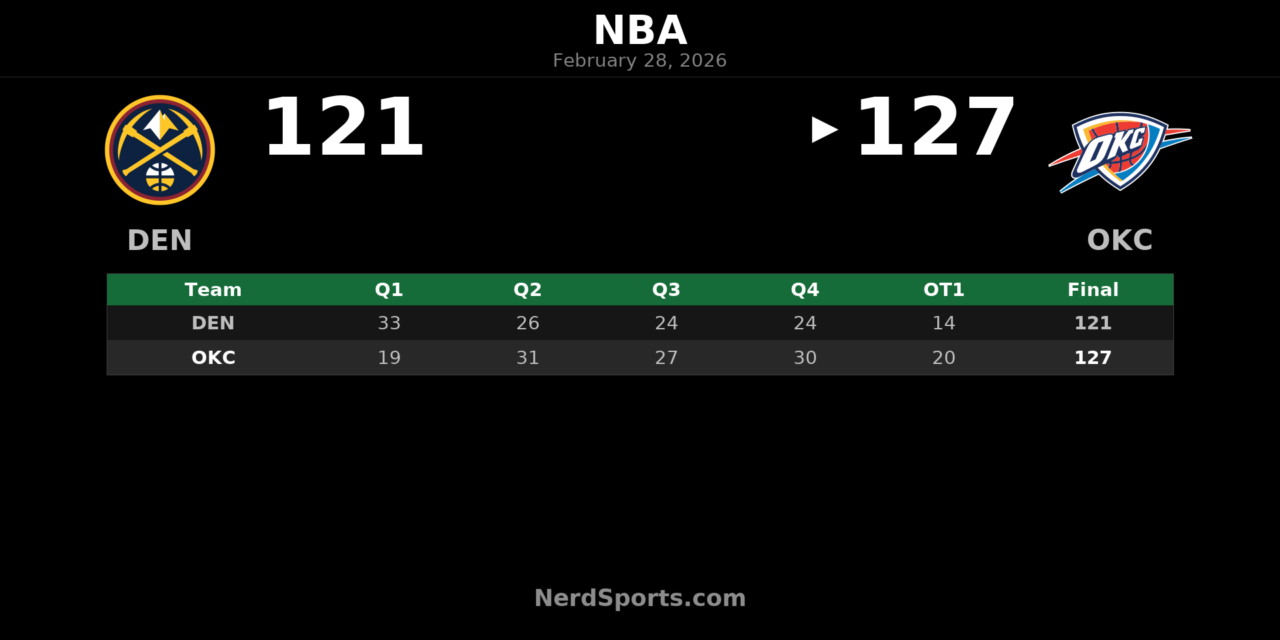
The Oklahoma City Thunder dug themselves out of an early hole and then held off Jamal Murray’s heroics to earn a hard-fought 127-121 overtime victory over the Denver Nuggets at Paycom Center on Friday night. Before a sold-out crowd of 18,203, OKC improved to 46-15 on the season by rallying from a 14-point first-quarter deficit — a statement win that underscored just how resilient this young Thunder squad has become in 2025-26.
Quarter-by-Quarter Breakdown
First Quarter: Denver Comes Out Firing (DEN 33, OKC 19)
The Nuggets wasted no time imposing their will in Oklahoma City. Denver shot efficiently out of the gate, pushing out to a 33-19 lead after one quarter and looking every bit like a team that had circled this matchup on the calendar. OKC’s defense was porous and the offense sputtered, leaving the Thunder in an early double-digit hole they would need to spend the next four-plus periods digging out of.
Second Quarter: Thunder Wake Up (OKC 31, DEN 26)
Oklahoma City flipped the script in the second quarter, outscoring Denver 31-26 to trim the deficit to seven at the half (59-50, DEN). The Thunder’s defense tightened considerably, and the offense found a rhythm — particularly through Shai Gilgeous-Alexander, who began asserting himself and creating opportunities for teammates. Denver’s lead entering halftime was manageable, but the Nuggets still held the advantage.
Third Quarter: Thunder Keep Climbing (OKC 27, DEN 24)
OKC continued its methodical comeback in the third, outscoring Denver 27-24 to close the gap further. The Thunder’s defense made Denver work considerably harder for every basket, and Chet Holmgren’s interior presence became increasingly disruptive. By the end of three quarters, the Nuggets’ lead had shrunk to just four points (83-77, DEN), and all the momentum belonged to the home team.
Fourth Quarter: Thunder Tie It Up (OKC 30, DEN 24)
Oklahoma City completed the comeback in the fourth, outscoring Denver 30-24 to force overtime tied at 107. The Thunder made winning plays down the stretch, with Gilgeous-Alexander repeatedly getting to his spots and finding open teammates. Denver had several chances to put the game away but could not generate enough clean looks against an increasingly locked-in OKC defense. When the buzzer sounded at the end of regulation, the home crowd was rocking.
Overtime: Thunder Pull Away (OKC 20, DEN 14)
The five-minute extra period was never truly in doubt once Oklahoma City seized the initiative. The Thunder outscored Denver 20-14 in overtime to close out the win, leaning on Gilgeous-Alexander’s poise and Holmgren’s ability to control the glass. Denver, despite Murray’s best efforts, could not find the efficiency needed to extend the game a second time. Final: OKC 127, DEN 121.
Key Performers
Shai Gilgeous-Alexander, OKC — 36 PTS, 9 AST
SGA was the engine that powered Oklahoma City’s comeback. He finished with 36 points and 9 assists, orchestrating the offense with the efficiency and calm that has defined his MVP-caliber 2025-26 season. His ability to get into the paint, draw fouls, and find cutters repeatedly put Denver’s defense on its heels. In overtime particularly, SGA made the critical decisions that allowed OKC to pull away. He also finished as OKC’s top-rated player by ESPN’s game rating metric.
Chet Holmgren, OKC — 21 REB
Holmgren’s 21-rebound performance was a decisive factor in Oklahoma City’s win. The Thunder controlled the glass overall (56 team rebounds to Denver’s 51), and Holmgren was central to that dominance. His interior presence on both ends of the floor altered Denver’s rhythm and gave OKC extra possessions throughout the night. Twenty-one boards is a standout performance for any player, let alone a center in his third NBA season.
Jamal Murray, DEN — 39 PTS, 8 REB, 6 AST
Murray put together an exceptional individual effort that ultimately came up just short. His 39-point performance — which included 8 rebounds and 6 assists — gave Denver every chance to win this game. Murray was Denver’s most reliable offensive option throughout the night and kept the Nuggets competitive even as OKC’s defense stiffened in the second half. His stat line was the highest-rated performance of the night, but without enough support around him in the clutch, it wasn’t enough.
Nikola Jokic, DEN — 17 REB, 14 AST
The reigning three-time MVP put together a characteristically unique stat line with 17 rebounds and 14 assists. Jokic’s playmaking kept Denver’s offense functioning even when shots weren’t falling at a high rate. Denver as a team went 43-of-103 from the field (41.7%) and 18-of-48 from three (37.5%), and while the three-point volume was there, the overall field goal efficiency fell below what the Nuggets needed to hold off a surging Thunder team.
Game Analysis
This game illustrated both the ceiling of these two franchises and the fine margins that separate them. Denver was the better team for roughly one quarter — and it showed, building a lead that looked potentially problematic for Oklahoma City. But the Thunder’s response was measured and methodical rather than frantic, which speaks to the culture Sam Presti and the coaching staff have built in OKC.
The rebounding battle was a significant differentiator. Oklahoma City’s 56 rebounds to Denver’s 51 gave the Thunder additional possessions that proved crucial in a game decided by six points after overtime. Holmgren’s 21-board effort was the headlining number, but the Thunder rebounded as a unit. OKC also shot 46.5% from the field compared to Denver’s 41.7%, and while Denver attempted more threes (48 to OKC’s 35) and made them at a slightly higher clip (37.5% to 34.3%), OKC’s interior efficiency was the deciding factor.
For Denver, the core concern remains what it has been for stretches of this season: the supporting cast around Jokic and Murray needs to provide enough scoring to take pressure off those two stars. When OKC’s defense focused its attention, Denver had limited secondary options capable of consistently converting. Murray’s 39 points were outstanding, but 39 points from one player in a 121-point game tells a story about where the rest of Denver’s offense landed on a night when they needed more.
OKC’s comeback was built on defensive adjustments and Gilgeous-Alexander’s relentless pressure. The Thunder were outscored by 14 in the first quarter but allowed only 14 points in overtime — a 28-point defensive swing that encapsulates why OKC has one of the best records in the NBA this season.
Standings & Series Implications
With the win, the Oklahoma City Thunder improve to 46-15 on the season — one of the best records in the Western Conference — and move to 25-7 at home at Paycom Center. Their road record of 21-8 further underscores that this team is a legitimate title contender, not just a home-court favorite. The Denver Nuggets fall to 37-23 overall and will need to regroup as the playoff picture in the West continues to take shape. Denver’s road record remains strong at 21-12, but losses in games this close to conference rivals make the path through the playoffs that much more difficult. Both teams will continue jockeying for position as the February 28 game counts toward the final stretch of the 2025-26 regular season schedule.