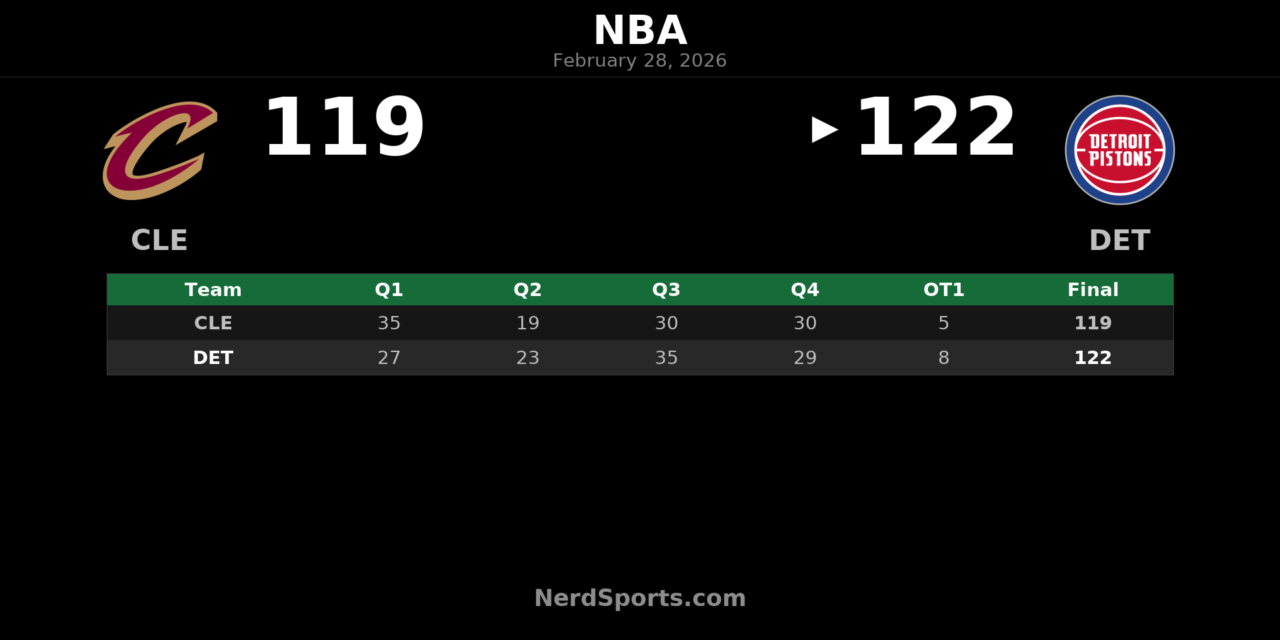
DETROIT — Jalen Duren delivered one of the most complete performances of his young career, and the Detroit Pistons needed every bit of it. In a game that featured an 18-minute stoppage caused by a blaring horn and a malfunctioning scoreboard, the Pistons held their composure and outlasted the Cleveland Cavaliers 122–119 in overtime on Friday night at Little Caesars Arena. The victory, played in front of 20,232 fans and broadcast nationally on ESPN, improved Detroit to an impressive 44–14 on the season and cemented their status as one of the NBA’s elite teams.
The win was not clean — Detroit shot just 46.0 percent from the field and a pedestrian 22.2 percent from three — but the Pistons found a way to grind out a result against a tough Cleveland team that refused to go away. That grittiness, more than any single play, defined Friday night in Detroit.
Quarter-by-Quarter Breakdown
First Quarter: Cleveland Jumps Out Early (CLE 35, DET 27)
The Cavaliers came out sharp and set the tone immediately, outscoring the Pistons 35–27 in the opening frame. Cleveland moved the ball with purpose — they would finish the game with 32 assists on 43 made field goals — and their perimeter shooting was on point throughout the early going. Detroit’s defense struggled to contain Cleveland’s ball movement, and an eight-point deficit at the end of one quarter put the home crowd on edge early.
Second Quarter: Pistons Respond (DET 23, CLE 19)
Detroit flipped the script in the second period, outscoring Cleveland 23–19 to close the gap heading into halftime. The Pistons tightened their defense and started to establish Duren in the post, drawing fouls and converting at the line. Detroit trailed by just four at the break, 54–50, and the momentum had clearly shifted toward the home side.
Third Quarter: Chaos, a Horn, and a Detroit Surge (DET 35, CLE 30)
The third quarter will be remembered less for the basketball and more for the bizarre interruption that accompanied it. A power surge at Little Caesars Arena caused the overhead scoreboard to malfunction, triggering a blaring horn that forced officials to halt play for 18 minutes. The stoppage tested the patience of both teams, the officials, and the crowd, but once play resumed, it was Detroit that capitalized. The Pistons outscored Cleveland 35–30 in the quarter to take their first lead of the game heading into the fourth, 85–84. Whether the delay disrupted Cleveland’s rhythm or simply allowed Detroit to reset, the Pistons clearly benefited from the extended break.
Fourth Quarter: Cleveland Forces Overtime (CLE 30, DET 29)
The Cavaliers showed their resilience in the fourth, matching Detroit nearly point for point and outscoring the Pistons 30–29 to knot the game at 114 apiece and force overtime. Craig Porter Jr. was instrumental in Cleveland’s fourth-quarter push, orchestrating the offense and keeping the Cavaliers in the game with his playmaking. It set up a tense extra session with both teams still standing.
Overtime: Detroit Seals It (DET 8, CLE 5)
In the overtime period, Detroit’s experience and interior dominance proved to be the difference. The Pistons outscored the Cavaliers 8–5 in the extra frame, with Duren continuing to impose his will around the basket. Cleveland managed only five points in OT, a sign that fatigue and Detroit’s physical advantage finally wore them down. The Pistons closed it out and secured the three-point victory, 122–119.
Key Performers
Jalen Duren, C — Detroit Pistons: 33 PTS, 16 REB, 3 BLK
Duren was the story of the night. The young center posted 33 points and 16 rebounds — a dominant double-double that earned him the game’s top rating — while also adding three blocks on the defensive end. His ability to score in the paint, protect the rim, and keep possessions alive on the offensive glass proved decisive in a game decided by three points in overtime. This was a statement performance from a player who is rapidly developing into one of the league’s premier big men.
Cade Cunningham, G — Detroit Pistons: 7 AST
Cunningham led Detroit’s assist chart with seven dimes, serving as the engine that kept the Pistons’ offense humming. While his scoring line is not reflected in the available data, his court vision and ability to find Duren in advantageous positions were central to Detroit’s offensive strategy throughout the game.
Jarrett Allen, C — Cleveland Cavaliers: 25 PTS, 9 REB
Allen was Cleveland’s best player on the night, posting 25 points and 9 rebounds in a battle of centers that had genuine playoff intensity. Allen held his own against Duren for much of the game, but Detroit’s big man ultimately had the edge when it mattered most in overtime.
Craig Porter Jr., G — Cleveland Cavaliers: 12 AST
Porter Jr. was exceptional as a facilitator, dishing out 12 assists to pace the Cavaliers and all players in the game. His ability to generate easy looks for teammates kept Cleveland competitive deep into the fourth quarter and overtime. However, Cleveland’s inability to convert late possessions cost them dearly.
Evan Mobley, C — Cleveland Cavaliers: 12 REB
Mobley led the Cavaliers on the glass with 12 rebounds, providing a secondary interior presence alongside Allen. Cleveland’s 41 total rebounds, however, were significantly outpaced by Detroit’s 56 — a gap that ultimately reflected the game’s outcome.
Game Analysis
The numbers tell an interesting story about how this game was won and lost. Detroit shot just 6-of-27 from three-point range (22.2%), a below-average night from the perimeter, while Cleveland connected on 13-of-35 threes (37.1%). On paper, the Cavaliers had the shooting advantage from distance. But Detroit’s massive 56–41 rebounding edge — a 15-board differential — essentially negated Cleveland’s three-point efficiency. More second-chance opportunities, more possessions, and more free throws (Detroit attempted 33 to Cleveland’s 27) made up the gap.
The 18-minute third-quarter delay is worth examining in its own right. Both teams were forced off the court, routines were disrupted, and the arena atmosphere had to be re-established from scratch. Detroit, playing at home with the crowd on their side, appeared to use the reset to their advantage, coming out of the stoppage and outscoring Cleveland in the third quarter despite the chaos. Whether that is coincidence or mental fortitude is hard to quantify, but the Pistons’ ability to refocus after the delay speaks to a maturity that has defined their season.
Cleveland’s 32 assists suggest a team that shares the ball and creates within the flow of the offense, but their 5-point overtime output indicates their legs may have been spent by the time the extra period arrived — a product of the Pistons’ physical style of play and Duren’s relentless activity around the basket.
Standings and Series Implications
With the victory, the Detroit Pistons improve to 44–14 overall, including a sterling 24–7 at home and a remarkable 20–7 on the road. Detroit continues to position itself at or near the top of the Eastern Conference standings, and a performance like Friday’s — winning in overtime against a quality opponent despite a bizarre scoreboard malfunction and subpar three-point shooting — underscores just how deep and resilient this team has become.
For the Cleveland Cavaliers, the loss drops them to 37–24. They remain a playoff team and are competitive enough to make noise in the postseason, as evidenced by their ability to match Detroit for most of four quarters and overtime. Craig Porter Jr.’s 12-assist night and Jarrett Allen’s continued strong play are positive indicators, but Cleveland will need to find more consistency in crunch-time situations if they want to close the gap on the conference’s top teams. If these two teams meet again — whether in the regular season or a potential playoff series — expect another physical, closely contested battle. Friday night proved the Cavaliers are no pushover, even for the East’s best.