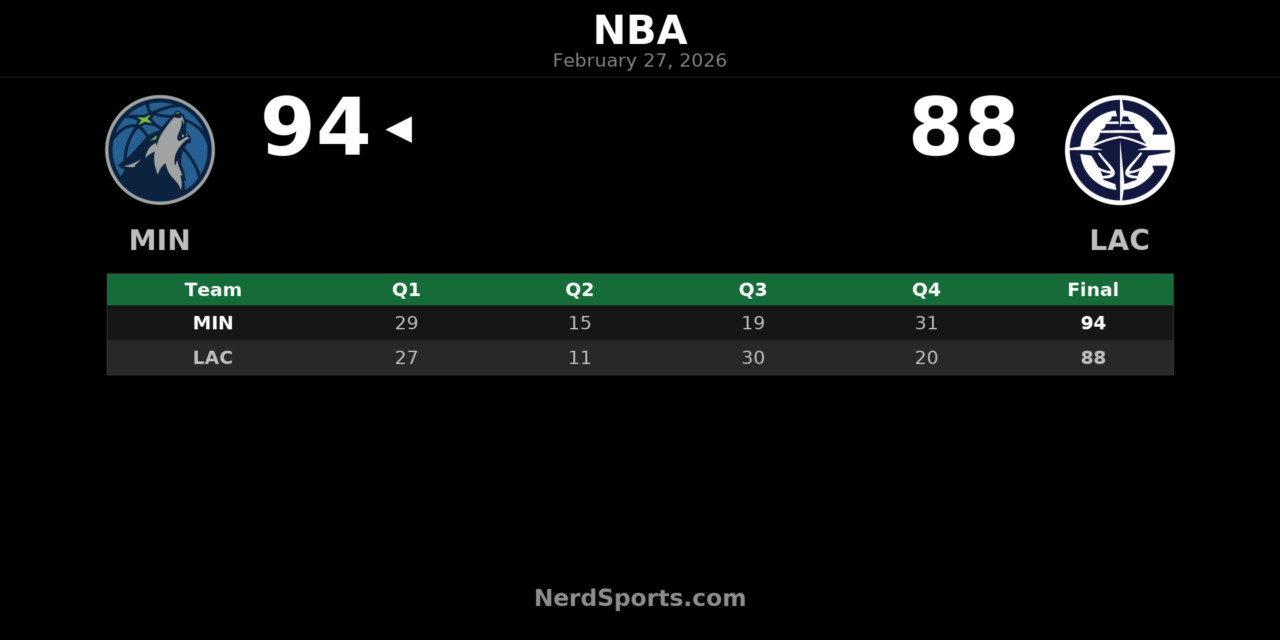
The Minnesota Timberwolves turned a shaky middle stretch into a convincing fourth-quarter statement, outlasting the LA Clippers 94-88 at Intuit Dome in Inglewood, California on Thursday night. Anthony Edwards carried the offense when Minnesota needed it most, and a dominant final frame sealed the road victory in front of 17,649 fans. The Clippers battled back from a large halftime deficit to briefly threaten in the third quarter, but could not sustain that momentum when it mattered most.
Quarter-by-Quarter Breakdown
First Quarter: Timberwolves Jump Out Early (MIN 29, LAC 27)
Minnesota came out with energy from the opening tip, establishing an early rhythm on both ends of the floor. The Wolves led 29-27 after one, a two-point edge that suggested a competitive night was ahead. The Clippers kept pace throughout the quarter and clearly had no intention of letting this one get away from them at home.
Second Quarter: Minnesota Extends the Lead (MIN 15, LAC 11)
The second quarter told a different story, with Minnesota outscoring Los Angeles 15-11 to push the halftime lead to six points, 44-38. The Clippers struggled to generate consistent offense during this stretch, shooting efficiently enough to stay in the game but unable to find the runs necessary to flip the margin. Minnesota’s defense tightened, and the Wolves went into the locker room with a comfortable cushion.
Third Quarter: Clippers Storm Back (MIN 19, LAC 30)
Los Angeles came alive after halftime in a significant way. The Clippers outscored Minnesota 30-19 in the third quarter, trimming the deficit and actually making it a one-possession game heading into the fourth. It was a genuine momentum swing — the crowd at Intuit Dome was engaged, the Clippers were generating good looks, and a comeback appeared entirely within reach.
Fourth Quarter: Timberwolves Close It Out (MIN 31, LAC 20)
Minnesota responded to the Clippers’ third-quarter charge with its best quarter of the night. The Wolves outscored Los Angeles 31-20 in the fourth, rebuilding the lead and never letting the Clippers threaten again. It was a mature, composed performance down the stretch from a Minnesota team that has learned how to win road games. The 94-88 final was never particularly in doubt after the first few minutes of the fourth quarter.
Key Performers
Anthony Edwards — Minnesota Timberwolves
Edwards was the engine of the Timberwolves’ offense from start to finish. The young guard led all scorers with 31 points, earning the game’s top rating according to ESPN’s metrics. His ability to create his own shot and attack downhill gave the Clippers’ defense fits all night. When Minnesota needed a bucket in the fourth quarter to push the lead back out, Edwards was the answer.
Rudy Gobert — Minnesota Timberwolves
Gobert did what he does — dominate the glass and protect the rim. The four-time Defensive Player of the Year pulled down a team-high 13 rebounds, helping Minnesota finish with 41 boards as a team. His interior presence kept second-chance opportunities at a minimum for Los Angeles and gave the Wolves consistent possessions.
Julius Randle — Minnesota Timberwolves
Randle was Minnesota’s primary facilitator on the night, leading the team with 6 assists. His ability to operate as a hub in the Wolves’ half-court offense helped keep the offense moving, especially in critical late-game situations.
Kris Dunn — LA Clippers
On a difficult night for Los Angeles, Kris Dunn was the Clippers’ most well-rounded contributor. He finished as the team’s top-rated player with 11 points, 6 rebounds, and 7 assists — a steady, versatile line that kept LA organized offensively. His 7 dimes led all Clippers and were the most of any player in the game.
Derrick Jones Jr. — LA Clippers
Jones Jr. led the Clippers in scoring with 18 points, providing the most consistent offensive production Los Angeles could muster. His athleticism was on display during the third-quarter comeback, but the Clippers ultimately needed more contributions from across the roster to hold off Minnesota.
Bennedict Mathurin — LA Clippers
Mathurin led the Clippers on the glass with 6 rebounds, adding a physical presence as LA fought to stay competitive throughout the night.
Game Analysis
This game was ultimately defined by two contrasting quarters. The Clippers’ 30-point third quarter was an impressive display of offensive execution — they shot the ball well, attacked the paint, and clearly made halftime adjustments. But Minnesota’s ability to respond with a 31-point fourth quarter of their own tells you something about the Timberwolves’ character and depth.
From a shooting perspective, neither team had a particularly efficient night. The Clippers shot just 40.5% from the field and a poor 22.7% from three (5-of-22), which made their third-quarter run all the more impressive and their overall inefficiency all the more costly. Minnesota was better but not by a wide margin, connecting on 43.4% of their field goal attempts and 30.8% from deep (8-of-26).
Where the Timberwolves did have a clear advantage was at the free-throw line in terms of volume. Los Angeles attempted 29 free throws — a notable number — but converting at only 79.3% left points on the board. Minnesota went to the line just 19 times but made 14 (73.7%). The Clippers’ free-throw opportunities did not translate into the kind of advantage that would change the outcome.
Minnesota’s 23 assists as a team compared to LA’s 21 reflects a Wolves offense that was generally moving the ball and finding open looks, even if the shooting percentages weren’t elite. Edwards’ ability to operate as both a scorer and shot creator gave the Wolves an alpha who could go get a bucket in any situation — a luxury the Clippers lacked on this particular night.
Standings and Implications
With the win, the Minnesota Timberwolves improve to 37-23 on the season (17-12 on the road), continuing to position themselves as a legitimate Western Conference contender. The Wolves’ ability to win road games in close, back-and-forth contests is a strong indicator of a team that knows how to execute when it counts. The LA Clippers fall to 27-31, a record that keeps them on the outside looking in at the playoff picture. The Clippers’ inability to hold a double-digit third-quarter swing will be a point of emphasis going forward, as opportunities to close out winnable home games become increasingly important for a team fighting for postseason positioning. This game was broadcast nationally on Prime Video, reflecting the league-wide interest in both franchises heading into the stretch run of the 2025-26 regular season.