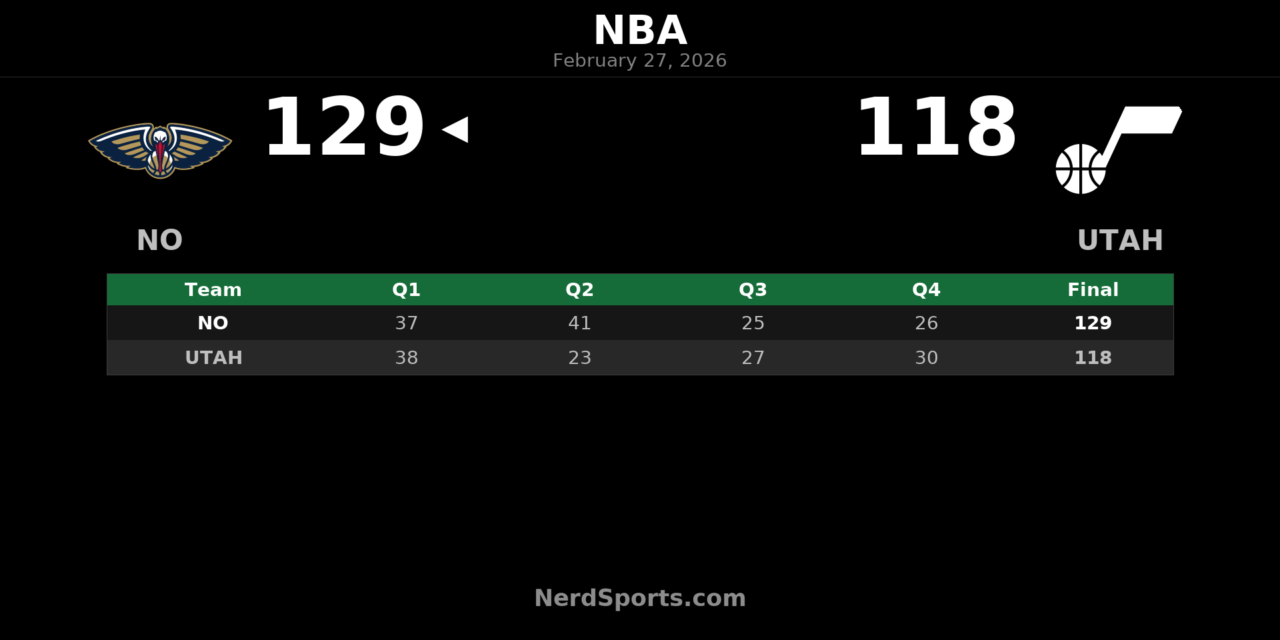
A scorching second quarter and a career night from Saddiq Bey were more than enough for the New Orleans Pelicans to walk out of Salt Lake City with a convincing 129-118 road victory over the Utah Jazz on Thursday, February 26, 2026. Before a crowd of 18,186 at Delta Center, Bey turned in one of the most prolific individual performances of the NBA season, carrying New Orleans through a game that was thoroughly competitive for one half before the Pelicans pulled decisively ahead.
Quarter-by-Quarter Breakdown
First Quarter: Jazz Draw First Blood, 38-37
Utah got off to a clean start, closing out the opening frame with a 38-37 edge over the Pelicans. Both offenses were firing early, combining for 75 points in the first 12 minutes — a pace that hinted at a shootout to come. The Jazz controlled the tempo at home, with their young core keeping the Pelicans at arm’s length through most of the period.
Second Quarter: Pelicans Go on a Tear, 41-23
This quarter decided the game. New Orleans outscored Utah 41-23 in the second period — a stunning 18-point swing that flipped a one-point deficit into a 78-61 halftime lead. The Pelicans shot efficiently, moved the ball with purpose, and simply overwhelmed a Jazz defense that had no answers. Saddiq Bey was the centerpiece of that blitz, and Dejounte Murray’s playmaking kept the offense in a constant flow. Utah’s offense, which had looked so promising in the first quarter, went cold at precisely the wrong moment.
Third Quarter: Jazz Regroup, 27-25
To Utah’s credit, they came out of halftime with more fight. The Jazz outscored the Pelicans 27-25 in the third quarter, showing some of the competitive spirit that head coach will want to build on going forward. Ace Bailey continued to generate offense, and the Jazz trimmed the gap slightly — but New Orleans’ halftime cushion was simply too large to fully erase.
Fourth Quarter: Pelicans Close It Out, 26-30
Utah actually edged New Orleans 30-26 in the fourth quarter, but that late push amounted to little more than a cosmetic improvement to the final scoreline. The Pelicans managed their lead professionally, and the final buzzer confirmed what the second quarter had already made clear: New Orleans was the better team on this night.
Key Performers
Saddiq Bey, New Orleans Pelicans — 42 Points, 7 Assists
There is no other place to start. Saddiq Bey was the story of this basketball game, delivering 42 points and 7 assists in a performance that announced his name to anyone who may not have been paying close enough attention to him this season. Bey’s efficiency, shot creation, and ability to make plays for teammates made him nearly impossible to guard for stretches of the game. His rating of 69.35 — easily the top mark on the floor — reflects just how dominant his overall impact was. On a Pelicans team still finding its identity in a difficult season, this was a reminder of the offensive ceiling Bey carries.
Dejounte Murray, New Orleans Pelicans — 9 Assists
Murray didn’t need to shoulder the scoring load with Bey going off, and he leaned into his playmaking role with 9 assists. The Pelicans’ team total of 37 assists on 46 made field goals speaks directly to Murray’s fingerprints on the offense — crisp, purposeful passing that kept New Orleans in a rhythm throughout the first half especially.
Derik Queen, New Orleans Pelicans — 7 Rebounds
The Pelicans won the glass battle as a team, finishing with 40 rebounds compared to Utah’s 37. Queen led New Orleans on the boards with 7 rebounds, providing the interior presence needed to support the team’s overall efficiency on both ends.
Ace Bailey, Utah Jazz — 23 Points
The Jazz’s most productive player on the night was Ace Bailey, who finished with 23 points and continued to flash the offensive toolkit that has made him one of the more intriguing young players in the league. His rating of 34.45 led Utah and underscored that even on a rough team night, Bailey found ways to create and contribute. He is clearly one of the building blocks Utah will lean on as they continue their rebuild.
Isaiah Collier, Utah Jazz — 7 Assists
Isaiah Collier tied the Jazz’s assist leader honors with 7 dimes, showing continued growth in his role as Utah’s floor general. His ability to facilitate helped keep the Jazz offense from completely stalling, particularly in the second half.
Kevin Love, Utah Jazz — 8 Rebounds
The veteran forward Kevin Love led Utah on the boards with 8 rebounds, providing the kind of steady, professional contribution that continues to make him a valuable presence on a roster full of youth.
Game Analysis
This game came down to one catastrophic quarter for Utah and one brilliant quarter for New Orleans. The Jazz shot 50.0% from the field for the game — a respectable number — and generated 28 assists on 45 made baskets. On paper, those are not the numbers of a team that loses by 11 points at home. But the second quarter exposed a critical vulnerability: Utah’s inability to sustain defensive intensity for extended stretches against an organized, ball-movement-oriented offense.
New Orleans, for their part, was simply excellent where it mattered most. The Pelicans finished at 52.3% from the field and 38.2% from three on 34 attempts — sharp shooting numbers that reflect a team that created quality looks consistently. Their 37 assists as a team is a particularly noteworthy figure, indicating that the ball moved freely and efficiently all night. The free throw line also tilted in New Orleans’ favor: the Pelicans converted 24 of 27 attempts (88.9%), while Utah converted just 16 of 25 (64.0%) — a 10-point swing that contributed meaningfully to the final margin.
Bey’s 42-point outburst is worth examining in the broader context of the Pelicans’ season. New Orleans has struggled to put together consistent performances in what has been a challenging year, but evenings like this one demonstrate the offensive firepower that exists on this roster when everything clicks. The combination of Bey’s scoring and Murray’s orchestration gives the Pelicans a legitimate two-headed offensive threat that other teams will need to game plan for.
Standings and Series Implications
With the win, the New Orleans Pelicans improve to 18-42 on the season, while the Utah Jazz fall to 18-41. Both franchises are firmly planted at the bottom of the standings, but the competitive nature of the first quarter — and Utah’s encouraging fourth-quarter push — suggests that the Jazz continue to compete hard even in a difficult rebuild year. For the Pelicans, who are 7-21 on the road, picking up a road victory in any form is a positive step. Saddiq Bey’s explosion will generate plenty of conversation in the days ahead, and rightfully so. For Utah, the focus remains on development, and players like Ace Bailey and Isaiah Collier gave their fans reasons to look ahead with genuine optimism even on a night the team came up short.