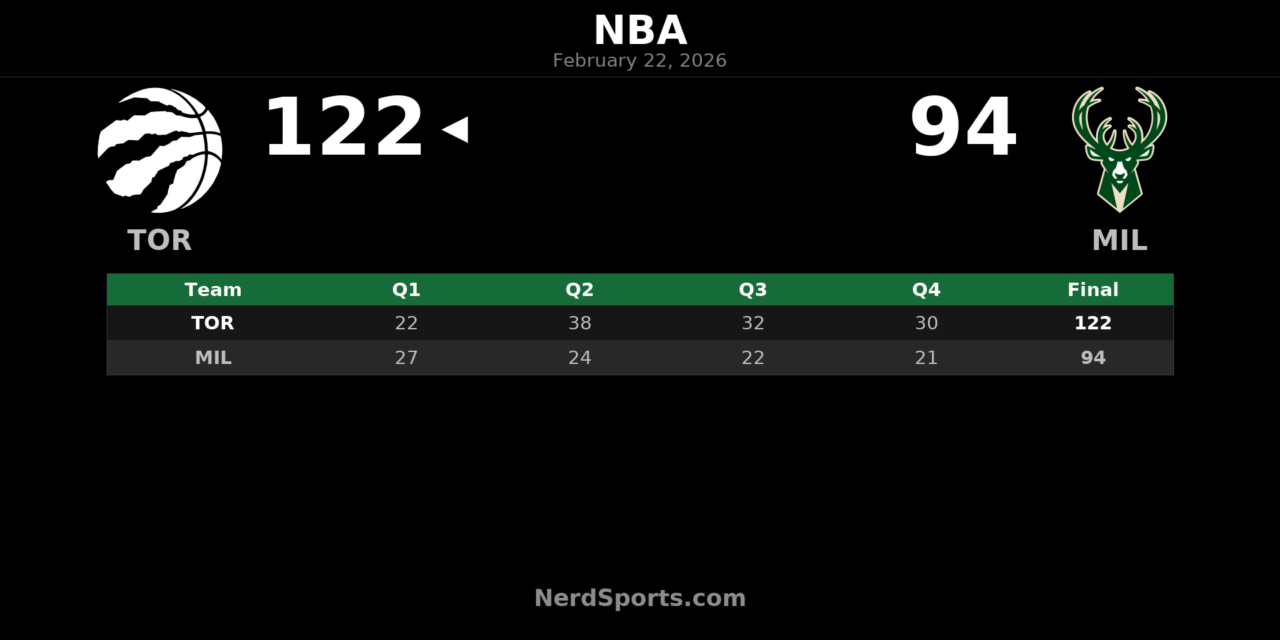
The Toronto Raptors made a statement on the road Sunday night, dismantling the Milwaukee Bucks 122-94 at Fiserv Forum in a wire-to-wire performance that was never truly in doubt after the first quarter. Powered by a 38-point second frame and a commanding effort from guard Immanuel Quickley, Toronto outplayed Milwaukee in nearly every statistical category, handing the Bucks a loss that underscores the gap between the two franchises at this stage of the 2025-26 season.
Quarter-by-Quarter Breakdown
First Quarter: Bucks Grab an Early Edge
Milwaukee came out with energy in front of 17,341 fans, closing the opening quarter with a 27-22 advantage. The Bucks moved the ball with purpose and hit a few early three-pointers, giving the home crowd reasons for optimism. Toronto, meanwhile, was still finding its footing but showed enough ball movement to stay within striking distance heading into the second period.
Second Quarter: Toronto Flips the Script
The second quarter is where this game fundamentally changed. The Raptors erupted for a staggering 38 points — their best single-quarter output of the night — while holding Milwaukee to just 24. Toronto’s pace, ball movement, and three-point shooting all clicked simultaneously, turning a 5-point deficit into a 60-51 halftime lead. The Bucks had no answer for the Raptors’ offensive rhythm during that 12-minute stretch, and the tone for the rest of the evening was set.
Third Quarter: Raptors Maintain Control
Any hope of a Milwaukee rally was quickly extinguished in the third quarter. Toronto continued to push the pace, adding 32 points to just 22 for the Bucks. The deficit ballooned to over 20 points, and the Raptors’ defense made it increasingly difficult for Milwaukee to generate quality looks. The home team’s 41.2% field goal percentage for the game reflects just how consistently Toronto’s defense disrupted their rhythm.
Fourth Quarter: Raptors Cruise to the Final Buzzer
With the game well in hand, Toronto’s reserves helped close out a 30-21 fourth quarter advantage. The final margin of 28 points accurately reflects the Raptors’ dominance throughout the contest. Milwaukee never mustered a legitimate comeback run, and the final score of 122-94 stood as a thorough statement from a Toronto team playing its best basketball of the season.
Key Performers
Immanuel Quickley, Toronto Raptors — 32 PTS, 9 AST
Quickley was the clear catalyst for Toronto’s offensive engine. The guard finished with 32 points and 9 assists, earning the game’s top player rating and effectively acting as both the primary scorer and playmaker throughout the night. His ability to create both for himself and his teammates kept Milwaukee’s defense scrambling for all 48 minutes. Quickley’s performance highlighted why Toronto has leaned on him as a cornerstone piece of their rebuild.
Jakob Poeltl, Toronto Raptors — 8 REB
The veteran center anchored Toronto’s frontcourt and led the team with 8 rebounds. Poeltl’s physicality and pick-and-roll presence helped open driving lanes for Quickley and Toronto’s perimeter players, contributing to the Raptors’ impressive 34 total assists on the night.
Ryan Rollins, Milwaukee Bucks — 21 PTS, 9 REB
In a tough night for Milwaukee, Rollins was the lone consistent bright spot. The guard led the Bucks with 21 points and grabbed 9 rebounds — a near double-double that demonstrated his ability to contribute across multiple areas. His effort was a positive sign on an otherwise difficult evening for the home team.
Kevin Porter Jr., Milwaukee Bucks — 21 PTS, 10 AST, 3 STL
Porter Jr. posted an impressive stat line of his own, recording 21 points and a team-high 10 assists to go along with 3 steals. Despite the lopsided result, his playmaking kept Milwaukee from completely falling apart and showed the kind of all-around game that makes him a valuable piece for the Bucks going forward.
Game Analysis
The numbers tell a compelling story. Toronto shot 46.8% from the field compared to Milwaukee’s 41.2%, but the most glaring disparity came in ball movement and three-point volume. The Raptors dished out 34 assists on 44 made field goals — a remarkable assist-to-make ratio that reflects a team playing with genuine cohesion. They attempted 46 threes and connected on 16 (34.8%), while Milwaukee managed just 9 makes from 32 attempts (28.1%).
Toronto’s second-quarter explosion of 38 points was the defining sequence of the game. The Raptors were clearly the more connected unit on both ends of the floor, and Milwaukee’s inability to guard in transition or contain dribble penetration proved costly all night. The Bucks also struggled to generate easy baskets, finishing with only 18 assists — a sign that too much of their offense became isolated and inefficient under pressure.
Defensively, Toronto made life difficult on the Bucks’ shooters while generating turnovers at a solid rate. Kevin Porter Jr.’s 3 steals were emblematic of Milwaukee’s willingness to compete, but individual effort alone was not enough to overcome the structural disadvantages on display throughout the evening.
Standings and Series Implications
With the victory, the Toronto Raptors improve to 34-23 on the season — a record that reflects a team firmly in the playoff conversation and comfortably above .500. Their road record of 18-10 is particularly noteworthy, demonstrating a toughness and consistency away from home that few teams can match. Milwaukee, meanwhile, falls to 24-31 overall, a record that leaves them outside the postseason picture and facing serious questions about the remainder of their season. For a franchise that has long been a Eastern Conference contender, Sunday’s 28-point loss at home represents a sobering reality check. The Bucks will need to regroup quickly as the trade deadline and playoff race continue to shape the landscape of the Eastern Conference.