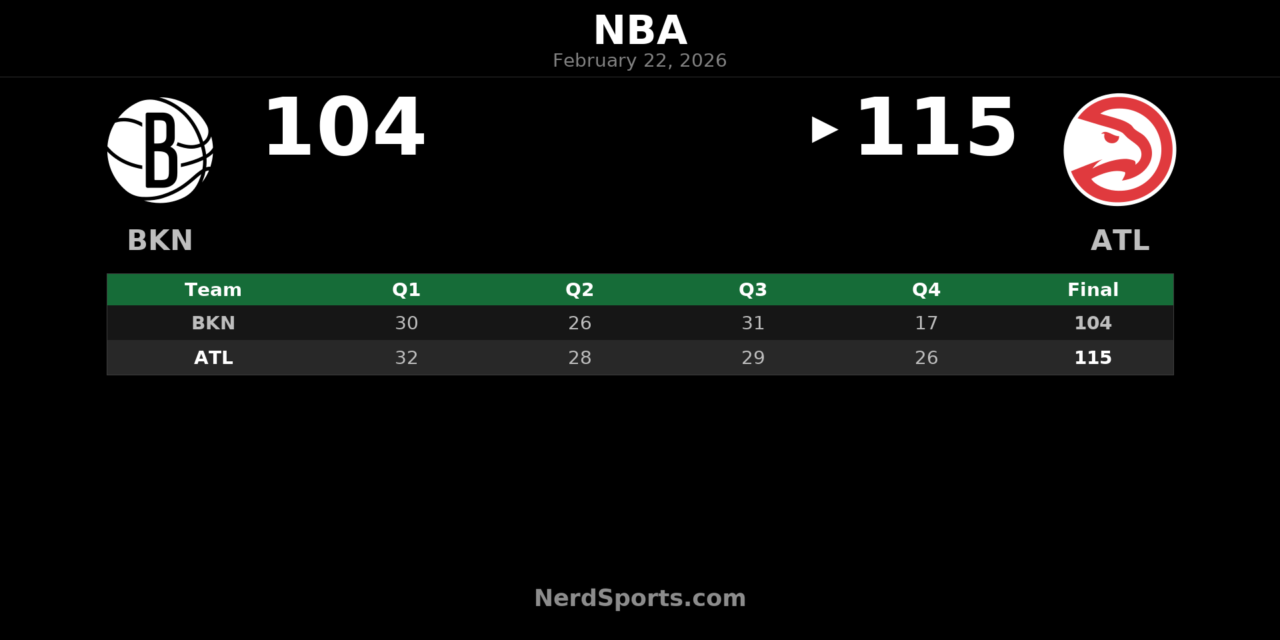
The Atlanta Hawks secured a comfortable 115-104 win over the Brooklyn Nets at State Farm Arena on Sunday evening, powered by a dominant performance from forward Jalen Johnson. In front of 17,121 fans in Atlanta, the Hawks controlled the game from tip-off and sealed the result with a decisive fourth-quarter push, moving to 28-31 on the season. Brooklyn, meanwhile, dropped to 15-41 as its rebuild continues to grind along.
Quarter-by-Quarter Breakdown
First Quarter: Hawks Strike First (ATL 32, BKN 30)
Atlanta set the tone early, outscoring Brooklyn 32-30 in the opening period. The Hawks’ offense moved the ball with purpose — they would finish the game with 28 assists — and held a narrow but meaningful edge heading into the second quarter. Brooklyn showed enough fight to keep the deficit manageable, but Atlanta’s energy at home gave them an early foothold.
Second Quarter: Hawks Extend the Lead (ATL 28, BKN 26)
The Hawks continued to control the pace in the second quarter, again outscoring the Nets 28-26. Atlanta’s ability to get to the free-throw line and convert (they shot 85.7% from the stripe on the night) kept the scoreboard ticking. Brooklyn’s offense generated movement — the Nets finished with 29 assists for the game — but couldn’t consistently convert their looks. Atlanta took a 60-56 lead into halftime.
Third Quarter: Nets Respond, Cut Into Lead (BKN 31, ATL 29)
Brooklyn came out of the locker room with renewed urgency and posted their best quarter of the night, outscoring Atlanta 31-29 to pull within four points. The Nets showed resilience and threatened to make a game of it heading into the final frame, trailing 89-87. It was the one period where Brooklyn’s offense looked consistently sharp, and it briefly made this a tightly contested contest.
Fourth Quarter: Hawks Pull Away (ATL 26, BKN 17)
Any drama from the third quarter was quickly extinguished. Atlanta dominated the fourth period 26-17, turning what had been a two-point game into a comfortable 11-point final margin. The Hawks’ defense stiffened when it mattered most, holding Brooklyn to just 17 points in the closing 12 minutes. Atlanta’s execution down the stretch was composed and decisive, a positive sign for a team fighting for relevancy in the playoff picture.
Key Performers
Jalen Johnson — Atlanta Hawks
Johnson was the unquestioned standout of the night. The Hawks forward finished with 26 points and 12 rebounds, delivering a double-double that anchored Atlanta’s effort on both ends of the floor. His rating of 44.6 was comfortably the best of any player in the game, and he was a consistent presence in the paint all evening. Johnson continues to develop into one of the more reliable two-way forwards in the Eastern Conference, and performances like this one underscore his value to Atlanta’s core.
Dyson Daniels — Atlanta Hawks
While Johnson led in scoring and rebounding, it was Dyson Daniels who did the heavy lifting as a playmaker. Daniels dished out a game-high 8 assists, helping orchestrate an Atlanta offense that shot 48.3% from the field and connected on 13-of-33 three-point attempts (39.4%). His ability to facilitate at a high level gives the Hawks a steadying hand in their backcourt.
Michael Porter Jr. — Brooklyn Nets
In a tough night for Brooklyn, Michael Porter Jr. was the one consistent bright spot. The forward led the Nets with 18 points, 7 rebounds, and 6 assists, showing the kind of versatility that made him an attractive acquisition for Brooklyn. Despite his efforts, the Nets couldn’t find enough secondary contributors to keep pace with Atlanta, particularly in the fourth quarter.
Nic Claxton — Brooklyn Nets
Claxton led Brooklyn on the glass with 8 rebounds, providing interior presence throughout the night. However, the Nets were badly outrebounded as a team — Atlanta pulled down 52 boards compared to Brooklyn’s 34 — a disparity that proved significant in shaping the game’s outcome.
Game Analysis
The story of this game was ultimately about Atlanta’s rebounding dominance. The Hawks hauled in 52 rebounds to Brooklyn’s 34, a staggering 18-board differential that gave Atlanta extended possessions and limited Brooklyn’s ability to generate second-chance opportunities. In a game decided by 11 points, that rebounding edge was a decisive factor.
Atlanta’s offense was balanced and efficient. Shooting 48.3% from the field and 39.4% from three, the Hawks made their possessions count. The team’s 28 assists on 42 made field goals reflects a ball-movement philosophy that head coach Quin Snyder has emphasized throughout the season. Brooklyn, for their part, were actually competitive in the assists department with 29, but their lower field goal percentage (44.7%) and poor free throw shooting (72.7% on 22 attempts, leaving points on the board) ultimately cost them.
The fourth-quarter collapse was Brooklyn’s most glaring problem. Scoring just 17 points in the final period against an Atlanta defense that locked in when it needed to, the Nets were unable to sustain the momentum they’d built in the third quarter. For a team at 15-41, that inability to close out competitive stretches continues to be a developmental challenge.
For Atlanta, this was the kind of gritty, well-rounded win that could serve as a building block. Johnson and Daniels looked like legitimate co-stars, and the Hawks’ depth appeared to wear Brooklyn down as the game progressed.
Standings and Series Implications
With the win, the Atlanta Hawks improve to 28-31 overall, keeping their slim playoff or play-in hopes alive. The Hawks are an impressive 17-15 on the road this season, though their 11-16 home record has been a concern — a win at State Farm Arena like this one is particularly meaningful in that context. Every game in the final stretch of the regular season carries weight for a team looking to avoid a fourth straight postseason miss.
For the Brooklyn Nets, the loss drops them to 15-41, one of the worst records in the NBA. At this stage of the season, Brooklyn’s focus is on development and evaluating young talent rather than wins and losses. Porter Jr.’s versatile showing offered some optimism, but the organizational priority remains building toward the future. Atlanta will look to carry this momentum into their next contest, while Brooklyn heads back to the drawing board as the trade deadline’s long-term decisions begin to take shape on the court.